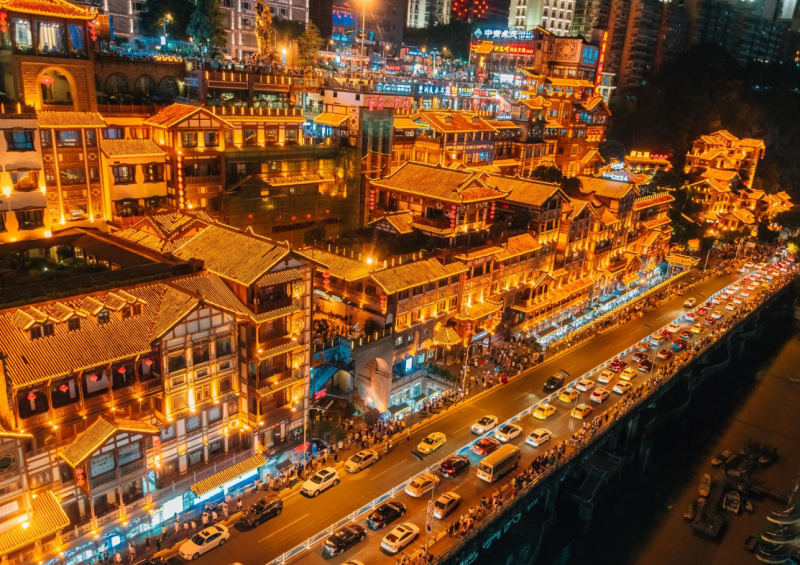
Hongya Cave (Hong Ya Dong), also known as Hongyan Cave or Shenxian Cave, and Hongya Gate in full, with its full name being the Hongya Cave Folk Customs Scenic Area, is a tourist area that combines sightseeing, tourism, leisure vacation, and other functions. It is located at No. 88 Jialing River Binjiang Road, Yuzhong District, Chongqing, in the riverside area at the confluence of the Yangtze River and the Jialing River, bordering Jiefangbei Cangbai Road to the north and Binjiang Road to the south. Hongya Cave is divided into 11 levels, reaches a height of 79 meters, and covers a total area of 31,500 square meters.
During the Warring States period (316 BC), Hongya Cave was a military fortress. During the Song Dynasty, Hongya Cave was a grotto temple. Hongya Gate was built above Hongya Cave and was originally an open gate. In the fourth year of the Hongwu reign of the Ming Dynasty (1371), Dai Ding rebuilt Chongqing City and newly established nine open gates and eight closed gates, totaling seventeen gates. Hongya Gate then became a closed gate, and Hongya Cave became integrated with it. During the Ming Dynasty, Hongya Cave had already become a commercial district, and during the Qing Dynasty it developed into a prosperous wharf, serving as one of Chongqing's trade centers. From the 1920s to the 1930s, Hongya Gate was destroyed, and people settled in Hongya Cave, putting up stilted buildings and forming Zhiyan River Alley. During the War of Resistance Against Japan, Hongya Cave was a refuge for Chongqing residents. After the founding of the People's Republic of China, Hongya Cave was listed as a cultural relic protection unit of Chongqing and began to become an important tourist attraction. In 2003, Hongya Cave was officially demolished and rebuilt. In 2006, the Hongya Cave Folk Customs Scenic Area was completed and opened in September of the same year. The main scenic spots in the area consist of landscapes such as stilted buildings, antique commercial streets, and Hongya Dicui, and include shops for specialty dining, leisure and entertainment, and Bayu folk handicrafts.
Hongya Cave is one of the "Twelve Views of Bayu" and is also one of the representative scenic areas of Chongqing's first ten-billion-level commercial district. In November 2007, it was rated as a national AAAA-level tourist attraction. In 2018, it became a nationally famous internet landmark. In December 2021, it was included in the "Second Batch of Chongqing Historical Place Name Protection List." In 2023, the operating revenue of Hongya Cave Cultural Tourism was 21.7988 million yuan. On Chinese New Year's Eve in 2024, Hongya Cave received nearly 90,000 visitors in total.