The Jianglang Mountain · Nianbadu Tourism Area is located in Jiangshan City, Quzhou City, Zhejiang Province, and is a national 5A-level tourist attraction. The tourism area consists of three core sections: Jianglang Mountain, Nianbadu Ancient Town, and Qingyang Village, with a total planned area of about 67.06 square kilometers, of which the core scenic area is 17.98 square kilometers. Jianglang Mountain is mainly characterized by Danxia landforms, with majestic and peculiar mountain bodies, and landscapes such as the Three Crags Stones are renowned at home and abroad; Nianbadu Ancient Town is a well-preserved Ming and Qing dynasty ancient town that integrates architectural styles from Zhejiang, Huizhou, Jiangxi, Fujian, and other places, with about 36 existing ancient buildings of various types and a total floor area of more than 14,000 square meters; Qingyang Village, as the birthplace of the Jiangnan Mao clan, retains a large number of ancient dwellings from the Ming and Qing dynasties. The scenic area is characterized by "wondrous mountains and ancient towns, folk treasures," integrating natural wonders, historic ancient towns, and folk culture, and is a highly representative tourist destination at the border of Zhejiang, Fujian, and Jiangxi.
Historical Culture
Jianglang Mountain has a long history and was called Yulang Mountain and Jinchun Mountain in ancient times, and was already recorded in the Book of the Later Han. Literati and poets of successive dynasties, such as Bai Juyi, Xin Qiji, and Xu Xiake, all climbed the mountain and wrote poems, leaving behind many verses. In August 2010, Jianglang Mountain was inscribed on the World Natural Heritage List as an important component of "China Danxia," becoming one of China's eighth World Natural Heritage sites, and its uniqueness and integrity of Danxia landforms have important scientific research value globally.
The history of Nianbadu Ancient Town is closely related to the Xianxia Ancient Road. After the Huang Chao rebel army opened the Xianxia Ancient Road in the late Tang dynasty, this place became a military fortress and an important commercial town. In the fourth year of the Xining reign of the Northern Song dynasty (1071), Jiangshan established forty-four du, and because this town ranked twenty-eighth, it was named "Nianbadu." Although the ancient town has only a population of more than 10,000, it has 142 surnames and 13 dialects. This phenomenon of "a hundred surnames and a hundred languages" is rare nationwide and is praised as a "natural folk museum." During the Ming and Qing dynasties, commerce in the ancient town flourished, forming an architectural complex that blended styles from multiple regions. Existing buildings such as the Wenchang Palace, Shuixing Temple, and ancient dwellings all bear witness to its glorious history as the "key to Zhejiang and Fujian."
Qingyang Village is the birthplace of the Jiangnan Mao clan. Since the Mao ancestors settled here during the Northern Song dynasty, it has had a history of more than 1,500 years. The Mao Ancestral Hall, Qingyang Ancestral Residence, and other buildings preserved in the village, as well as the Qingyang Mao Clan Genealogy, provide important physical materials for the study of Chinese surname culture and family history, and were listed as a Major Historical and Cultural Site Protected at the National Level in 2006.
Main Attractions
Three Crags Stones
The Three Crags Stones are the landmark landscape of Jianglang Mountain, composed of three giant Danxia stone peaks—Lang Peak, Ya Peak, and Ling Peak—arranged in the shape of the Chinese character "川," like three brothers standing shoulder to shoulder. Among them, Lang Peak has a relative height of 319 meters, Ya Peak 271 meters, and Ling Peak 268 meters, ranking first nationwide in height among tower peaks of Danxia landforms. The three peaks are connected at the base and independent at the top, with steep bodies and vertical rock walls, and a minimum slope of 88 degrees, making climbing relatively difficult. The vegetation coverage on the surface of the peaks is about 65%, mainly drought-tolerant plants such as pines and cypresses. Every spring, wildflowers blooming in the crevices of the rock walls add a different kind of vitality.
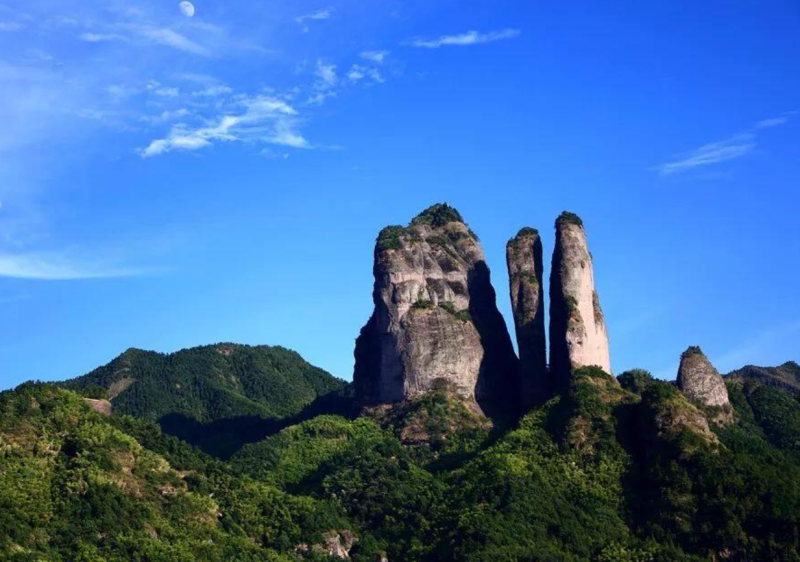
One-Line Sky
One-Line Sky is a natural stone crevice between Ya Peak and Ling Peak, about 100 meters long, only 3.5 meters wide at its narrowest point and about 5 meters at its widest, and about 298 meters high. Visitors passing through it must turn sideways, and looking up, they can see only a single line of sky. The folds and textures on the stone walls are clearly visible, and sunlight filtering through the crevice creates ever-changing light and shadow, offering a powerful visual impact. On the rock walls on both sides of One-Line Sky are inscriptions left by literati of successive dynasties, among which the three characters "One-Line Sky" were inscribed by a Qing dynasty scholar, with vigorous brushwork.
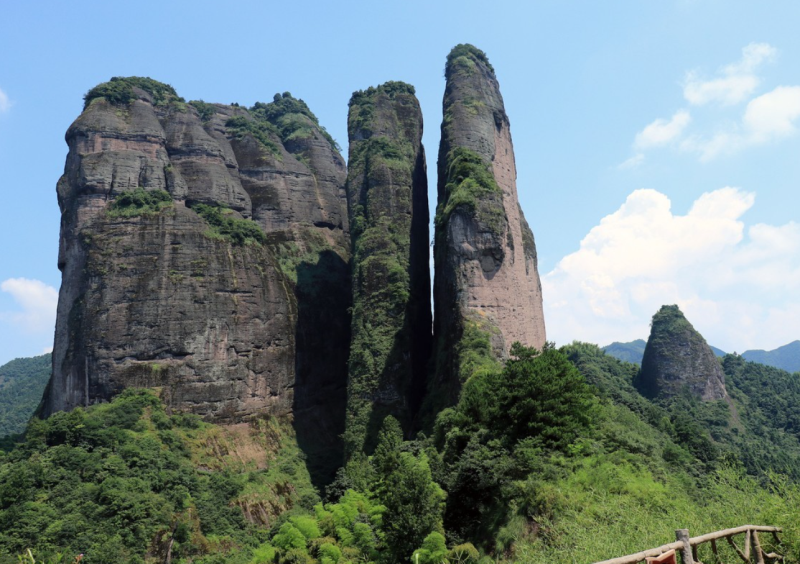
Great Man Peak
Great Man Peak is a natural pictographic landscape of Jianglang Mountain. Viewed from a specific angle at the entrance of the scenic area, the outline of Lang Peak resembles the side profile of a great man, with clearly defined eyebrows, eyes, bridge of the nose, and jawline, and a solemn expression, hence the name. The landscape is about 200 meters high and about 80 meters wide. Because of the unique viewing angle, it is best viewed from an observation deck at an altitude of about 300 meters, and it is a popular spot for tourists to take photos.
Nianbadu Ancient Town
Nianbadu Ancient Town covers an area of about 1.4 square kilometers. The existing ancient streets from the Ming and Qing dynasties are about 1 kilometer long, running through the entire town from north to south, with 36 well-preserved ancient dwellings and 11 public buildings distributed on both sides. The architectural style of the ancient town is unique, featuring not only the white walls and black tiles of the Zhejiang style, but also the horse-head walls and brick carvings of the Huizhou style, as well as the stilted buildings of northern Fujian and Western-style lattice windows. It is called a "museum of architecture in dialect regions" by architectural scholars. Wenchang Palace is the core building of the ancient town, built during the Xuantong reign of the Qing dynasty, covering about 800 square meters. The wood carvings and stone carvings in the palace are exquisite, especially the carvings with themes such as "Eight Immortals Crossing the Sea" and "Kui Xing Pointing to the Dipper." In addition, the Folk Customs Museum in the ancient town displays local folk items such as wedding customs and festivals, allowing visitors to intuitively experience the cultural diversity of "a hundred surnames and a hundred languages."
Qingyang Village
Qingyang Village covers an area of about 0.5 square kilometers. The ancient building complex in the village is centered on the Mao Ancestral Hall and distributed in a radial pattern, with a total of 28 ancient dwellings from the Ming and Qing dynasties and a total floor area of about 5,000 square meters. The Mao Ancestral Hall was first built in the Northern Song dynasty, and the existing building was rebuilt in the Qing dynasty. It covers 1,200 square meters and consists of a gate hall, main hall, and rear hall. The wood carvings on the beams, such as "A Hundred Birds Paying Homage to the Phoenix" and "Squirrel Stealing Grapes," are lifelike. Qingyang Pagoda in the east of the village was built in the Ming dynasty, about 28 meters high, hexagonal and seven-storied, and is the landmark building of the village. The "Qingyang Ancestral Residence" at the entrance of the village is a traditional Jiangnan courtyard house, covering about 300 square meters, and displays historical materials and daily necessities of the Mao family.
Food
Nianbadu Wind Stove Tofu
Nianbadu Wind Stove Tofu is a traditional local famous dish, named because it is stewed using a specially made clay "wind stove." It uses tender tofu made from local high-mountain soybeans, cut into 4-centimeter square pieces, paired with pork belly, shiitake mushrooms, dried bamboo shoots, and other ingredients, and slowly stewed over charcoal on the wind stove for 1.5 hours. The tofu absorbs the umami of the meat and spices, with a soft and tender texture that does not break apart, and the broth is thick with a faint charcoal aroma. This dish is the first of the "Eight Big Bowls" of Nianbadu and can be tasted at time-honored restaurants in the ancient town, priced at about 38 yuan per serving.
Nianbadu Copper Gong Cake
Copper Gong Cake is a traditional festival pastry of Nianbadu, named because it resembles a copper gong, and has a history of a thousand years. It uses glutinous rice flour and early rice flour as raw materials, adds mugwort juice, osmanthus, walnut kernels, sesame, and other ingredients, and is hand-kneaded into round cakes about 20 centimeters in diameter and about 3 centimeters thick. After steaming, they are cooled, and can be pan-fried or reheated by steaming when eaten. The finished product is dark green on the outside with layers inside, with a soft, glutinous, slightly chewy texture and a sweet, fragrant taste. Pastry shops in the ancient town make and sell them fresh, at 5 yuan each, and vacuum-packed gift boxes (6 pieces) are sold at 35 yuan, making them a favorite souvenir among tourists.
Yanpi Wontons
Yanpi Wontons originated in northern Fujian and were introduced to Nianbadu with merchants, becoming a local specialty snack. Its "yanpi" is made from pork hind leg meat, which is manually pounded for 2 hours into a meat paste, then mixed with sweet potato starch and rolled into a wrapper as thin as a cicada's wing, each about 8 centimeters square and weighing only 3 grams. The filling is made from pork, chopped scallions, and shiitake mushrooms. After being wrapped in the yanpi and cooked, they are served with bone broth, with a smooth and tender texture and delicious soup. Each bowl contains 10 pieces and is priced at 15 yuan, and they can be tasted at wonton shops on the main street of the ancient town.
Fengxi Fish
Fengxi Fish uses wild stone grouper (about 10-15 centimeters long) from the Fengxi River in Nianbadu. After being cleaned, it is marinated with salt and cooking wine for 10 minutes, coated with a thin layer of starch, pan-fried until golden brown in local rapeseed oil, and then simmered for 5 minutes with perilla leaves, ginger, and chili. The finished dish is crispy on the outside and tender on the inside, with few bones and fresh meat, carrying the fragrance of perilla. It is one of the "Eight Big Bowls" of Nianbadu, using about 500 grams of fresh fish per serving, priced at 58 yuan. Because the ingredients are fresh, the daily supply is limited.
Tickets:
Combined ticket 199 yuan/person (including Jianglang Mountain, Nianbadu Ancient Town, and Qingyang Village).
Jianglang Mountain ticket 105 yuan (including sightseeing bus), Nianbadu Ancient Town 80 yuan/person, Qingyang Village ticket 50 yuan/person.
You can search for the official WeChat public account "Jiangshan Duojiao Tourism" to obtain the latest updates or buy tickets online.
Opening Hours:
The opening hours of Jianglang Mountain Scenic Area are: April 1-October 31, 7:30-17:30 (last entry at 16:30); November 1-next year March 31, 8:00-17:00 (last entry at 16:00).
The opening hours of Nianbadu Ancient Town are: April 1-October 31, 8:00-17:30 (last entry at 17:00); November 1-next year March 31, 8:30-17:00 (last entry at 16:30).
The opening hours of Qingyang Village Scenic Area are: daily 8:30-17:00 (last entry at 16:30), open all year round (normally open on statutory holidays).
Tour Routes:
One-day tour route: Arrive at Jianglang Mountain Scenic Area at 8:00 a.m., take the scenic area shuttle to the climbing entrance (about 10 minutes), hike to visit One-Line Sky and Great Man Peak (about 2 hours), then challenge Lang Peak (about 3 hours round trip), and have lunch at a farmhouse restaurant in the scenic area (about 50 yuan per person); at 2:30 p.m., go to Nianbadu Ancient Town (about 30 minutes by car), visit Wenchang Palace, the ancient dwelling complex, and the Folk Customs Museum (about 2 hours), taste specialty foods such as Copper Gong Cake and Wind Stove Tofu, and end the itinerary at 5:30 p.m. The whole journey involves about 8 kilometers of walking and about 40 minutes of driving.
Two-day tour route: On the first day, arrive at Nianbadu Ancient Town at 9:00 a.m., check into a guesthouse in the ancient town, visit the core area of the ancient town, and experience handmade Copper Gong Cake making (about 3 hours); in the afternoon, go to Qingyang Village (about 20 minutes by car) and visit the Mao Ancestral Hall and Qingyang Ancestral Residence (about 1.5 hours), then return to the ancient town to enjoy the night view; on the second day, go to Jianglang Mountain at 7:30 a.m. to watch the sunrise (check the sunrise time in advance), and spend the whole day deeply touring the scenic spots of Jianglang Mountain, then return at 3:00 p.m. This route allows you to fully experience the integration of natural landscapes and human history, with a moderate pace.
Transportation:
High-speed rail: Take the high-speed rail to Jiangshan Station. After leaving the station, transfer to the scenic area direct shuttle (Jianglang Mountain line), which runs every hour from 8:00 to 16:00, takes about 40 minutes, and costs 15 yuan; from Jianglang Mountain to Nianbadu Ancient Town, you can take the same line direct shuttle, which takes about 30 minutes and costs 10 yuan.
Bus: In Jiangshan city, take bus No. 202 to Jianglang Mountain Visitor Center Station, which takes about 1 hour and costs 6 yuan; take bus No. 201 to Nianbadu Ancient Town Station, which takes about 1.5 hours and costs 8 yuan, with departures about every 1 hour.
Self-driving: From Hangzhou, take the Hangzhou-Changsha Expressway and Beijing-Taipei Expressway to the Jiangshan exit, drive southeast along Provincial Highway 46 for about 25 kilometers to Jianglang Mountain Scenic Area, then drive along National Highway 205 for about 40 kilometers to Nianbadu Ancient Town. The whole journey takes about 3 hours. Scenic area parking lots charge 5 yuan/hour (Jianglang Mountain parking lot capacity 500 vehicles, Nianbadu parking lot capacity 300 vehicles).
Must-Visit Attractions:
Three Crags Stones: The core landscape of Jianglang Mountain. The relative heights of the three stone peaks all exceed 250 meters, and it is China's highest Danxia waterfall. From the summit, you can overlook the scenery at the border of Zhejiang, Fujian, and Jiangxi. It is a representative of natural and geological wonders.
Nianbadu Ancient Town: A "common-people ancient town" with 142 surnames and 13 dialects. Its 36 Ming and Qing ancient buildings blend architectural styles from multiple regions, and the wood carvings of Wenchang Palace are outstanding. It is a must-visit place to experience folk culture.
One-Line Sky: A natural stone crevice 100 meters long and 298 meters high, only 3.5 meters wide at its narrowest point. Passing through it allows you to feel the majesty and steepness of Danxia landforms. It is one of the landmark wonders of Jianglang Mountain.
Qingyang Village: The birthplace of the Jiangnan Mao clan, preserving a 1,500-year-old ancestral hall and ancestral residence. The Qingyang Mao Clan Genealogy is a national-level cultural relic and is suitable for visitors interested in history and culture.
Travel Suggestions:
Climbing Jianglang Mountain is relatively difficult. It is recommended to wear non-slip sports shoes and carry trekking poles (available for rent in the scenic area at 10 yuan/pole). Reaching the summit of Lang Peak requires sufficient physical strength. The elderly and frail can choose to visit One-Line Sky and Great Man Peak and then return.
Guesthouses in Nianbadu Ancient Town are moderately priced (average about 200 yuan/night) and allow you to experience local life. It is recommended to stay at least one night to feel the morning and night atmosphere of the ancient town.
April-May and September-October each year are the best seasons for visiting, when temperatures are suitable (15-25°C) and there is less precipitation, making them suitable for outdoor activities; in summer, take sun protection measures and bring a sun hat and sunscreen. There may be brief afternoon showers in the mountains, so it is advisable to bring rain gear.
Buying the combined ticket is more cost-effective and can be used over two days. It is recommended to plan ticket purchases in advance according to your itinerary. Online ticket purchase can reduce queuing time on site.
Notes:
Some sections of the Lang Peak climbing path on Jianglang Mountain are suspended walkways, limited to single-person passage. Running and playing are prohibited, and those afraid of heights should enter with caution; on rainy days, the walkways are slippery, so hold the railings firmly and walk slowly.
The ancient buildings in Nianbadu Ancient Town are mostly wooden structures. Smoking and open flames are strictly prohibited. Fire-fighting equipment is provided in the scenic area, and tourists must comply with fire safety regulations.
The Qingyang Mao Clan Genealogy in Qingyang Village Scenic Area is a precious cultural relic. Photography and touching are prohibited, and visitors must follow the guide's instructions during the visit.
The wild plants and animals in the scenic area are protected by law. Picking and catching are strictly prohibited, and violators will face fines (500-2,000 yuan).
During peak season (April-October), there are many tourists. It is recommended to book accommodation and tickets 1-2 days in advance. Climbing Jianglang Mountain should be staggered to avoid the peak period from 10:00 to 12:00.