Xitang Ancient Town is located in Jiashan County, Jiaxing City, Zhejiang Province, at the junction of Zhejiang, Jiangsu, and Shanghai. It is a national 5A-level tourist attraction, known as the "Root of Wu and Corner of Yue," and is one of the important birthplaces of Wu-Yue culture. The core area of the ancient town is 1.01 square kilometers, with 250,000 square meters of ancient buildings from the Ming and Qing dynasties still preserved. It is notable for its "many bridges, many alleys, and many covered corridors." The scenic area features more than 2,000 meters of the Misty Rain Corridor, 27 ancient stone bridges, and 122 alleys. Its architectural layout preserves the traditional appearance of a Jiangnan water town "dwelling by the water," and it is praised as a "living thousand-year-old ancient town."
Historical Culture
The history of Xitang can be traced back to the Spring and Autumn and Warring States periods, when it was the border area between the states of Wu and Yue, hence the name "Root of Wu and Corner of Yue." Legend has it that during the Spring and Autumn period, Wu Zixu supervised the excavation of Wuzitang here and carried out water conservancy projects, laying the foundation for the town's water system. During the Kaiyuan period of the Tang Dynasty, a village gradually formed, and residents built houses along the water, beginning a lifestyle of living by the water.
During the Southern Song Dynasty, Xitang had already formed a market, and by the Yuan Dynasty it had developed into a town, with commerce becoming increasingly prosperous. The Ming and Qing dynasties were the heyday of Xitang, when it became an important handicraft and commercial town in the Jiangnan region, with silk, textiles, and winemaking industries well known far and wide. Historically, Xitang had a flourishing literary culture, producing 19 jinshi and 31 juren, with as many as 103 people leaving published works, demonstrating its profound cultural heritage.
As a living fossil of Jiangnan water town culture, Xitang has fully preserved traditional folk activities, such as the "Red Drying Festival" on the sixth day of the sixth lunar month and the "Water Temple Fair" during the Spring Festival. Its "covered corridor construction technique" has been included in the intangible cultural heritage list of Zhejiang Province.
Main Attractions
Misty Rain Corridor
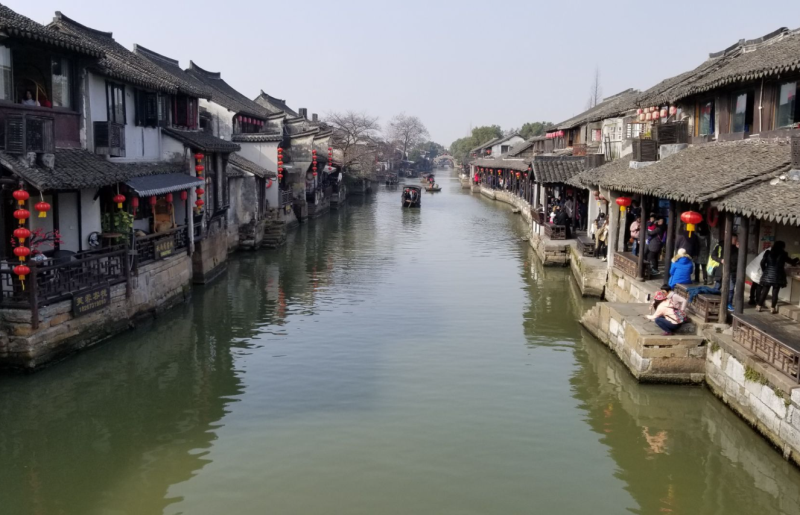
The Misty Rain Corridor is the landmark landscape of Xitang Ancient Town. It is 2,006 meters long and is a roofed street built along the river, composed of more than 100 eaves. It provides both shade and shelter from rain and a place for pedestrians to rest, and is a unique architectural form of the Jiangnan water town. Under the corridor are benches with backrests, and about every 50 meters there is a red lantern. At dawn when thin mist curls around, or in the evening when the lanterns are lit, it presents a poetic scene of "misty and rainy haziness." In the middle section of the corridor is the Chinese Button Museum, which displays more than 3,000 button collectibles from the Neolithic Age to modern times, systematically presenting the 3,000-year history of button development.
Shipi Alley
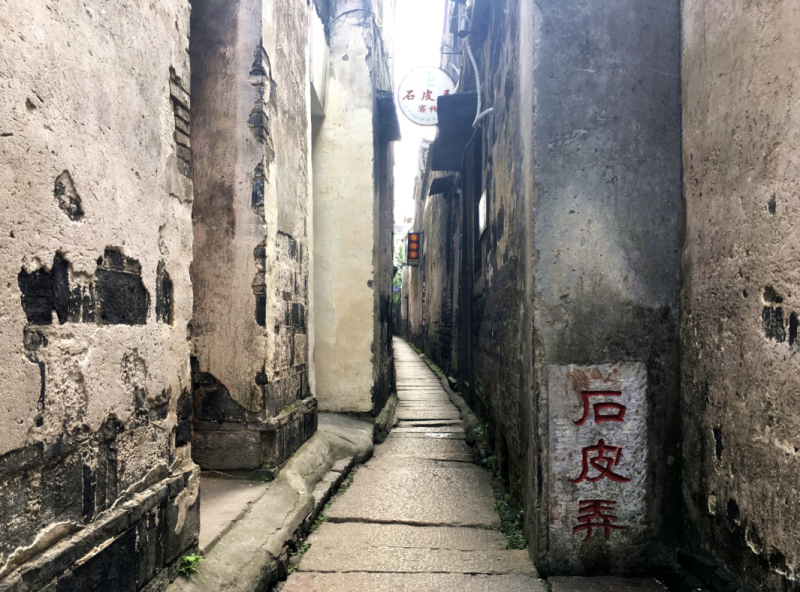
Shipi Alley is known as the "narrowest alley in Jiangnan." It is located in the middle section of West Street, 68 meters long and only 0.8 meters wide, with the narrowest point only 0.6 meters. On both sides are fire-sealing gable walls 6-8 meters high. The ground is paved with 168 bluestone slabs. It is called "Shipi Alley" because the stone slabs are as thin as skin. The light inside the alley is dim, with only a narrow slit at the top for daylight, creating a "single line of sky" light-and-shadow effect. It is a popular spot for taking ancient-style photos. The alley connects the courtyards of two wealthy families, reflecting the layout wisdom of Jiangnan residences known as "four waters returning to the hall."
Songzi Laifeng Bridge
Songzi Laifeng Bridge was first built in the tenth year of the Chongzhen reign of the Ming Dynasty (1637) and rebuilt in the forty-eighth year of the Kangxi reign of the Qing Dynasty (1709). It is a three-arch stone bridge, 38.5 meters long, 4.8 meters wide, and 7.5 meters high. There are railings on both sides of the bridge. The east railing is carved with the two characters "Songzi," and the west railing with "Laifeng," hence the name. In the center of the bridge are steps, with slopes on both sides. It is said that newlyweds walking up the east steps may pray for a child, and pregnant women walking down the west slope may ensure safety. This bridge is the most representative ancient bridge in Xitang and one of the best locations for photographing water town scenery. The bridge body and its reflection in the water form a complete circle, symbolizing "perfection."
West Garden
West Garden is a private garden from the Ming Dynasty, first built during the Wanli period of the Ming Dynasty. It covers about 4,000 square meters and consists of rockeries, ponds, pavilions, and towers, embodying the gardening philosophy of "although made by man, it appears as if made by heaven." The garden is planted with ancient trees such as ginkgo and wisteria, and the pond is filled with lotus flowers. In summer, the lotus leaves spread across the water, creating a serene scene. The garden has a pingtan performance stage, where classic pieces such as "The Pearl Pagoda" and "Jasmine Flower" are performed daily from 14:00 to 16:00. Visitors can enjoy Xitang green tea (30 yuan per cup) while appreciating Jiangnan silk-and-bamboo music. West Garden was a filming location for Jay Chou's "Tianya Guoke" MV, and its "moon gate framed scenery" image has become an iconic scene.
Tangdong Street
Tangdong Street is the commercial street of Xitang, about 500 meters long, with Ming and Qing style buildings on both sides, shops on the lower floors and residences above. The street preserves the traditional layout of "shop in front, workshop in back," and gathers many time-honored shops, such as "Lu's Wonton Shop" and "Qian's Tofu Pudding." At night, the lanterns along the street (386 in total) are lit, their red glow shining on the bluestone road and reflecting in the water, and it is praised as "Jiangnan's little Spirited Away." The "Xitang Bar Street" in the middle section of the street blends traditional and modern elements, with folk song performances at night, making it a good place for young people to relax.
Button Museum
The Button Museum is located in the middle section of the Misty Rain Corridor. It was originally the "Xue Residence" from the Republican period, covering about 500 square meters and consisting of three exhibition halls. The museum houses more than 3,200 items, from bone buttons of the Neolithic Age to jade buttons of the Shang and Zhou dynasties, bronze buttons of the Tang Dynasty, buttons of the Ming and Qing dynasties, and various modern buttons, systematically showing the evolution of buttons from practical items to decorative items. Among them, Ming and Qing treasures such as the "Hundred Sons Button" and the "Dragon and Phoenix Bring Auspiciousness Button" use techniques such as openwork and inlay, and are exquisitely beautiful, demonstrating the superb craftsmanship of Jiangnan handicrafts.
Food
Steamed Pork with Rice Flour
Steamed pork with rice flour is a traditional famous dish of Xitang. It uses local black pork as the ingredient, cut into 5-centimeter square pieces, marinated in soy sauce and yellow wine for 2 hours, coated with glutinous rice flour, wrapped in fresh lotus leaves, and steamed for 45 minutes. The finished product has a rich lotus leaf fragrance, the meat is fatty but not greasy, and the glutinous rice is soft and flavorful. "Ding's Restaurant" at No. 168 West Street is a century-old time-honored brand. Its steamed pork with rice flour costs 28 yuan per portion and sells more than 200 portions per day on average. It is a must-try specialty for visitors.
Cicada Robe Wrapped Round
Cicada Robe Wrapped Round is named because its outer skin is as thin as a cicada's wing, and it is a traditional snack unique to Xitang. Tofu skin is used as the wrapper, and the filling is a mixture of diced bamboo shoots, minced meat, shiitake mushrooms, and dried shrimp. It is wrapped into balls 3 centimeters in diameter, steamed, and then drizzled with sesame oil and light soy sauce. The Cicada Robe Wrapped Round at "Ming Qing Shi Dai" (No. 35 Misty Rain Corridor) is the most famous, sold at 20 yuan for 10 pieces. It has a fresh and tender taste, reflecting the "fresh, clear, crisp" characteristics of Jiangnan cuisine.
Gorgon Cake
Gorgon cake is a traditional pastry of Xitang. It uses local gorgon fruit (commonly known as "chicken-head rice") and glutinous rice flour as ingredients, with added osmanthus, walnut, sesame, and other auxiliary ingredients. It is made by steaming and slicing. The finished product is off-white, soft and chewy in texture, sweet but not greasy. "Zhao Dayou Pastry Shop" at No. 55 Tangdong Street has inherited the craft for five generations. Its gorgon cake is an intangible cultural heritage of Zhejiang Province. It comes in 6 flavors including original, osmanthus, and walnut. Each box (250 grams) costs 15 yuan and can be kept for 15 days in vacuum packaging. It is a popular souvenir.
Crab Roe Noodles
Crab roe noodles are a specialty food of Xitang in autumn. They use the crab roe of Taihu hairy crabs (each bowl uses the crab roe of 3 crabs), stir-fried with shredded ginger and yellow wine, then added to stock to make a topping, and poured over handmade pulled noodles. "Qian Miaoyun Restaurant" at No. 18 Tawan Street is famous for crab roe noodles, at 68 yuan per bowl. Paired with sweet green rice balls (5 yuan each), the flavor is even better. The restaurant also offers a "Whole Crab Banquet" set meal for two (268 yuan), including crab roe tofu, steamed hairy crab, and other dishes.
Lu's Wonton
Lu's Wonton is a century-old snack of Xitang, begun in 1908, and is famous for its thin wrappers and fresh filling. The wonton wrappers are handmade and as thin as paper. The filling is a mixture of pork, chopped scallions, and shrimp. Each bowl has 10 wontons, cooked in bone broth and sprinkled with shredded egg and seaweed. The old shop at No. 12 West Street supplies only 500 bowls per day, at 10 yuan per bowl. It is a favorite breakfast choice for locals, and is best tasted from 6:30 to 8:00 in the morning.
Tickets:
Tickets are 95 yuan per person.
You can search for the official WeChat public account "Xitang Tourism" to get the latest updates or buy tickets online.
Opening Hours:
The ancient town area is open all day (accessible 24 hours); the opening hours of individual small attractions are 8:00-17:30 (last entry at 17:00), and in winter (November-February of the following year) it closes earlier at 17:00 (last entry at 16:30).
West Garden pingtan performance time: daily 14:00-15:30; Button Museum guided tour service: once every hour on the hour (9:00-16:00), 20 minutes each time.
Suggested Routes:
One-day highlight route: Arrive at Shipi Alley at 6:00 in the morning to photograph the narrow alley in the morning mist (at this time there are no crowds and the light and shadow are best); at 7:30 go to Yongning Bridge to watch black-awning boats passing through the morning mist; at 9:00 stroll along the Misty Rain Corridor and visit the Button Museum (about 1 hour); at 11:00 visit West Garden and enjoy the garden scenery; at 12:00 taste steamed pork with rice flour and cicada robe wrapped round on Tangdong Street; at 13:30 take a black-awning boat (Wolong Bridge-Huanxiu Bridge section, 150 yuan per boat, seats 6 people, takes 40 minutes); at 15:00 go to Songzi Laifeng Bridge to take photos; at 18:00 enjoy the lantern night view on Tangdong Street; after 20:00 you can take a boat again to enjoy the reflections of the lights (night boat ticket 200 yuan per boat). The whole route involves about 6 kilometers of walking and 1 hour of boating.
Two-day route: On the first day, visit core attractions such as the Misty Rain Corridor and Shipi Alley in the morning, experience "handmade button making" in the afternoon (30 yuan per person, about 1 hour), and enjoy the sunset in the evening; on the second day, participate in the "ancient town morning run" at dawn (7:00-8:00, the scenic area provides a route map), visit the nearby "Farming Culture Museum" in the morning (1.5 kilometers from the ancient town), learn to make gorgon cake in the afternoon (25 yuan per person), and return at 16:00. This route balances sightseeing and experiences, with a relaxed pace.
Transportation:
High-speed rail: Take the high-speed rail to Jiashan South Station, then transfer to Bus K222 (Jiashan South Station-Xitang Scenic Area), running every 20 minutes daily from 6:30 to 21:00, with a 40-minute ride and a fare of 5 yuan; or take the scenic area direct shuttle (15 yuan per person, one every 30 minutes), directly to the entrance of the ancient town.
Bus: Within Jiashan county town, take Bus K215 (Jiashan Passenger Transport Center-Xitang) or K216 (Jiashan Railway Station-Xitang), running every 15 minutes daily from 6:00 to 18:30, with a 30-minute ride and a fare of 3 yuan; from Jiaxing city area, take Bus K152 (Jiaxing North Station-Xitang), with a 1-hour ride and a fare of 6 yuan.
Self-driving: From Shanghai, take the Shanghai-Kunming Expressway-Shenjiahu Expressway and get off at the Xitang exit, then drive 5 kilometers along Pingli Highway to reach the ancient town parking lot, about 1.5 hours in total; from Hangzhou, take the Hangzhou-Ningbo Expressway-Shanghai-Kunming Expressway-Shenjiahu Expressway, about 2 hours in total. The scenic area parking lot charges 5 yuan per hour. The East Parking Lot (capacity 800 vehicles) and North Parking Lot (capacity 500 vehicles) are both about 300 meters from the entrance. In peak season, it is recommended to arrive before 8:30.
Must-Visit Attractions:
Misty Rain Corridor: The longest covered corridor in Jiangnan at 2,006 meters. The morning mist and evening lanterns create a beautiful mood, and you can experience the water town life of "sheltering from rain under the corridor" while strolling.
Shipi Alley: The narrowest alley in Jiangnan at 0.8 meters wide. Its unique "single line of sky" light and shadow make it a must-go place for ancient-style portraits. It is recommended to go before 7:00 in the morning to avoid crowds.
Songzi Laifeng Bridge: The three-arch stone bridge and its reflection in the water form a circular landscape, symbolizing perfection. It is a classic scene for Hanfu photos, and even better with a black-awning boat in the frame.
West Garden: The pingtan performance in the Ming Dynasty garden (14:00-15:30) shows Jiangnan culture. The "moon gate" of the "Tianya Guoke" filming location is an internet-famous check-in spot.
Travel Advice:
The best seasons to visit are March-April (misty and rainy, rapeseed flowers blooming) and September-October (clear autumn weather, fat and delicious crabs). In summer, pay attention to heat prevention (tree shade coverage in the scenic area is about 60%). Winter is colder but has fewer tourists.
For accommodation, it is recommended to choose "corridor homestays" in the ancient town (average 260 yuan per night), such as "Mingjufang" on West Street. Walking to all attractions takes within 10 minutes, and you can experience the ancient town in the morning mist.
Clothing suggestions: In spring, you can wear Hanfu (rental in the scenic area is 50 yuan per hour); in summer, choose light-colored clothing (photos come out better); shoes should preferably be flat (the bluestone roads are slippery).
Dining consumption: In the ancient town, the average per person for a main meal is 50-80 yuan, and for snacks 20-30 yuan. It is recommended to eat at old shops "off the main street" for better prices (such as "Apo Tea House" on Beizha Street).
Notes:
The river channels in the ancient town are relatively deep (average water depth 2.5 meters). When boating, life jackets must be worn (provided free of charge). Children must be accompanied by adults, and playing by the river is prohibited.
The bluestone roads are slippery on rainy days, especially sections such as Shipi Alley and bridge arches. It is recommended to wear non-slip shoes. Rain boots can be rented at the entrance of the scenic area (10 yuan per pair).
It is prohibited to carve or post on ancient buildings. The red lanterns of the Misty Rain Corridor are protected cultural relics, and touching or taking them is prohibited. Violators will be fined 200-500 yuan.
In peak season (March-May, October), there are many tourists. It is recommended to make a reservation in advance on the official public account (can reserve 1 day ahead to avoid queuing).
Some alleys in the scenic area are narrow. During peak hours (10:00-16:00), pay attention to yielding. When taking photos, avoid staying for a long time and blocking the passage.