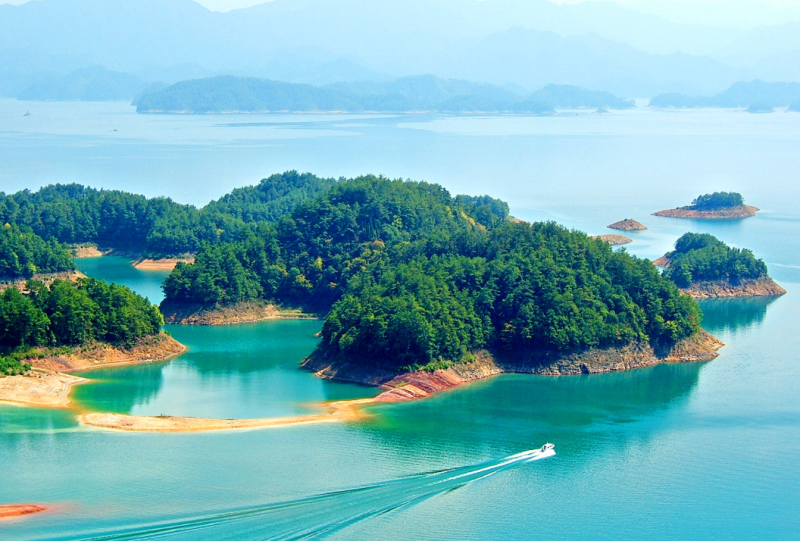
Qiandao Lake Scenic Area is located in Chun'an County, Hangzhou City, Zhejiang Province. It is a national 5A-level tourist attraction and one of China's first batch of national-level scenic spots. The scenic area is renowned for its "Number One Beautiful Water Under Heaven." It is an artificial lake formed in 1959 by the construction of the Xin'an River Hydropower Station. The lake contains 1,078 islands of various sizes, scattered like stars and varied in shape, hence the name "Qiandao Lake" (Thousand Island Lake).
The scenic area covers a total area of 982 square kilometers, of which the lake area is 573 square kilometers, with a water storage capacity of 17.84 billion cubic meters, equivalent to the water storage capacity of 3,184 West Lakes. The lake's transparency reaches 12 meters and it is a national first-class water body, with visibility ranking among the highest among domestic freshwater lakes. The lake area is surrounded by continuous mountains, with a forest coverage rate of over 95%, and an excellent ecological environment, featuring the unique landscape of "half city mountain scenery, half city lake." There are currently more than 30 scenic spots of various types in the scenic area, including natural landscapes, cultural relics, and leisure entertainment, and the annual tourist reception has long ranked among the top in Zhejiang Province.
Historical Culture
The Qiandao Lake area has a long history, with traces of human activity dating back to the Neolithic Age. Beneath the lake waters lie two ancient cities that have been submerged for a thousand years—He City and Lion City. They were the old county seats of Chun'an and Sui'an counties, built during the Han and Tang dynasties, and sank to the bottom of the lake in 1959 when the reservoir was completed. The ancient cities retain a large number of architectural relics from the Ming and Qing dynasties, such as city walls, archways, and residences, becoming important physical materials for studying ancient urban planning and architectural art. In 2011, an underwater archaeology team conducted exploration of part of Lion City and discovered well-preserved stone-paved roads, brick walls, and other relics.
The Chun'an area is a place where Huizhou culture and Wu-Yue culture converge. It has produced many talented people in history. Tang dynasty poet Huangfu Shi and Ming dynasty politician Hai Rui once served or lived here. During his tenure as magistrate of Chun'an, Hai Rui was upright and honest, built water conservancy projects, and was deeply loved by the people. The Hai Rui Temple in the scenic area was built to commemorate him. In addition, many ancient villages, ancient bridges, and cliff inscriptions remain around the lake area. For example, Qinchuan Ancient Village retains more than 300 Huizhou-style buildings from the Ming and Qing dynasties and is one of the most completely preserved ancient villages in western Zhejiang.
The local folk culture is rich and diverse. "Chun'an Bamboo Horse" is a national-level intangible cultural heritage that originated in the Southern Song dynasty. During performances, riders hold bamboo horse props and dance to the rhythm of gongs and drums, creating a lively scene. "Mu Opera" is a local opera popular in western Zhejiang, with a history of more than 100 years, and was included in the national intangible cultural heritage list in 2008. These cultural heritages, combined with the natural scenery of Qiandao Lake, form a unique cultural landscape.
Main Attractions
Meifeng Island
Meifeng Island is one of the most representative attractions of Qiandao Lake. It is located in the central lake area, 215 meters above sea level, and is named after the wild bayberries that cover the island. From the summit, visitors can overlook more than 300 islands in the lake area. There is a saying: "If you do not go up Meifeng to view the islands, you do not know the true face of Qiandao." The island has two viewing platforms, of which the main viewing platform covers about 500 square meters and offers a 360-degree view of the lake. There are two ways from the pier to the mountaintop: a cableway and a walking path. The cableway is 600 meters long and takes about 8 minutes one way; the walking path has 1,300 steps in total and takes 30-40 minutes to reach the top. Every year in May and June, when the bayberries ripen, the island holds a "Bayberry Festival," attracting many tourists to pick and taste them.
Moonlight Island
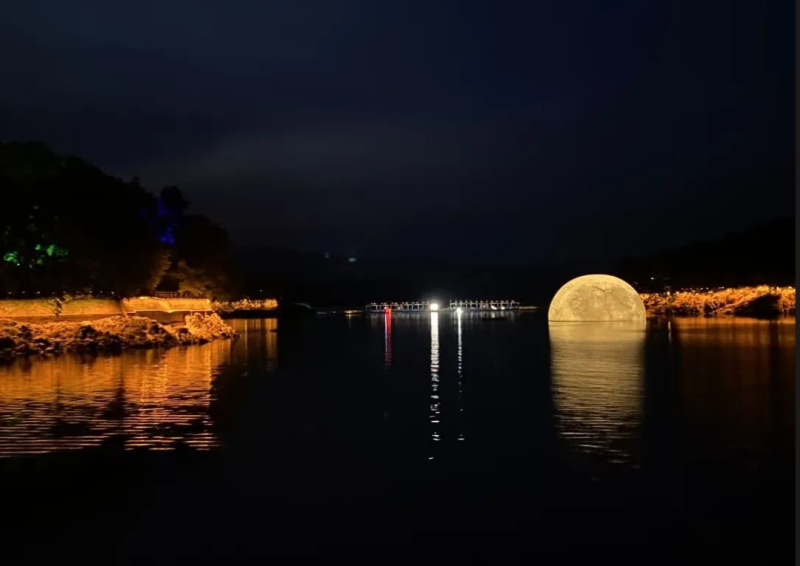
Moonlight Island was originally named Wulong Island. It is located in the central lake area and consists of four islands—Lock Island, Bird Island, Zhenqu Garden, and Qishi Island—connected by floating bridges, with a total area of about 0.7 square kilometers. Lock Island is the core of the scenic area. More than 100,000 locks from around the world hang on the island, including safety locks, love locks, and friendship locks. The largest bronze lock weighs 2 tons and is inscribed with the words "Number One Lock Under Heaven." Bird Island is home to more than 50 species of birds, including lovebirds, mynas, and swans, and visitors can interact closely with the birds. Zhenqu Garden has water entertainment facilities and a children's play area, making it a popular destination for family trips.
Longshan Island
Longshan Island is located in the central lake area, with an area of 0.45 square kilometers. It is named because the island resembles a crouching giant dragon. The most famous building on the island is the Hai Rui Temple, first built in the 41st year of the Jiajing reign of the Ming dynasty (1562). The existing building was reconstructed in 1985, covering an area of 625 square meters. The temple displays Hai Rui's life deeds and related cultural relics. On the west side of the island are the remains of Shixia Academy, first built during the Jiading reign of the Southern Song dynasty, and one of the most famous academies in Chun'an history. The island is densely vegetated with ancient trees towering to the sky. Among them is an ancient camphor tree 800 years old, with a trunk circumference of 5.8 meters, requiring four people to encircle it. Climbing to the top of Longshan offers a distant view of the entire lake area and is an excellent place to watch the sunset.
Huangshan Jian
Huangshan Jian is located in the southeast lake area, 266 meters above sea level, and is one of the highest points in the lake area. Looking down from the mountaintop viewing platform, more than 30 islands form the Chinese character "公" (gong), which can be called the uncanny workmanship of nature. This landscape is known as "Number One Gong Under Heaven." The mountain vegetation is mainly masson pine and Chinese fir, with a forest coverage rate of 98%. A trail winds up the mountain, 1.5 kilometers long, with five viewing pavilions along the way. The scenic area also has amusement projects such as grass skiing and cable cars. The cable car is 800 meters long, with a height difference of 150 meters between the upper and lower stations, and takes about 10 minutes. The sunrise scenery at Huangshan Jian is especially spectacular. In the early morning, sunlight falls on the lake, shimmering beautifully.
Underwater Ancient City Ruins
The underwater ancient city ruins include two sites, He City and Lion City, located in the southeast lake area of Qiandao Lake, at a depth of about 20-40 meters below the water surface. Lion City was first built in the 18th year of the Kaiyuan reign of the Tang dynasty (730). The city perimeter is about 2.7 kilometers, with five city gates. The city contains main streets such as East Street, West Street, and Main Street, retaining a large number of buildings from the Ming and Qing dynasties. In 2012, the scenic area launched the "Underwater Ancient City Diving Exploration" project, where tourists can dive under the guidance of professional coaches and view the ancient city ruins up close. To facilitate viewing by tourists, an "Underwater Ancient City Museum" has been built on the shore, displaying the historical appearance of the ancient city and the results of underwater archaeology through physical objects, pictures, and videos. The museum also displays more than 200 cultural relics salvaged from underwater, including ancient steles and porcelain.
Qinchuan Ancient Village
Qinchuan Ancient Village is located in Langchuan Township, Chun'an County, about 40 kilometers from the Qiandao Lake Scenic Area. It was first built at the end of the Song dynasty and the beginning of the Yuan dynasty and has a history of more than 800 years. The village is distributed along both banks of Qinchuan Stream, with a total length of 1 kilometer. It preserves more than 300 Huizhou-style buildings from the Ming and Qing dynasties, of which more than 100 are well preserved. The architectural style is mainly brick-and-wood structure, mostly two-story buildings, with features such as courtyards and carved beams and painted rafters. The village is known for its "seven bridges and eight lanes." Seven ancient bridges span Qinchuan Stream, the oldest of which, Jiyun Bridge, was built during the Yongle reign of the Ming dynasty. There are many cultural relics and historic sites in the village, such as the Wang Family Ancestral Hall and Guangyu Hall. The wood carvings and stone carvings in the Wang Family Ancestral Hall are exquisite and have high artistic value. The ancient village still retains a traditional way of life. Villagers mainly rely on farming and handicrafts, making it an ideal place to experience ancient village culture.
Food
Qiandao Lake Fish Head
Qiandao Lake Fish Head is the most famous local specialty dish. It is made from bighead carp, also known as fathead fish, produced in the lake area. This fish grows in high-quality water and has a long growth cycle. Generally, adult fish weighing 3-5 kilograms are selected, and the fish head accounts for more than one-third of the body weight. The most classic preparation is fish head tofu soup. The fish head is pan-fried until golden brown on both sides, then boiled in water, and tender tofu is added to simmer over low heat. The soup is milky white and delicious. There are also styles such as chopped chili fish head and braised fish head in sauce. In restaurants within the scenic area, a serving of fish head tofu soup costs about 120-180 yuan, depending on the size of the fish head. September and October are the seasons when the fish head is fattiest and most delicious. At this time, the meat is tender and rich in collagen.
Chun'an Cured Meat
Chun'an cured meat is a traditional local preserved food with a history of more than 100 years. Fresh pork belly is selected and marinated for 7-10 days with seasonings such as soy sauce, sugar, and cooking wine, then hung in a ventilated place to dry. When eaten, it is cut into thin slices and steamed. Its characteristics are bright red color, salty with a hint of sweetness, and fatty but not greasy. The production of Chun'an cured meat is mostly carried out in winter. There is a local custom of "curing and air-drying in winter to store for the winter." In farm restaurants around the scenic area, a plate of cured meat costs about 40-60 yuan and is often stir-fried with spring bamboo shoots for a better flavor.
Rice Soup
Rice soup is a traditional snack in the Chun'an area, also known as "hulatai." It is made by grinding rice into powder, then adding ingredients such as green vegetables, tofu, dried bamboo shoots, and minced meat and cooking them together. It has a thick texture and a fresh, savory taste. Rice soup has a long history locally. It is said to have been invented by ancient common people to save food, and today it has become an essential food during festivals. In breakfast shops in Chun'an County, a bowl of rice soup costs about 5-8 yuan, and chili, chopped scallions, and other seasonings can be added according to personal taste.
Qiandao Jade Turtle
Qiandao Jade Turtle is a dish made from stone frogs, also known as spiny-breasted frogs, a specialty of Qiandao Lake. It is named because the stone frog resembles a turtle in appearance. Stone frogs grow in mountain streams around the lake area, and their meat is tender and rich in protein. The cooking methods are mostly braised or steamed. Braised stone frog is cooked with soy sauce, sugar, cooking wine, and other seasonings and simmered over low heat until the meat absorbs the flavor; steamed stone frog preserves its freshness to the greatest extent. Because stone frogs are protected wild animals, the current "Qiandao Jade Turtle" in the scenic area mostly uses bullfrogs instead, with a similar taste. One serving costs about 80-120 yuan.
Surrounding Cuisine
In addition to the lake area's specialty foods, there are many worthwhile local snacks in the surrounding areas of Qiandao Lake. For example, Jiande tofu buns use tender tofu as filling, with thin wrappers and generous filling, and taste delicious. Tonglu rice cakes are made with glutinous rice flour wrappers and filled with dried bamboo shoots, minced meat, and other fillings, then steamed, with a soft and glutinous texture. Lin'an hickory nuts are a famous specialty of western Zhejiang, plump and fragrant, and a great choice for leisure snacks. These foods can all be tasted in the snack streets of Chun'an County, with affordable prices. A per capita consumption of about 30-50 yuan is enough to eat well.
Tickets:
Central Lake Area ticket 195 yuan/person (including boat ticket), Southeast Lake Area ticket 195 yuan/person (including boat ticket).
You can search for the official public account "Qiandao Lake Tourism Co., Ltd." on WeChat to get the latest updates or buy tickets online.
Opening Hours:
Open all year round, with specific opening hours adjusted according to the season. Peak season (March 1-November 30): opening hours are 8:00-17:00, with boat departure times from 8:00-10:30, and the last boat returning to the pier at 17:00; off-season (December 1-February 28 of the following year): opening hours are 8:30-16:30, with boat departure times from 8:30-10:00, and the last boat returning to the pier at 16:30.
The opening hours of each attraction are consistent with the lake area. Among them, the Underwater Ancient City Museum is open from 9:00-16:30, with last admission at 16:00; Qinchuan Ancient Village is open all day, but some ancient buildings in the village are open from 8:00-17:00.
It should be noted that boat departure times may be adjusted according to the number of tourists and weather conditions. It is recommended that tourists arrive at the pier one hour in advance to complete boarding procedures so as not to miss the boat. In extreme weather such as typhoons and heavy rain, the scenic area may be temporarily closed. Tourists can follow the official website or public account for the latest information.
Tour Routes:
The Qiandao Lake Scenic Area is large. It is recommended to plan routes reasonably according to the number of days of travel. For a one-day tour, you can choose to visit either the central lake area or the southeast lake area. For a two-day tour, you can visit both lake areas and deeply experience the lake scenery.
One-day tour (Central Lake Area): At 8:30 a.m., board the boat at the Qiandao Lake Town Tourist Pier and first go to Meifeng Island. Take the cableway up the mountain to view the panoramic lake scenery, about 1.5 hours. At 10:30, take the boat to Moonlight Island, visit Lock Island, Bird Island, and other attractions, experience interactive projects, about 2 hours, and have lunch at a restaurant on the island. At 13:30 p.m., go to Longshan Island, visit the Hai Rui Temple and the Shixia Academy ruins, about 1 hour. At 15:00, take the boat back to the pier and end the trip. The total boat time is about 3 hours, and the total route is about 50 kilometers.
Two-day tour: On the first day, visit the central lake area (same route as above), and stay overnight in Qiandao Lake Town; on the second day, at 8:30 a.m., depart from the southeast lake area pier and go to Huangshan Jian. Climb to the top to view the "Number One Gong Under Heaven" landscape, about 1.5 hours. At 10:30, go to Mishan Island, visit Mishan Buddhist Temple, and learn about Buddhist culture, about 1 hour. At 12:00, have lunch on the island. At 13:30 p.m., go to Guihua Island, view karst landforms and monkey performances, about 1 hour. At 15:00, take the boat back to the pier. If time permits, you can go to Qinchuan Ancient Village on the second afternoon to experience the style of an ancient village. The drive takes about 1 hour, and the visit takes about 2 hours before returning to Qiandao Lake Town.
Transportation:
External Transportation - Airplane: The nearest airport to Qiandao Lake is Hangzhou Xiaoshan International Airport, about 180 kilometers from the scenic area, about 2 hours by car. There are direct buses from the airport to Qiandao Lake, 6 buses per day, with departure times at 10:30, 12:00, 14:00, 15:30, 17:30, and 19:30, fare 85 yuan/person, about 2 hours.
External Transportation - Train: Qiandao Lake does not have a direct railway station. Tourists can take the high-speed rail to Hangzhou East Station or Jiande Station. There are direct buses from Hangzhou East Station to Qiandao Lake Town, every 30 minutes from 7:00-19:00, fare 65 yuan/person, about 1.5 hours; there are 8 buses per day from Jiande Station to Qiandao Lake Town, with departure times from 8:00-18:00 every 2 hours, fare 25 yuan/person, about 1 hour.
External Transportation - Long-distance Bus: Qiandao Lake Bus Passenger Transport Center has buses to surrounding cities such as Hangzhou, Shanghai, Nanjing, and Suzhou. Hangzhou West Bus Station to Qiandao Lake has buses every 20 minutes from 6:00-18:30, fare 60 yuan/person, 1.5 hours; Shanghai Hongqiao Long-distance Bus Station to Qiandao Lake has buses every 2 hours from 7:30-16:00, fare 120 yuan/person, about 4 hours.
External Transportation - Self-driving: Qiandao Lake has convenient transportation, with the Hangzhou-Qiandao Lake Expressway and Qiandao Lake-Huangshan Expressway passing through. From Hangzhou, drive about 120 kilometers along the Hangzhou-Qiandao Lake Expressway, taking 1.5 hours; from Shanghai, take the Shanghai-Kunming Expressway to the Hangzhou-Qiandao Lake Expressway, about 300 kilometers in total, taking 3.5 hours; from Nanjing, take the Changchun-Shenzhen Expressway to the Hangzhou-Qiandao Lake Expressway, about 350 kilometers in total, taking 4 hours. There are multiple parking lots in the scenic area, with a charging standard of 5 yuan/hour and a daily cap of 50 yuan.
Internal Transportation - Cruise: The main means of transportation in the lake area is cruise boats. The central lake area and southeast lake area each have dedicated cruise boats. Cruise boats are divided into ordinary cruise boats and luxury cruise boats. Ordinary cruise boats are included in the ticket, while luxury cruise boats require an additional 30 yuan/person. Cruise boats travel on fixed routes, and tourists need to get on and off at designated times.
Internal Transportation - Scenic Bus: There are scenic buses between Qiandao Lake Town and various attractions. The bus from the Central Lake Area Tourist Pier to the entrance of Meifeng Island Scenic Area costs 5 yuan/person, and departure times connect with cruise boat times; the bus from Qiandao Lake Town to Qinchuan Ancient Village runs 4 times a day, with departure times at 7:30, 9:30, 13:30, and 15:30, fare 15 yuan/person, about 1 hour.
Internal Transportation - Taxi: Taxis in Qiandao Lake Town have a starting fare of 6 yuan for 3 kilometers, then 2 yuan/kilometer. From the town center to the Central Lake Area Tourist Pier is about 3 kilometers, with a taxi fare of about 10 yuan; to the Southeast Lake Area Tourist Pier is about 5 kilometers, with a taxi fare of about 15 yuan.
Must-Visit Attractions:
Meifeng Island: A landmark attraction of Qiandao Lake, where you can overlook the magnificent landscape formed by more than 300 islands. It has the reputation of "If you do not go up Meifeng to view the islands, you do not know the true face of Qiandao." The viewing platform on the island has an excellent field of view, and you can also experience going up and down the mountain by cableway.
Huangshan Jian: You can view the unique "Number One Gong Under Heaven" landscape, where many islands form the shape of the Chinese character "公" (gong). The uncanny workmanship of nature is astonishing. Taking the cable car to the top allows you to take in the beautiful scenery.
Underwater Ancient City Ruins (Exhibition Area): Although the ancient city is underwater, the Underwater Ancient City Museum on the shore vividly displays the historical appearance of the ancient city and the results of underwater archaeology through rich and diverse methods. The displayed cultural relics allow tourists to feel the heritage of the thousand-year-old city.
Tianyu Mountain Viewing Platform: The best place to watch the sunset at Qiandao Lake. Here you can overlook the lake and island scenery in all directions. Under the glow of the sunset, the scenery of Qiandao Lake is breathtakingly beautiful. Taking the elevator up the mountain is convenient and labor-saving.
Qinchuan Ancient Village: An ancient village with a history of more than 800 years, perfectly preserving more than 300 Ming and Qing Huizhou-style buildings. Its "seven bridges and eight lanes" layout is unique. Historic sites such as the Wang Family Ancestral Hall witness the changes of time and allow tourists to deeply experience ancient village culture.
Travel Suggestions:
Time Arrangement: It is recommended to arrange 2-3 days to visit Qiandao Lake. One day to visit the central lake area, one day to visit the southeast lake area, and the remaining time can be used to go to Qinchuan Ancient Village, Tianyu Mountain Viewing Platform, and other places. If time is limited, a one-day tour can choose the central lake area, where the essence of the attractions is concentrated.
Cruise Boat Choice: Ordinary cruise boats are economical and practical and are included in the ticket; luxury cruise boats have more comfortable facilities and require an additional 30 yuan/person. You can choose according to your budget. When taking a boat, arrive at the pier in advance so as not to miss the departure time.
Project Experience: If you like excitement, you can try water projects such as jet skis and paragliders; if you want leisure and relaxation, you can choose cycling by the lake. The Qianfen Greenway is recommended, with beautiful scenery; if you are interested in history and culture, you can learn more about the history of the underwater ancient city or visit historical sites such as the Hai Rui Temple on Longshan Island.
Season Selection: Spring and autumn have pleasant climates and beautiful scenery, suitable for outdoor activities; summer is good for escaping the heat, but pay attention to sun protection and mosquito prevention; winter has relatively fewer tourists, allowing you to enjoy a quiet atmosphere, and some hotels also offer discounts.
Notes:
Tickets and Documents: Buy tickets in advance through official channels and pay attention to ticket validity and scope of application. Carry valid documents. People who meet preferential policies can enjoy corresponding discounts.
Traffic Safety: Choose regular means of transportation, such as scenic buses and taxis. When driving by yourself, obey traffic rules. Roads in the scenic area have many curves and steep slopes, so drive cautiously. Parking spaces in the scenic area are limited, so try to avoid peak periods.
Water Safety: When participating in water projects, be sure to wear life jackets and follow the instructions of staff. Do not swim or play in dangerous areas. When taking a boat, sit firmly and hold on, and avoid walking around on the boat at will.
Environmental Protection: The ecological environment of Qiandao Lake is fragile. Do not litter, do not damage vegetation and landscapes, protect water source cleanliness, and jointly maintain the beautiful scenery.
Food Hygiene: When dining in or around the scenic area, choose restaurants with good sanitary conditions to avoid gastrointestinal discomfort caused by unclean food. When tasting specialty foods, pay attention to moderation to prevent gastrointestinal intolerance.
Weather Protection: In summer, take good sun protection measures and carry sunscreen, sunglasses, sun hats, etc.; in rainy weather, prepare rain gear. There may be rainfall in mountainous areas, so prepare in advance.