Wuzhen Scenic Area is located in Tongxiang City, Jiaxing City, Zhejiang Province. It is a national 5A-level tourist attraction and is known as "China's last town on the water." It is famous for its well-preserved ancient Jiangnan water town scenery. The core area of the scenic area includes East Scenic Zone and West Scenic Zone, among which East Scenic Zone covers about 0.9 square kilometers, West Scenic Zone covers about 4.92 square kilometers, and the total town area is about 110.93 square kilometers. The ancient town takes rivers as streets, with bridges connected to streets. It preserves a large number of Jiangnan residential buildings from the Ming and Qing dynasties, including waterside pavilions, covered corridors, and arcade buildings. Dozens of ancient bridges of various types still exist, fully continuing the traditional water town layout of "small bridges, flowing water, and households." It is a typical representative of Jiangnan water town culture.
Historical Culture
Wuzhen has more than 7,000 years of civilization history and more than 1,300 years of town history. During the Spring and Autumn period, this place was a garrison area of the State of Wu and was called "Wushu"; during the Qin dynasty, it was divided into Wudun (west) and Qingdun (east), belonging to different counties; during the Song and Yuan dynasties, Wuzhen belonged to Wucheng County of Huzhou Prefecture, while Qingzhen belonged to Chongde County of Jiaxing Prefecture. This divided administration continued through the Ming and Qing dynasties; in 1950, Wu and Qing towns merged into "Wuzhen" and were placed under Tongxiang County.
The name of the ancient town evolved from "Wudun" and "Qingdun." There are various explanations for the origin of the character "Wu": one says it comes from Prince Wuyu of the State of Yue being granted a fief here; another says it commemorates General Wu who suppressed a rebellion during the Tang dynasty; there is also a view that it is related to the local Wutuo historic site or the color of the soil. As an important node of Jiangnan culture, Wuzhen has produced many talented people throughout history. The great modern literary master Mao Dun was born here. The ancient town still preserves folk cultures such as sericulture customs and water town wedding customs, and has also nurtured traditional crafts such as Sanbaijiu brewing and sister-in-law cake making.
Main Attractions
East Scenic Zone
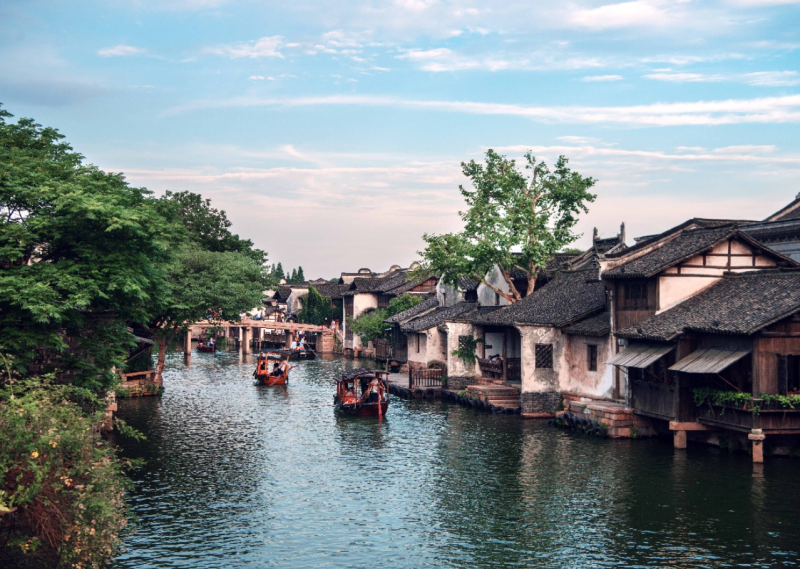
East Scenic Zone stretches from Yingjia Bridge in the west to Fengyuan Twin Bridge in the east, with a total length of 1,300 meters and an area of 0.9 square kilometers. It is the most completely preserved original ecological ancient town area in Wuzhen. The scenic area includes East Market River, Ming-Qing Ancient Street, 11 ancient bridges, and many historical buildings, such as Mao Dun's Former Residence, Jiangnan Hundred Beds Museum, and Hongyuantai Dyeing Workshop. Visitors can experience traditional workshops here, such as the Sanbaijiu Workshop and Blue Calico Workshop, watch shadow puppet performances, and feel the authentic water town life scene.
West Scenic Zone
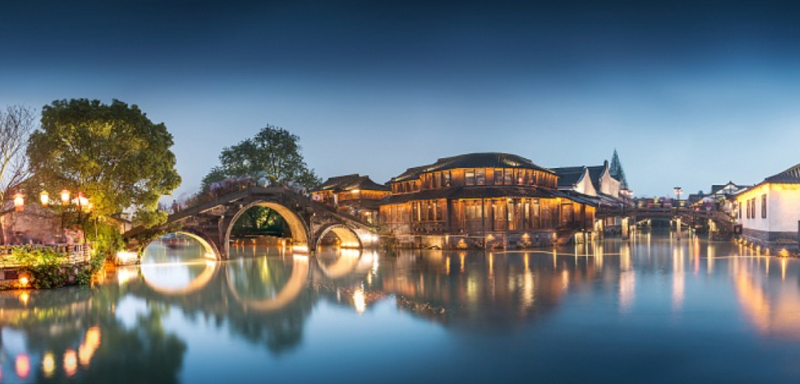
West Scenic Zone covers an area of about 4.92 square kilometers. After unified planning and development, it not only preserves the water town style but also integrates modern leisure elements. The scenic area includes attractions such as White Lotus Pagoda, Zhaoming Academy, Xuchang Soy Sauce Garden, and the Water Market. At night, the lights are brilliant, making it the core area for enjoying Wuzhen's night views. In addition, West Scenic Zone has well-equipped guesthouses, cafes, and other facilities, suitable for tourists to deeply experience the slow life of the water town.
Mao Dun's Former Residence
Located at No. 17 Guanqian Street in East Scenic Zone, it is the residence where Mao Dun (Shen Yanbing)'s ancestors lived. It was first built in the mid-19th century, with a building area of 650 square meters, and is a typical Qing dynasty Jiangnan residential building. The former residence preserves traces of Mao Dun's childhood life and related documents and materials. In 1988, it was listed as a Major Historical and Cultural Site Protected at the National Level. It is an important place for understanding Mao Dun's life and literary achievements.
Mu Xin Art Museum
Located near the entrance of West Scenic Zone, it was designed by a disciple of master architect I. M. Pei. The museum building is built along the water, and its exterior resembles a corridor of undulating piano keys. The museum displays Mr. Mu Xin's paintings, manuscripts, letters, and other works, comprehensively presenting his artistic career. Museum tickets are 20 yuan per person, and it is closed every Monday (except statutory holidays).
Jiangnan Hundred Beds Museum
Located on East Street in East Scenic Zone, it was originally the Zhao Family Hall and is the first museum in China specializing in collecting ancient beds. The museum displays dozens of ancient beds from the Ming and Qing dynasties to modern times, including step-in beds, canopy beds, and other types. The bed bodies are exquisitely carved, with themes covering flowers and birds, figures, and mythological stories, reflecting the furniture culture and living customs of the Jiangnan region.
Food
Sanbaijiu
A traditional famous liquor of Wuzhen, made from white rice, white flour, and white water using traditional brewing methods. Its alcohol content is about 55 degrees, and its taste is mellow and smooth. The Sanbaijiu Workshop in East Scenic Zone allows visitors to observe the brewing process. Tourists can taste it for free. Bottled liquor ranges from dozens to hundreds of yuan and is a local specialty souvenir.
Sister-in-law Cake
A traditional pastry of Wuzhen. It is said to be named after a sister-in-law and sister-in-law who created it together. Made from flour, sesame, white sugar, and other ingredients through multiple processes, it has a crisp texture, moderate sweetness and saltiness, and a sesame aroma. It is sold in many shops in the scenic area, priced at about 20-30 yuan per box.
Dingsheng Cake
A traditional Jiangnan pastry, often used in Wuzhen for festivals or happy occasions. Made from glutinous rice flour and japonica rice flour, with brown sugar or red bean paste filling, it is steamed and formed into a diamond shape, with the words "Dingsheng" printed on the surface. It has a soft, glutinous, sweet taste and implies good fortune. The unit price is about 3-5 yuan per piece.
White Water Fish
A freshwater fish specialty of Wuzhen's waters, with a slender body and tender meat. The local method is mainly steaming, which preserves the freshness to the greatest extent, paired with scallions and ginger for fragrance. It is a common dish in restaurants in the scenic area. One portion costs about 60-100 yuan, depending on the size of the fish.
Surrounding Food
In addition to the specialty foods in the ancient town, Tongxiang City and surrounding areas also have many local snacks. For example, Tongxiang pot (a clay pot stew made with chicken feet, prawns, tofu, and other ingredients), Chongfu braised pork knuckle (soy-braised pig trotter, tender and flavorful), and mutton noodles around the Puyuan Sweater Market (a autumn and winter specialty with tender mutton and rich soup). Tourists can taste them on the way to and from Wuzhen.
Tickets:
East Scenic Zone ticket: 110 yuan per person; West Scenic Zone ticket: 150 yuan per person; East West combined ticket: 190 yuan per person.
You can search for the official public account "Wuzhen Scenic Area" on WeChat to get the latest updates or buy tickets online.
Opening Hours:
East Scenic Zone opening hours: summer time (April 1-October 31) 7:00-18:00; winter time (November 1-March 31) 7:00-17:30.
West Scenic Zone opening hours: 9:00-22:00 (the night tour area closes after 22:00).
Mu Xin Art Museum opening hours: 9:00-17:30 (last entry at 17:00), closed every Monday (except statutory holidays).
Some attractions in the scenic area, such as Mao Dun's Former Residence and Jiangnan Hundred Beds Museum, have opening hours consistent with the scenic zone where they are located. Specific times are subject to on-site notices.
Tour Routes:
One-day tour route (combined ticket recommended): Arrive at East Scenic Zone before 8:00 a.m., visit Mao Dun's Former Residence, Jiangnan Hundred Beds Museum, and Hongyuantai Dyeing Workshop, and watch the pole boat performance around 10:00; at 12:00, taste local snacks in East Scenic Zone, such as Dingsheng Cake and White Water Fish; at 13:30 p.m., go to West Scenic Zone and visit Xuchang Soy Sauce Garden, Zhaoming Academy, and the Water Market in sequence; after 16:00, go to Mu Xin Art Museum; in the evening, take a sculling boat in West Scenic Zone (60 yuan per person, shared boat) and enjoy the water town scenery under the sunset; at night, tour the night view of West Scenic Zone and return after 21:00.
Two-day tour route: On the first day, arrive in the morning and first tour West Scenic Zone, stay in a guesthouse in West Scenic Zone, visit Mu Xin Art Museum and White Lotus Pagoda in the afternoon, and stroll around the Water Market in the evening; the next morning, go to East Scenic Zone to deeply experience traditional workshops and folk displays, leave East Scenic Zone at noon, and before returning, visit South Scenic Old Street (free and open, preserving the original ecological style) and buy handicrafts.
Transportation:
Plane: The nearest airports to Wuzhen are Hangzhou Xiaoshan International Airport (about 80 kilometers) and Shanghai Hongqiao International Airport (about 130 kilometers). Xiaoshan Airport has direct airport buses to Wuzhen, 6 buses per day (departure times 9:00-18:00, one bus every 2 hours), about 1.5 hours, 65 yuan per person; from Hongqiao Airport, you need to first take the subway to Shanghai South Bus Station, then transfer to a long-distance bus to Wuzhen.
High-speed rail: The nearest high-speed rail station is Tongxiang Station (about 25 kilometers from Wuzhen). From Tongxiang Station, you can take bus K282 directly to Wuzhen Bus Station (about 1 hour, 5 yuan), then transfer to bus K350 (8 minutes, 2 yuan) to East or West Scenic Zone; you can also take a taxi, costing about 50-80 yuan, about 30 minutes.
Long-distance bus: Wuzhen Bus Station has buses to Hangzhou, Shanghai, Suzhou, and other cities. From Hangzhou East Bus Station to Wuzhen, buses run every 30 minutes from 7:00 to 18:00, about 1.5 hours, 38 yuan per person; from Shanghai South Bus Station to Wuzhen, buses run every 40 minutes from 7:15 to 18:30, about 2 hours, 56 yuan per person.
Self-driving: From Hangzhou, take the Shanghai-Kunming Expressway to the Shenjiahu Expressway and exit at Wuzhen, about 1 hour in total; from Shanghai, take the Shanghai-Kunming Expressway to the Shenjiahu Expressway, about 2.5 hours in total; from Suzhou, take the Changtai Expressway to the Shenjiahu Expressway, about 1.5 hours in total. There are parking lots in both East and West Scenic Zones, charging 5 yuan per hour, with a 24-hour cap of 50 yuan.
Must-visit Attractions:
West Scenic Zone Night View: The night lights of West Scenic Zone are laid along the river channels and buildings, outlining the gentle contours of the water town. When taking a night boat tour, you can enjoy the scene of lanterns on both banks reflected on the water. It is one of Wuzhen's signature experiences.
Mao Dun's Former Residence: As a Major Historical and Cultural Site Protected at the National Level, it fully preserves Mao Dun's growth environment. The exhibits in the museum show his literary achievements and life, and it is an important window for understanding modern Chinese literature.
Mu Xin Art Museum: The architectural design and exhibit display complement each other. Visitors can not only appreciate Mu Xin's artworks but also overlook the water scenery of West Scenic Zone through window seats. It is suitable for art lovers.
East Scenic Zone Original Ecological Block: Compared with West Scenic Zone, it has more everyday atmosphere. Visitors can see residents washing clothes by the river and traditional handicraft workshops in operation, and feel the original flavor of the water town that has not been overly commercialized.
Travel Suggestions:
Best seasons to visit: spring (March-May, misty and rainy) and autumn (September-November, cool climate). In summer, pay attention to heat prevention; in winter, you can experience the ancient town atmosphere with fewer people and quiet scenery.
Accommodation choices: Guesthouses in West Scenic Zone are uniformly managed by the scenic area and are mostly waterside residences, allowing you to experience water town life with a river view from the window. Prices are about 300-800 yuan per night; accommodation outside East Scenic Zone or in Wuzhen town is more affordable, about 150-400 yuan per night, suitable for tourists with limited budgets.
Experience projects: sculling boats in West Scenic Zone (60 yuan per person, shared boat), blue calico making experience in East Scenic Zone (about 30 yuan per piece), and pingtan performances at the National Music Theater (free, need to arrive early for seats), etc., can enrich the itinerary.
Avoid peak times: There are many tourists on holidays and weekends. It is recommended to go on weekdays; West Scenic Zone has fewer crowds just after opening at 9:00 a.m., suitable for taking photos.
Notes:
Ticket validity: East Scenic Zone and West Scenic Zone tickets are valid only on the day of issue. After leaving the park, re-entry is not allowed, so single-visit time needs to be reasonably planned.
Transportation tips: Motor vehicles are prohibited in the ancient town, and touring mainly relies on walking; West Scenic Zone is relatively large, and you can take the free sightseeing bus within the scenic area (round trips between stops).
Property care: There are many tourists in the scenic area, so take care of mobile phones, wallets, and other personal belongings, especially in crowded covered corridors or when taking boats.
Environmental requirements: The ancient town water system is used for daily life. Littering into the river is prohibited; photography is prohibited in some areas, such as Mu Xin Art Museum, and sign reminders must be followed.
Special situations: In case of heavy rain, typhoons, and other extreme weather, the scenic area may temporarily close some areas or adjust boat schedules.