Mount Putuo Scenic Area is located in Putuo District, Zhoushan City, Zhejiang Province. It is a National 5A Tourist Attraction and one of the Four Great Sacred Buddhist Mountains in China, known as the "Buddhist Kingdom of Sea and Sky" and the "Sacred Realm of the South Sea." The scenic area is situated in the eastern waters of the Zhoushan Archipelago. It is a small island among the 1,390 islands of the Zhoushan Archipelago, shaped like a crouching dragon in the sea, with an area of approximately 12.52 square kilometers. Mount Putuo integrates Buddhist culture with mountain and sea scenery. It is not only the sacred site of Guanyin Bodhisattva but also a coastal tourist resort. Its landscape, featuring mountains and sea coexisting and Buddhist temples interspersed throughout, is uniquely distinctive. The scenic area preserves numerous Buddhist structures, including the three major temples of Puji Temple, Fayu Temple, and Huiji Temple, as well as dozens of nunneries such as Zizhulin Nunnery and the Unwilling-to-Leave Guanyin Hall, with a total building area exceeding 50,000 square meters. The architectural style blends Buddhist architectural art from the Tang, Song, Ming, and Qing dynasties. In 2007, it was rated as a National AAAAA Tourist Attraction, in 2012 it was listed as a National Scenic Area, and in 2019 it was selected as a "Sacred Site of Chinese Buddhist Culture."
History and Culture
The Buddhist culture of Mount Putuo can be traced back to the Tang Dynasty. According to legend, in the fourth year of Xiantong (863 AD), the Japanese monk Hui'e obtained a Guanyin statue from Mount Wutai and was returning to Japan with it. When he reached the waters near Mount Putuo, he encountered storms and was blocked. Believing that Guanyin did not wish to go east, he built the "Unwilling-to-Leave Guanyin Hall" on the island. This marked the beginning of Mount Putuo's Buddhist culture, with a history of more than 1,100 years.
During the Song and Yuan dynasties, Buddhism on Mount Putuo gradually developed. The Song court allocated funds multiple times to repair temples, and Baotuo Guanyin Temple (the predecessor of today's Puji Temple) became an important Buddhist temple in the south. In the Yuan Dynasty, Mount Putuo was designated as a "Pure Land of the Buddhist Kingdom," and the scale of its temples further expanded. In the Ming Dynasty, Mount Putuo's Buddhist status rose significantly. During the Wanli period, it formed a layout of "three temples, seventy nunneries, and a hundred monks' quarters" and was known together with the other three great sacred sites as one of the Four Great Sacred Buddhist Mountains in China.
The Qing Dynasty was the peak period of Buddhism on Mount Putuo. In the thirty-eighth year of Kangxi (1699), the emperor bestowed the plaque "Puji Qunling," and Fayu Temple was granted the plaque "Tianhua Fayu." During the Yongzheng and Qianlong periods, the temples were expanded multiple times, and the number of monks reached several thousand at its peak, creating a scene described as "temples hidden wherever the mountain curves, and monks encountered whenever the road seems to end."
In addition to Buddhist culture, Mount Putuo also contains rich maritime culture and cultural heritage. Literati of successive dynasties such as Su Shi, Lu You, and Dong Qichang left hundreds of poems, inscriptions, and steles. Folk customs such as "Sea Worship" and "Guanyin's Birthday" merged with Buddhist festivals, forming a unique cultural system. The scenic area currently preserves more than 200 cultural relics, including cliff inscriptions and ancient steles from the Tang Dynasty to the Qing Dynasty. In 2013, "Guanyin Belief on Mount Putuo" was inscribed on the National Intangible Cultural Heritage List.
Major Attractions
Puji Temple
Puji Temple is the largest temple on Mount Putuo and a National Key Buddhist Temple, located at the southern foot of Lingjiu Peak on Baihua Summit. It was first built in the Song Dynasty under the original name "Baotuo Guanyin Temple." The existing buildings were rebuilt in the Qing Dynasty, covering an area of 11,400 square meters with a building area of 7,854 square meters. The temple is laid out along a central axis, consisting successively of a screen wall, imperial stele pavilion, Haiyin Pond, Heavenly King Hall, Mahavira Hall, Yuantong Hall, and Sutra Library. The Yuantong Hall is the core building, 18 meters high, 24 meters wide, and 20 meters deep. It houses an 8.8-meter-high Vairocana Guanyin statue, flanked by statues of Guanyin's Thirty-Two Manifestations, making it a landmark Buddha statue of Mount Putuo. In front of the temple, Haiyin Pond covers about 15 mu, with three ancient stone bridges (Yongshou Bridge, Lotus Bridge, and Flat Bridge) that are simple and elegant. Lotuses are widely planted in the pond, creating a beautiful scene when they bloom in summer. Puji Temple receives a constant stream of pilgrims daily and is the center of Buddhist activities on Mount Putuo.
Fayu Temple
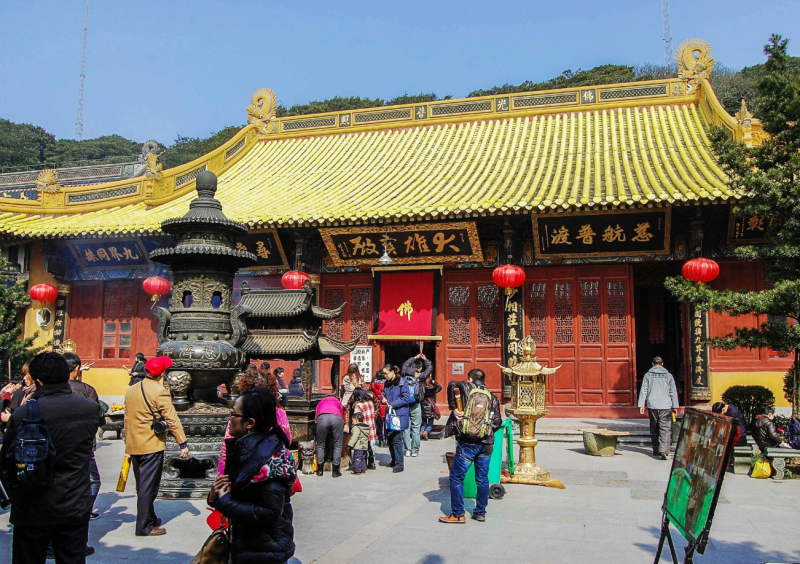
Fayu Temple is the second largest temple on Mount Putuo and a National Key Buddhist Temple, located at the foot of Guangxi Peak. It was first built in the eighth year of Wanli in the Ming Dynasty (1580), originally named Haichao Nunnery, and was granted the name "Fayu Chan Temple" by Emperor Kangxi in the thirty-eighth year of his reign (1699). The temple covers an area of 33,000 square meters with a building area of 13,000 square meters, built along the mountain in a seven-hall layout. Its landmark building, the "Nine-Dragon Caisson" in the Mahavira Hall, is a Ming Dynasty relic, 4.5 meters high and 3.7 meters in diameter, formed by nine carved wooden dragons coiled together with gilded bodies and exquisite craftsmanship. It is a treasure of Chinese Buddhist architecture. The Jade Buddha Hall enshrines a 2-meter-high white jade Shakyamuni statue carved from a single piece of Burmese jade. Fayu Temple also preserves Qing Dynasty imperial steles, a Nine-Dragon Wall, and other cultural relics. Its overall architecture is magnificent and reflects the typical style of Qing Dynasty Buddhist architecture.
Huiji Temple
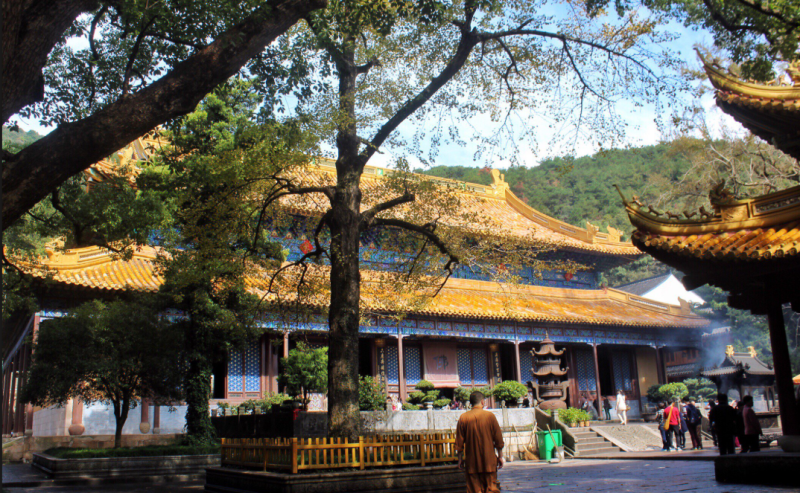
Huiji Temple is located on Foguang Summit, the main peak of Mount Putuo, and is the third largest temple on Mount Putuo and a National Key Buddhist Temple. It was first built in the Ming Dynasty under the original name Huiji Nunnery and was expanded into a temple in the fifty-eighth year of Qianlong in the Qing Dynasty (1793). The temple covers an area of 3,000 square meters with a building area of 1,450 square meters. Because it is located at an altitude of 291.3 meters on the mountaintop, it is one of the highest sea-and-sky Buddhist temples in China. Its architectural layout breaks the conventional central axis arrangement and is built according to the mountain terrain. The main buildings include the Mahavira Hall, Jade Emperor Hall, and Guanyin Hall. The Guanyin Hall enshrines a thousand-armed Guanyin statue 3.3 meters high with an exquisite form. The temple is surrounded by lush trees and is rich in Foguang Mountain cloud-mist tea. Visitors can taste tea brewed with mountain spring water in the temple. From Huiji Temple, one can overlook the entire island of Mount Putuo and the islands of the East China Sea, taking in the full view of the mountain and sea scenery.
Nanhai Guanyin Statue
The Nanhai Guanyin Statue is located at the top of Longwan Ridge. Completed in 1997, it is a landmark structure of Mount Putuo. The statue has a total height of 33 meters (including the 18-meter Buddha figure, 2-meter lotus pedestal, and 13-meter base), weighs more than 70 tons, and is assembled from 96 imitation gold-copper cast pieces with a gilded surface. It shines brilliantly in the sunlight. The statue faces the East China Sea, holding a dharma wheel in the left hand and displaying the abhaya mudra with the right hand. Its expression is solemn and compassionate, embodying the Guanyin spirit of "compassionately saving the world." The base is a three-tiered white marble structure, carved around with images of Guanyin's Thirty-Two Manifestations. Inside the base is a Guanyin Hall enshrining a thousand-armed Guanyin statue. The location of the statue offers a broad field of vision and is an important place for viewing the sea and paying homage, as well as a popular photo spot on Mount Putuo.
Zizhulin Nunnery
Zizhulin Nunnery is located in the southeast corner of Mount Putuo, backed by Chaoyang Peak and facing Lianhua Ocean. It is named after the purple bamboo that grows around it. First built in the Qing Dynasty, it covers an area of 1,300 square meters with a building area of 700 square meters and is a typical Jiangnan nunnery-style structure. Its main buildings include Yuantong Hall, Dabei Tower, and the Unwilling-to-Leave Guanyin Hall. The Yuantong Hall enshrines an 8.8-meter-high Guanyin statue, flanked by the Eighty-Four Manifestations of Guanyin. Zizhulin Nunnery is closely associated with the legend of the "Unwilling-to-Leave Guanyin" and is a symbolic place of Guanyin's spiritual practice. Nearby attractions include Chaoyin Cave and Guangming Pond. The environment is quiet and the Zen atmosphere is strong, making it a good place for visitors to pray and find peace.
Unwilling-to-Leave Guanyin Hall
The Unwilling-to-Leave Guanyin Hall is the oldest temple on Mount Putuo, located beside Zizhulin Nunnery above Chaoyin Cave. It was first built in the Tang Dynasty, and the existing buildings were reconstructed in 1980. It covers an area of 200 square meters with a building area of 100 square meters. Although small, the temple is famous for the legend of "Hui'e Requesting the Statue": the "Unwilling-to-Leave Guanyin Statue" enshrined inside is in Tang Dynasty style, 1.2 meters high, with a serene expression. Beside the hall, Chaoyin Cave is a natural sea-eroded cave, 30 meters deep and 10 meters wide. When waves rush in, it emits a thunderous sound, complementing the Guanyin legend. This is the source of Mount Putuo's Buddhist culture and a must-visit place for understanding the history of Mount Putuo.
Qianbu Sand
Qianbu Sand is the longest beach on Mount Putuo, located on the eastern side of the island, extending from Jibao Ridge in the south to Wanghai Pavilion in the north. It is 1,750 meters long and about 100 meters wide, with an area of about 175,000 square meters. The beach has pure sand composed of quartz sand, golden in color, fine and soft, with a gentle slope and clear seawater. It is a natural seaside bathing beach. Summer (June-September) is the best period for visiting, when swimming, beach volleyball, and other activities can be enjoyed. On the western side of the beach is "Listening to the Tide Rock." When the tide rises, waves strike the rock with a thunderous sound. In the early morning, one can watch the sunrise over the sea here, and in the evening, enjoy the "Golden Sand Sunset" scenery. Together with the Buddhist architecture, it forms the unique landscape of the "Buddhist Kingdom of Sea and Sky."
Foguang Summit
Foguang Summit is the main peak of Mount Putuo, with an altitude of 291.3 meters, the highest point on the island. The mountain body is composed of granite, with vegetation coverage of more than 90%, mainly subtropical evergreen broad-leaved forest, and is rich in cloud-mist tea and Guanyin bamboo. From the summit, one can enjoy a 360-degree panoramic view of Mount Putuo and the islands of the East China Sea. On clear days, one can see Zhujiajian, Taohua Island, and other islands in the distance. There are two ways to reach the summit: Xiangyun Road (a walking path) and a cable car. Xiangyun Road is 3.5 kilometers long with 1,088 stone steps, with viewing platforms and pavilions along the way. The cable car is 1,600 meters long, with a one-way ride of 7 minutes and a height difference of 205 meters between the upper and lower stations. Foguang Summit is not only a scenic spot but also a Buddhist sacred site. Huiji Temple is located at the summit, creating the artistic conception of "a temple within the mountain, the temple hidden in the mountain."
Food
Mount Putuo Vegetarian Cuisine
Mount Putuo vegetarian cuisine is a representative of Buddhist dietary culture, characterized by "purity, cleanliness, vegetarianism, and elegance." Its ingredients are bean products, vegetables, fungi, rice, and flour. Meat, fish, and the five pungent vegetables (scallions, garlic, chives, etc.) are prohibited. Vegetarian cuisine emphasizes presentation and taste, using exquisite cooking skills to imitate meat dishes, such as "vegetarian chicken," "vegetarian duck," and "vegetarian ham," with realistic textures. The dining halls of Puji Temple and Fayu Temple provide buffet-style vegetarian meals at 20-30 yuan per person, served daily from 11:00 to 13:00. Specialty dishes include "Luohan Zhai" (a stew of various mushrooms and vegetables) and "Guanyin Tofu" (made from premna leaves). Vegetarian cuisine is not only food but also embodies the Buddhist concept of "compassionate protection of life."
Zhoushan Hairtail
Zhoushan hairtail comes from the Zhoushan Fishing Ground, China's largest fishing ground, with the waters around Mount Putuo as a core production area. It is characterized by a slender body (up to more than 1 meter), silvery surface, and tender meat, rich in protein and unsaturated fatty acids. Zhoushan hairtail can be prepared in many ways: steamed hairtail preserves its original flavor and has delicate meat; braised hairtail has a rich sauce aroma and is salty and savory; pan-fried hairtail is crispy outside and tender inside, and even more flavorful with pepper salt. At seafood stalls on Mount Putuo, a portion of braised hairtail costs about 60-80 yuan and is recommended with local rice wine. Hairtail is fattest and most delicious in winter (November to February of the following year), which is the best season to taste it.
Swimming Crab
The swimming crab is a specialty of the waters around Mount Putuo. It is named for its shuttle-like shape, with the scientific name "Portunus trituberculatus." Zhoushan swimming crabs are large (up to more than 500 grams), with plump meat and rich crab roe, and are rich in protein and trace elements. Steaming is the main method of consumption, preserving the fresh flavor to the greatest extent. It can also be used to make "crab fried rice cakes," where the freshness of crab meat and the chewiness of rice cakes blend together. Pepper-salt swimming crab is crispy outside and tender inside, with a rich flavor. September to November is the fishing season for swimming crabs, when the price is about 80-120 yuan per jin. Fresh swimming crabs can be bought at Shenjiamen Fishing Port or the Mount Putuo seafood market, and restaurant processing fees are about 20 yuan per portion.
Yellow Croaker Dried
Yellow croaker dried is a traditional Zhoushan cured product made from fresh large yellow croaker through cleaning, salting, and sun-drying, with a history of more than a thousand years. The yellow croaker from the waters around Mount Putuo has firm meat. After being made into dried fish, it is golden in color, salty and savory, and easy to preserve. Yellow croaker dried can be eaten in many ways. Steamed yellow croaker dried with pork belly makes the fish more delicious after absorbing the fat. Cooked with winter melon, the soup is refreshing and is a summer heat-relieving delicacy. In specialty shops on Mount Putuo, a 500-gram package of yellow croaker dried costs about 40-60 yuan and is a favorite souvenir for tourists.
Shan Chan
Shan Chan, also known as dragon-head fish or water shan, is a common fish in the coastal waters of Mount Putuo. Its body is ribbon-like, and its meat is as tender as tofu, with almost no small bones and rich in water and protein. It is suitable for the elderly and children. It can be braised, stewed with tofu, or cooked with pepper salt. Braised shan chan with bean paste seasoning has soft, glutinous, and flavorful meat. Tofu stew with shan chan has a milky white soup that is fresh and sweet. In restaurants on Mount Putuo, a shan chan dish costs about 30-50 yuan. Shan chan is fattest and most delicious in spring (March-May).
Tickets:
Tickets are 239 yuan per person (including round-trip boat tickets).
You can search for the official public account "Mount Putuo Scenic Area" on WeChat to get the latest updates or buy tickets online.
Opening Hours:
Open all day. Opening hours of attractions within the scenic area are as follows:
Temple attractions: Puji Temple, Fayu Temple, Huiji Temple, etc. In summer (May 1-September 30), they are open from 6:00 to 18:00; in winter (October 1-April 30 of the following year), they are open from 6:30 to 17:30. The Nanhai Guanyin Statue and Zizhulin Nunnery have the same opening hours as the temples.
Natural attractions: Qianbu Sand, Baibu Sand, Foguang Summit, etc. are open all day, but visitors should pay attention to safety when visiting at night, as some areas have no lighting.
Ferry operating hours: From Zhujiajian Centipede Ferry Terminal to Mount Putuo, during peak season (May-October) 5:40-21:00, one every 10-15 minutes; during off-season (November-April) 6:00-20:00, one every 15-20 minutes. From Shenjiamen Banshengdong Ferry Terminal to Mount Putuo, during peak season 6:00-19:30, during off-season 6:30-18:00, one every 30 minutes. One-way ferry travel time is 10-20 minutes.
Tour Route:
A recommended two-day tour route allows a comprehensive experience of Mount Putuo's Buddhist culture and natural scenery:
Day 1: In the morning, take a boat from Zhujiajian Centipede Ferry Terminal to Mount Putuo (about 15 minutes). After disembarking, walk 10 minutes to Puji Temple and tour for 1.5 hours, viewing Haiyin Pond, Yuantong Hall, etc.; at 10:30, go to Qianbu Sand and stroll on the beach for 1 hour; at noon, dine at a restaurant near Puji Temple. In the afternoon at 13:00, go to Fayu Temple and visit the Nine-Dragon Caisson, Jade Buddha Hall, etc., touring for 1 hour; at 15:00, go to the Nanhai Guanyin Statue, pay homage, and enjoy the sea view for 1 hour; at 17:00, go to Baibu Sand to watch the sunset and enjoy for 1 hour; after dinner, check into a hotel on the island.
Day 2: In the morning at 7:30, take the cable car up Foguang Summit (or walk), tour Huiji Temple for 1 hour, and overlook the island scenery; at 10:00, go down the mountain to Zizhulin Nunnery and tour for 40 minutes; at 11:00, visit the Unwilling-to-Leave Guanyin Hall and Chaoyin Cave, and learn about the legendary story for 1 hour; at noon, dine near Zizhulin. In the afternoon at 13:30, choose according to interest to visit Dacheng Nunnery or relax by the sea; before 15:30, take a boat off the island and end the trip. The whole journey combines walking and transportation, with a total distance of about 25 kilometers and moderate physical exertion.
Transportation:
External Transportation - Airplane: Zhoushan Putuo Mountain Airport is located on Zhujiajian Island, facing Mount Putuo across the sea, about 5 kilometers from Centipede Ferry Terminal. It currently has routes to Beijing, Shanghai, Guangzhou, Shenzhen, Chengdu, and other major domestic cities. From the airport to Centipede Ferry Terminal, one can take a taxi, with a travel time of about 5-10 minutes and a cost of about 20 yuan; or take airport bus No. 25, with a fare of 5 yuan and a travel time of about 10-15 minutes.
External Transportation - Train: There is no direct railway station near Mount Putuo. Tourists usually arrive first at Ningbo Station. From the South Bus Station at the South Square of Ningbo Station, there are buses to Zhujiajian Centipede Ferry Terminal, with a travel time of about 2 hours and a fare of 40 yuan; or to Shenjiamen Banshengdong Ferry Terminal, with a travel time of about 1.5 hours and a fare of 30 yuan. Departure times are daily from 6:00 to 18:00, one every 30 minutes.
External Transportation - Long-distance Bus: Zhoushan Putuo Long-distance Passenger Transport Center (Chengbei Station) has buses to Shanghai, Hangzhou, Ningbo, and other surrounding cities. From Shanghai South Railway Station Long-distance Bus Station to Zhoushan Putuo Long-distance Bus Center, departure times are 7:00-19:30, one every 30-45 minutes, travel time about 5 hours, fare 150-230 yuan; from Shanghai Tourism Huangpu Distribution Center (Nanpu Bridge Station), departure times are 7:00-18:00, one per hour, fare 138 yuan for ordinary bus and 198 yuan for VIP cabin. Hangzhou Jiubao Passenger Transport Station (Passenger Transport Center Station) and Hangzhou South Bus Station both have buses to Mount Putuo, with departure times from 6:50 to 18:20, about one per hour, fare 80 yuan.
External Transportation - Ferry:
Shanghai Wusongkou Pier has a night boat (slow boat) to Mount Putuo every evening at 19:30, stopping at Daishan en route and arriving at 7:30 the next day. Fares range from 109 to 499 yuan.
Shanghai Nanpu Bridge (Luchaogang Pier/Xiaoyangshan Pier) has combined bus and boat tickets. Xiangfei and Baotuo express boats depart from Shanghai at 7:40 and 8:00 respectively, with a journey of about 2.5 hours and a fare of 258 yuan.
Jinshanzui Vehicle-Passenger Ferry Terminal (Jinshanwei Maritime Passenger Transport Station) has one departure daily at 8:45, arriving at Mount Putuo at 11:30; the return trip departs at 13:45 and arrives at Jinshan at 16:30. Fares are 238 yuan per person for middle cabin, 268 yuan for upper cabin, and 298 yuan for business cabin.
Internal Transportation - Ferry: To go to Mount Putuo, one must take a boat at Zhujiajian Centipede Ferry Terminal or Shenjiamen Banshengdong Ferry Terminal. From Zhujiajian Centipede Ferry Terminal to Mount Putuo, during peak season (May-October) it operates from 5:40 to 21:00, one every 10-15 minutes; during off-season (November-April) it operates from 6:00 to 20:00, one every 15-20 minutes. The boat ride is 10-15 minutes, and the fare is 30-50 yuan per person. From Shenjiamen Banshengdong Ferry Terminal to Mount Putuo, during peak season it operates from 6:00 to 19:30, and during off-season from 6:30 to 18:00, one every 30 minutes. The boat ride is 15-20 minutes, and the fare is slightly lower than departures from Zhujiajian Centipede Ferry Terminal.
Internal Transportation - Scenic Area Bus: On Mount Putuo, travel mainly relies on scenic area buses. Bus routes cover the main attractions, with fares of 5-10 yuan per trip, supporting QR code payment. Operating hours are roughly synchronized with the scenic area's opening hours, but there are slight adjustments in different seasons and on different routes. Before traveling, pay attention to station notices.
Internal Transportation - Walking: Some attractions on Mount Putuo are close to each other, such as Puji Temple and Baibu Sand, and Zizhulin Nunnery and the Unwilling-to-Leave Guanyin Hall. Walking is a good choice for experiencing Mount Putuo's natural scenery and Buddhist atmosphere, and it can also save transportation costs. However, Mount Putuo has many mountain roads, and walking the entire route requires high physical stamina.
Must-Visit Attractions:
Puji Temple: The largest temple on Mount Putuo and a National Key Buddhist Temple, located at the southern foot of Lingjiu Peak on Baihua Summit. It covers an area of 11,400 square meters with a building area of 7,854 square meters. The Yuantong Hall enshrines an 8.8-meter-high Vairocana Guanyin statue, a landmark Buddha statue of Mount Putuo. In front of the temple, Haiyin Pond covers about 15 mu, and the stone bridges on the pond are simple and elegant. Suggested visiting time: 1-2 hours.
Nanhai Guanyin Statue: A landmark structure of Mount Putuo, located at the top of Longwan Ridge. The statue has a total height of 33 meters (18-meter Buddha figure, 2-meter lotus pedestal, and 13-meter base), weighs more than 70 tons, and is assembled from 96 imitation gold-copper cast pieces with a gilded surface. The Guanyin statue faces the East China Sea and is solemn and compassionate. The area around the statue offers a broad field of vision and overlooks the sea. Suggested visiting time: 1 hour.
Fayu Temple: The second largest temple on Mount Putuo and a National Key Buddhist Temple, located at the foot of Guangxi Peak. It covers an area of 33,000 square meters with a building area of 13,000 square meters. The "Nine-Dragon Caisson" in the Mahavira Hall is a Ming Dynasty relic, 4.5 meters high and 3.7 meters in diameter, with nine carved wooden dragons of exquisite craftsmanship. The Jade Buddha Hall enshrines a 2-meter-high white jade Shakyamuni statue. Suggested visiting time: 1 hour.
Huiji Temple: Located on Foguang Summit, the main peak of Mount Putuo, at an altitude of 291.3 meters. It covers an area of 3,000 square meters with a building area of 1,450 square meters. The Guanyin Hall contains a thousand-armed Guanyin statue 3.3 meters high. The temple is surrounded by trees and offers an overview of Mount Putuo and the islands of the East China Sea. Suggested visiting time: 1-2 hours. One can choose to go up by cable car or on foot. The cable car is 1,600 meters long and takes 7 minutes one way.
Qianbu Sand: The longest beach on Mount Putuo, located on the eastern side of the island, 1,750 meters long and about 100 meters wide, with an area of about 175,000 square meters. The sand is golden, fine, and soft, and the seawater is clear, making it an ideal seaside bathing beach. In summer (June-September), one can swim and play beach volleyball. In the early morning, one can watch the sunrise, and in the evening, enjoy the "Golden Sand Sunset." Suggested visiting time: 1 hour.
Zizhulin Nunnery and Unwilling-to-Leave Guanyin Hall: Zizhulin Nunnery is located in the southeast corner of Mount Putuo, covering an area of 1,300 square meters with a building area of 700 square meters. Its Yuantong Hall enshrines an 8.8-meter-high Guanyin statue. The Unwilling-to-Leave Guanyin Hall is the oldest temple on Mount Putuo, located beside Zizhulin Nunnery, covering an area of 200 square meters with a building area of 100 square meters. It enshrines a 1.2-meter-high "Unwilling-to-Leave Guanyin Statue." Both are closely related to the Guanyin legend, and nearby attractions such as Chaoyin Cave provide a quiet environment. Suggested visiting time: 1 hour.
Travel Suggestions:
Itinerary Planning: If time is sufficient, it is recommended to arrange 2-3 days to visit Mount Putuo for an in-depth experience of Buddhist culture and natural scenery. If time is limited, a one-day itinerary can include core attractions such as Puji Temple, the Nanhai Guanyin Statue, and Fayu Temple.
Season Selection: Spring and autumn (March-May, September-November) have pleasant weather and beautiful scenery, making them the best seasons to visit Mount Putuo. Summer (June-August) allows enjoyment of the seaside bathing beach, but the weather is hot and there are many typhoons. Winter (December-February) is quieter, but one can experience a different kind of tranquility, and some attraction tickets also have discounts.
Accommodation Arrangement: If you want to attend morning chanting at the temples or experience the quiet night on the island, you can choose to stay near Puji Temple or Fayu Temple on the island, with guesthouses and hotels costing 200-500 yuan. For better value, you can stay in Zhujiajian outside the island, where there are many hotel and guesthouse choices and lively snack streets.
Prayer Preparation: Learn Buddhist etiquette in advance, such as lighting incense with the left hand, not stepping on door thresholds, and entering a hall to first pay homage to the Bodhisattva and then to other Buddhas clockwise. Incense flower coupons at each temple cost 5-6 yuan and only cash is accepted, so prepare in advance. You may bring your own eco-friendly incense, and some temples also provide it for free.
Clothing and Equipment: Mount Putuo has many mountain roads, so it is recommended to wear comfortable sports shoes. Island weather is changeable, so carry a light jacket, a sun-and-rain umbrella, a power bank, and sun protection items (sunscreen, sun hat, sunglasses).
Notes:
Buddhist Etiquette: Follow traditional Buddhist etiquette, such as not blowing out incense flames with the mouth but gently fanning them out with the hand. Insert incense with the left hand, first in the middle, then on the right, then on the left. Do not photograph Buddha statues at will, especially those inside halls. When making wishes, state your family name and address. When bowing, palms should face upward. Enter halls from the sides and do not step on thresholds. Men should step first with the left foot, women with the right foot.
Dress Requirements: When visiting temples and other religious sites, avoid overly revealing clothing such as short skirts, shorts, and off-shoulder tops. Choose plain-colored, loose, and appropriate clothing. When entering halls, remove hats and sunglasses, and do not wear gloves.
Scenic Area Transportation: Pay attention to the operating hours of scenic area buses and ferries, especially the last departure times, so as not to delay your itinerary. At transportation hubs such as piers, there may be "black tour guides" and "fortune tellers" soliciting business. Do not trust them easily to avoid being cheated.
Environmental Requirements: Mount Putuo is a National Scenic Area. Protect the environment and do not litter. Advocate civilized incense offering, burn incense according to the prescribed amount, and reduce environmental pollution.
Respecting Monks: Treat monks with respect. You may greet them with palms together and say "Amitabha." Do not actively shake hands with monks or touch their bodies. Keep quiet in temples, avoid loud noise, and observe all temple regulations.
Prices and Consumption: Prices on the island are relatively high, and the prices of food, beverages, and souvenirs may exceed those outside the island. Consume reasonably according to your own needs. When buying specialties, pay attention to identifying quality and price to avoid buying low-quality goods at high prices.