Jinyun Xiandu Scenic Area is located in Jinyun County, Lishui City, Zhejiang Province. It is a national 5A-level tourist attraction, as well as a national-level scenic area and national geopark. The scenic area covers a total area of 5.23 square kilometers and is composed of multiple attractions, including Dinghu Peak, Furong Gorge, Zhutan Mountain, Little Red Cliff, Niweng Cave, and Zhaohou Temple. It is known for its "extraordinary peaks and rocks and divinely beautiful landscapes," integrating natural scenery with cultural history. The scenic area preserves a large number of ancient buildings and cliff inscriptions from the Tang, Song, Ming, and Qing dynasties. Among them, the cliff inscription group contains a total of 72 inscriptions and is listed as a Major Historical and Cultural Site Protected at the National Level. Because its unique Danxia landform and pastoral scenery complement each other, it has served as a filming location for many film and television works, including Chinese Paladin and Monk Comes Down the Mountain, and is known as a "natural studio."
Historical Culture
The history of Jinyun Xiandu can be traced back to the Neolithic Age. Multiple Neolithic cultural sites have been discovered within the scenic area, where artifacts such as stone axes and pottery have been unearthed. According to legend, the Yellow Emperor once refined pills and ascended to heaven here. Related records appear in the Records of the Grand Historian and Classic of Mountains and Seas, and therefore this place became an important site for the Chinese nation to offer sacrifices to the Yellow Emperor. Yellow Emperor culture has become the core cultural connotation of the Xiandu Scenic Area.
Since the Tang Dynasty, Xiandu has been a place visited by literati and poets, and Li Bai, Bai Juyi, Su Shi, and others all left poems here. During the Qianyuan period of the Tang Dynasty (758-760), Li Yangbing, the county magistrate of Jinyun, inscribed "Yellow Emperor Temple" here. Thereafter, it was repaired in successive dynasties. The existing Yellow Emperor Temple was rebuilt on the original site in 1998, covering an area of about 12,000 square meters and recreating the architectural style of the Tang Dynasty. It is one of the largest places for worshipping Yellow Emperor culture in the country.
In the Song Dynasty, the religious culture of Xiandu became increasingly prosperous, and Taoist and Buddhist buildings were constructed one after another. Niweng Cave, Zhaohou Temple, and others were all built during this period. During the Ming and Qing dynasties, cliff inscriptions appeared in large numbers. Among the existing 72 cliff inscriptions, 3 are cultural relics protection units at the national level. Among them, inscriptions by famous figures such as Shen Kuo of the Song Dynasty and Xu Xiake of the Ming Dynasty are the most precious, bearing witness to the continuation and development of Xiandu's historical culture.
Main Attractions
Dinghu Peak
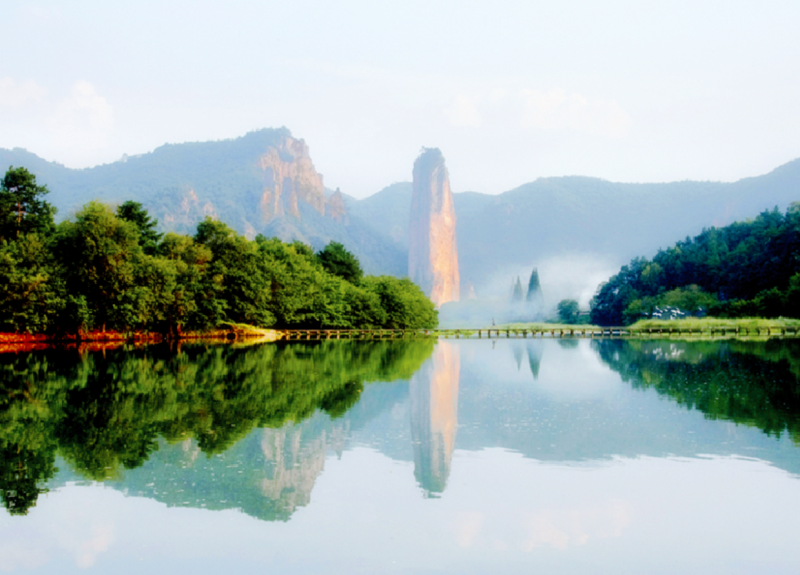
Dinghu Peak is the landmark landscape of the Xiandu Scenic Area. It is a columnar Danxia peak rock, 170.8 meters high, with a base diameter of 60 meters and a top area of about 710 square meters. It is praised as "the finest peak under heaven" and "the finest bamboo shoot in China." At the top of the peak is a natural lake with an area of about 0.2 hectares. According to legend, it was the tripod lake used by the Yellow Emperor when refining pills, hence the name Dinghu Peak. At the foot of the peak is the Yellow Emperor Temple, and beside the peak is the Small Stone Bamboo Shoot (Child Peak), forming the "mother and child peaks" wonder. Tourists can take the cableway to the viewing platform halfway up the mountain (at an altitude of about 200 meters) to overlook the panorama, or follow the hiking trail directly to the top of the peak. The entire route has about 3,000 steps and takes 2.5 hours round trip.
Zhutan Mountain
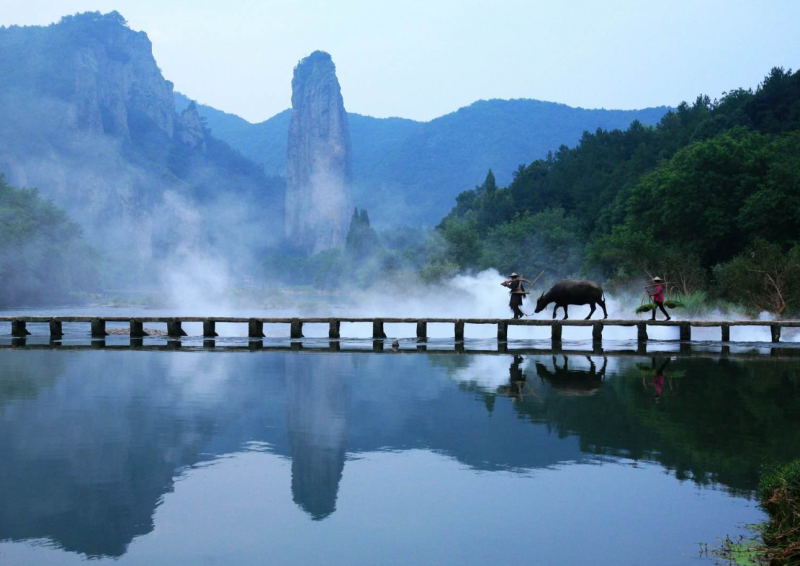
Zhutan Mountain is located on the southwest side of Dinghu Peak. It was named because Zhu Xi, a Neo-Confucian scholar of the Southern Song Dynasty, once lectured here. Its total area is about 0.5 square kilometers. The scenic area is characterized by "mountains encircling and water winding around." Its core landscape is the stone arch bridge (Xiandi) spanning the Lianxi River, 120 meters long and 3 meters wide. In the early morning, the reflection of Dinghu Peak falls into the water, forming a beautiful scene with the morning mist and villages. It is a must-visit place for photography enthusiasts, and the best shooting period is from 5:30 to 7:00 every morning.
Little Red Cliff
Little Red Cliff is also called "Baishui Mountain." It is named because the cliff wall is reddish brown and resembles the Red Cliff. It is about 600 meters long and about 60 meters high. On the cliff wall is an inscription of "Little Red Cliff" copied by Wang Jing, a calligrapher of the late Ming and early Qing dynasties, from Mi Fu. In the scenic area, there are landscapes such as Longgeng Road and Mother-in-Law Rock. Longgeng Road is a natural stone corridor on the cliff wall, about 100 meters long and about 1 meter wide. According to legend, it was plowed by a dragon. Along the way, pictographic rocks such as "Buddha's Hand Rock" and "Crocodile Stone" can be seen. The entire walking tour takes about 1 hour.
Niweng Cave
Niweng Cave is a karst cave group composed of three interconnected rock caves, with a total area of about 300 square meters. It is named because it is said that Ni Zi (Ni Kuan) lived in seclusion and refined pills here during the Warring States period. There are 34 cliff inscriptions from successive dynasties in the cave. Among them, the seal-script inscription "Niweng Cave" by Li Yangbing of the Tang Dynasty is the most famous, with characters 0.5 meters in diameter and vigorous brushwork. It is a national-level cultural relic. Outside the cave are peculiar rocks such as "Fairy Looking in the Mirror" and "Mouse Stealing Oil." The "Dufeng Academy" in the scenic area is a Ming Dynasty building covering about 800 square meters and was an important place for spreading Neo-Confucianism in southern Zhejiang.
Furong Gorge
Furong Gorge is named because the peaks and rocks on both banks resemble hibiscus. It is about 3,000 meters long, with the narrowest point only 20 meters, and the cliff walls on both sides are about 100 meters high, forming a "one-line sky" landscape. In the gorge, streams flow murmuringly, with an average water depth of 1.5 meters. Bamboo raft drifting is available (the entire route is about 1.5 kilometers, takes 40 minutes, and costs 50 yuan per person). In the gorge is the "Iron City" cliff inscription, inscribed by Geng Dingxiang of the Ming Dynasty. The characters are 3 meters in diameter and majestic, complementing the gorge landscape.
Yellow Emperor Temple
The Yellow Emperor Temple was first built in the Eastern Jin Dynasty. The existing building was rebuilt in 1998, covering 12,000 square meters. It consists of a gate tower, main hall, side halls, and others, adopting the architectural style of the Tang Dynasty, with vermilion walls and glazed tile roofs. A statue of the Yellow Emperor is enshrined in the hall, 5.9 meters high, and is the largest seated statue of the Yellow Emperor in the country. Grand ceremonies for worshipping the Yellow Emperor are held every year on Qingming Festival and Double Ninth Festival, attracting Chinese people from home and abroad to come and pay respects. It is an important carrier for inheriting Yellow Emperor culture. The temple also has a Yellow Emperor Culture Exhibition Hall, displaying the legends and achievements of the Yellow Emperor and the origins of Xiandu and Yellow Emperor culture.
Food
Jinyun Baked Cake
Jinyun Baked Cake is an intangible cultural heritage of Zhejiang. It is made from flour, pork, and preserved mustard greens and baked over charcoal fire. The baked cake shops in the Xiandu Scenic Area use traditional techniques. The dough undergoes 3 rounds of fermentation. The cake blank is about 15 centimeters in diameter and about 2 centimeters thick. The baking time is 8 minutes. After coming out of the oven, it is crispy outside and soft inside, salty and delicious. A single cake costs 6 yuan, and one stuffed with fried dough sticks ("baked cake with fried dough sticks") costs 8 yuan. It is the most representative local snack. The "Old Brand Baked Cake Shop" at the entrance of the scenic area has an average daily sales volume of more than 500.
Qiaorougeng
Qiaorougeng is a traditional Jinyun soup thick with starch. Pork lean meat is cut into thin slices, pounded with a wooden mallet until the meat becomes loose, and then cooked with sweet potato starch, mushrooms, bamboo shoots, and others. It has a smooth and tender texture and delicious soup. Farmhouses in the scenic area all provide it. Each serving costs 25 yuan and is usually eaten with baked cakes. It is a necessary dish at local banquets and is said to have evolved from the "marching ration" of the Yellow Emperor period.
Tushuang Noodles
Tushuang Noodles, also known as Jinyun Suomian, are made from local high-quality wheat flour through 18 manual processes. They are as fine as hair and do not become mushy after long cooking. In noodle shops in the Xiandu Scenic Area, they are usually served with chicken soup or bone soup as the base, paired with poached eggs and green vegetables. Each bowl costs 15 yuan. Its production technique has been included in the Lishui Municipal Intangible Cultural Heritage. Tourists can watch the production process in villages near the scenic area and experience the fun of handmade pulled noodles.
Xiandu Dried Bamboo Shoots
Xiandu Dried Bamboo Shoots are made from spring bamboo shoots of local high-mountain moso bamboo, made through steaming and sun-drying, with a water content of about 15%, and are rich in dietary fiber. They are sold in specialty stores in the scenic area and are divided into varieties such as tender bamboo shoot tips (80 yuan per kilogram) and dried bamboo shoot slices (50 yuan per kilogram). They are vacuum-packed, have a shelf life of 6 months, and are a favorite souvenir for tourists. When cooking, they need to be soaked for 2 hours in advance and can be stir-fried with meat or stewed in soup, with a unique flavor.
Tickets:
Tickets are 110 yuan per person (including sightseeing bus).
You can search for the official public account "Jinyun Xiandu Scenic Area" on WeChat to obtain the latest updates or buy tickets online.
Opening Hours:
Open all year round. The opening hours of each attraction are as follows: April 1-October 31 is 7:30-17:30 (last entry at 17:00); November 1-next March 31 is 8:00-17:00 (last entry at 16:30). The opening hours of the Yellow Emperor Temple are 8:00-17:00. During sacrificial activities, there may be temporary adjustments, so please check in advance.
Tour Routes:
One-day tour route: Arrive at Dinghu Peak Scenic Area at 8:00 a.m., visit the Yellow Emperor Temple and climb Dinghu Peak (about 3 hours); at 11:30 dine at a farmhouse near the scenic area and taste Jinyun baked cakes and Qiaorougeng; at 13:30 go to Zhutan Mountain to photograph the reflection of Dinghu Peak (about 1 hour), then visit Little Red Cliff (1.5 hours) and Niweng Cave (1 hour), and end the trip at 17:00. The total transportation time is about 30 minutes, and walking is about 5 kilometers.
Two-day tour route: On the first day, visit Dinghu Peak and the Yellow Emperor Temple in the morning, and in the afternoon go to Furong Gorge for rafting and explore the Iron City cliff inscriptions; on the second day, photograph the sunrise at Zhutan Mountain in the early morning, then visit Niweng Cave and Little Red Cliff, and in the afternoon visit the Jinyun Baked Cake Museum (about 5 kilometers from the scenic area), experience handmade baked cake making, and return at 16:00. This route takes into account both natural landscapes and cultural experiences, with a relaxed itinerary.
Transportation:
High-speed rail: Take the high-speed rail to Jinyun West Station, then transfer to the Xiandu tourist special line (K203) after leaving the station. It runs every 30 minutes from 7:00 to 18:00, takes 30 minutes, costs 5 yuan, and goes directly to the entrance of Dinghu Peak Scenic Area.
Bus: Within Jinyun County, take bus No. 2 or No. 6 to the Xiandu Tourist Center Station. The ride takes 20 minutes, the fare is 2 yuan, and the departure interval is 15 minutes; from the tourist center to each attraction, visitors can take the scenic area sightseeing bus. The through ticket is 20 yuan per person and is valid on the same day.
Self-driving: Departing from Hangzhou, take the Hangjinqu Expressway and Changshen Expressway, exit at Jinyun, and drive northeast along Provincial Highway 42 for about 10 kilometers to Dinghu Peak Scenic Area. The entire journey takes about 2.5 hours. The scenic area parking lot charges 5 yuan per hour, with a maximum capacity of 500 vehicles. In peak season, it is recommended to arrive before 9:00.
Must-Visit Attractions:
Dinghu Peak: A 170.8-meter-high columnar Danxia peak rock and the landmark landscape of Xiandu. You can climb the peak to overlook the scenery or take the cableway for sightseeing, and experience the magnificence of the "finest peak under heaven."
Zhutan Mountain: Famous for the reflection of Dinghu Peak and morning mist scenery. It is a paradise for photography enthusiasts, and the best shooting period is from 5:30 to 7:00 every morning.
Yellow Emperor Temple: A Tang Dynasty-style building covering 12,000 square meters and one of the largest places for worshipping the Yellow Emperor in the country. Visitors can participate in sacrificial ceremonies and learn about Yellow Emperor culture.
Furong Gorge: A 3,000-meter-long gorge landscape, with the narrowest point only 20 meters. Taking a bamboo raft drift allows visitors to experience the "one-line sky" wonder and admire the "Iron City" cliff inscription.
Travel Suggestions:
The climbing steps of Dinghu Peak are relatively steep. It is recommended to wear slip-resistant sports shoes, carry drinking water, and take sun protection measures when climbing in summer. The wind at the top is strong, so a thin jacket can be prepared.
The morning mist reflection at Zhutan Mountain is an internet-famous landscape. It is recommended to stay in a homestay near the scenic area (average price about 150 yuan per night) to facilitate early morning photography and avoid missing the best time.
Every year on the third day of the third lunar month (the birthday of the Yellow Emperor) and the ninth day of the ninth lunar month (Double Ninth Festival), the Yellow Emperor Temple holds large-scale sacrificial activities. It is recommended to visit at these times to experience the traditional cultural atmosphere.
Dining prices in the scenic area are slightly higher than in the county seat. You can go to Xiandu Customs Town, 3 kilometers from the scenic area, for more choices, with an average consumption of about 40 yuan per person.
Precautions:
Some sections of the Dinghu Peak climbing trail are narrow. In peak season, travel at off-peak times to avoid the peak period from 10:00 to 14:00, and pay attention to yielding when going up and down the mountain.
The Xiandi at Zhutan Mountain is a popular photography location. When shooting, please protect the environment. It is forbidden to trample on lawns or pick flowers and trees. The scenic area has a dedicated shooting platform.
Cliff inscriptions are precious cultural relics. Touching or carving on them is prohibited. The area of Li Yangbing's Tang Dynasty inscription in Niweng Cave is monitored, and violators will face fines (200-2,000 yuan).
When rafting in Furong Gorge, life jackets must be worn. Children must be accompanied by adults. The best time for rafting in summer is from 10:00 to 15:00. Avoid afternoon thunderstorm weather.
Open flames are strictly prohibited in the scenic area. Smoking must be done in designated areas. Smoking is completely prohibited in ancient building complexes such as the Yellow Emperor Temple. Violators will be dealt with according to fire protection laws and regulations.