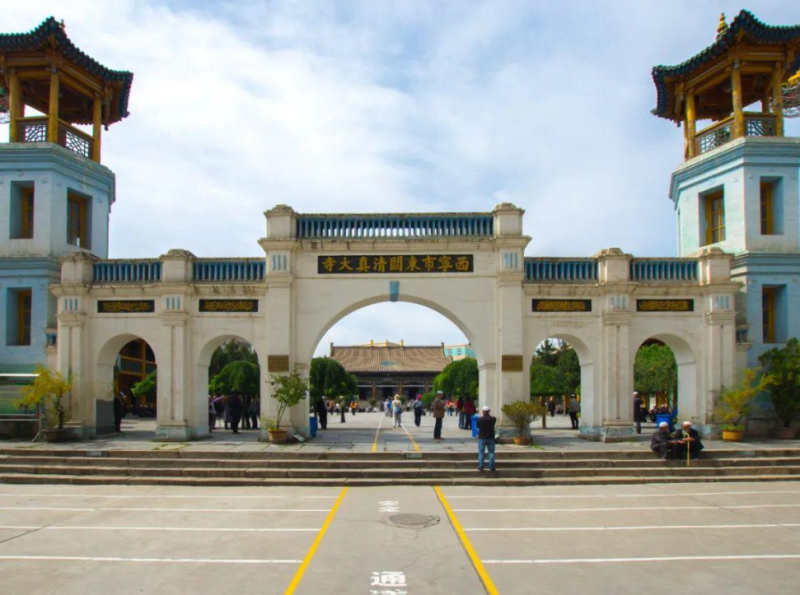
Dongguan Great Mosque, commonly known as the "Camel Mosque," is located at No. 31 Dongguan Street, Chengdong District, Xining City, Qinghai Province. Covering an area of 21,951 square meters, it was first built in the 20th year of the Hongwu reign of the Ming Dynasty (1380). It is one of the five major Friday mosques in China.
The mosque features a layout of one entrance leading to two courtyards. Its main structures consist of the Front Gate (Third Gate), the Fifth Gate, the Minaret, the North and South Wing Buildings, and the Great Prayer Hall. During its construction, the mosque received assistance from Tibetan and Tu compatriots from Guanghui Temple and Youning Temple, as well as donations from Han brothers. Notably, the gilded treasure vases (prayer wheels) gifted by the Labrang Monastery and Kumbum Monastery of Tibetan Buddhism were installed on the roof ridge of the Great Prayer Hall and the top of the Minaret. Additionally, the relief inscription "Xining Dongguan Great Mosque," calligraphed by Mr. Yu Youren, was placed above the main gate. These elements serve as exemplary models of cultural fusion, reflecting the historical fact of unity, mutual assistance, and harmonious coexistence among the Hui, Han, Tibetan, and Tu ethnic groups in the Hehuang region.
On March 5, 2013, Dongguan Great Mosque was announced by the State Council of the People's Republic of China as a Major Historical and Cultural Site Protected at the National Level (the seventh batch).