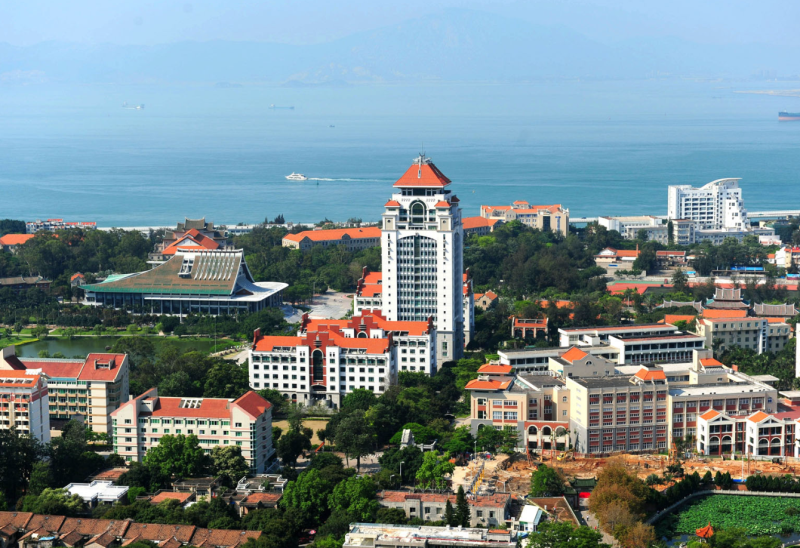
Xiamen University (XMU), founded in 1921 by the renowned patriotic overseas Chinese leader Mr. Tan Kah Kee (Chen Jiageng), with its main campus located in Siming District, Xiamen, Fujian Province, is a comprehensive research-oriented key national university directly under the Ministry of Education of the People's Republic of China. It is a university directly administered by the central government, a key university in the national "211 Project" and "985 Project", a leading university of the national "2011 Plan", and a "Double First-Class" university. It is also the first university founded by overseas Chinese in the history of modern Chinese education, and one of the earliest Chinese universities to enroll graduate students.
Historical Development: Xiamen University was officially established in 1921. In March 1928, it was registered as a private university with government approval. From 1929 to 1933, when the school could no longer sustain itself financially, Chen Jiageng unconditionally donated it to the government. In July 1937, the university was nationalized. In September of the same year, due to the war, it relocated to Changting to continue its operations. In the 1980s, the university successively obtained authorization for master's and doctoral degree programs. In 1997, it was included in the national "211 Project" key construction program, and the following year it was included in the "985 Project".
Educational Conditions: As of December 2025, the university covers an area of more than 9,700 mu (about 647 hectares), with 2.42 million square meters of campus buildings. It has over 48,000 enrolled students and nearly 3,000 full-time faculty members, including 14 academicians of the Chinese Academy of Sciences and the Chinese Academy of Engineering.
Academic Research: As of December 2025, the university's disciplinary system covers 12 disciplinary categories, with 6 disciplines including chemistry selected for the second round of national "Double First-Class" construction. Five disciplines at its Malaysia Branch have entered the top 1% of ESI globally. More than 300 research institutes have been established, including 6 national key laboratories.