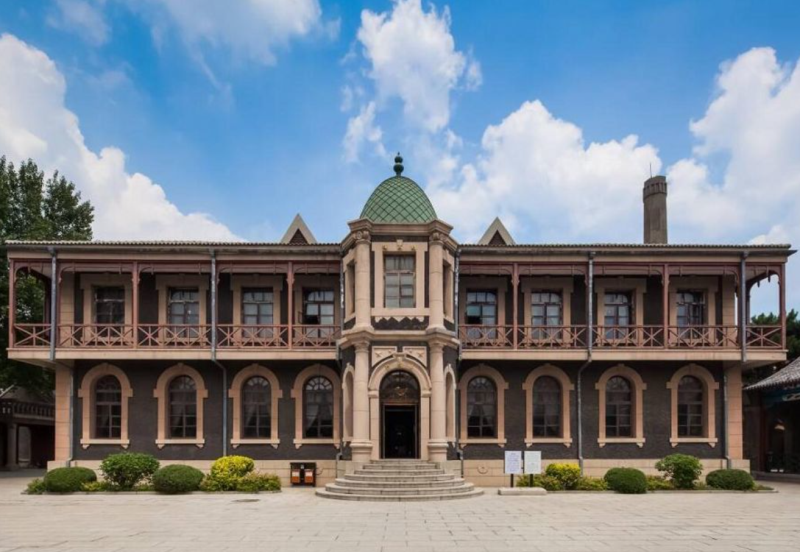
The Palace Museum of the Manchurian Regime is located at No. 5 Guangfu North Road, Kuancheng District, Changchun City, Jilin Province. Founded in 1962, it covers a total area of 250,500 square meters, with a building area of 137,000 square meters. Built on the site of the former palace complex of Puyi, it is a palace-ruins-type museum and a National First-Class Museum.
The museum's predecessor was the Jilin-Heilongjiang Salt Administration Office, which managed salt affairs in Jilin and Heilongjiang provinces during the Republic of China period. The museum was established in 1962; conservation and restoration work on the former site of the Puppet Manchukuo Imperial Palace began in 1982, and in February 2001 it was renamed the Palace Museum of the Manchurian Regime. It now features 50 original-state displays of the puppet Manchukuo court, including the Jixi Building, the Qinmin Building and Tongde Hall, along with 2 large-scale permanent exhibitions, 3 thematic exhibitions, 33 temporary exhibitions, 17 domestic touring exhibitions and 11 overseas exhibitions. Its collections include a large number of puppet Manchukuo court relics, modern and contemporary Japanese and Northeast China artifacts, folk items, and artistic masterpieces such as representative modern calligraphy and painting, sculpture, and works by intangible cultural heritage inheritors.
The Puppet Manchukuo Imperial Palace was a product of Japan's invasion of China. With its multiple layers of meaning and unique value, it truthfully reflects the death-struggle of the last emperor of China's feudal society, and bears witness to the bloodiness and brutality of Japan's invasion of Northeast China and its colonial rule, making it one of the most representative cautionary memorial sites of modern Chinese colonial culture. On August 15, 2026, at the event commemorating the 81st anniversary of the liberation of Northeast China, the Changchun Post Office Customs donated to the museum photo albums published during the Japanese invasion period that had been used to beautify the war of aggression.
Since 2007, the museum has been named an Advanced Collective of the National Cultural Relics System, a National AAAAA-Level Tourist Attraction, a National Demonstration Base for Patriotic Education (fourth batch), and a National Key Cultural Relics Protection Unit; it was also included in the first list of National Commemorative Facilities and Sites of the War of Resistance, and in the list of National Bases for Primary and Secondary School Research and Study Practice. As of the end of 2022, the museum held 56,346 items/sets of collections, including 11,128 items/sets of precious cultural relics, with an annual total of 267,734 visitors.