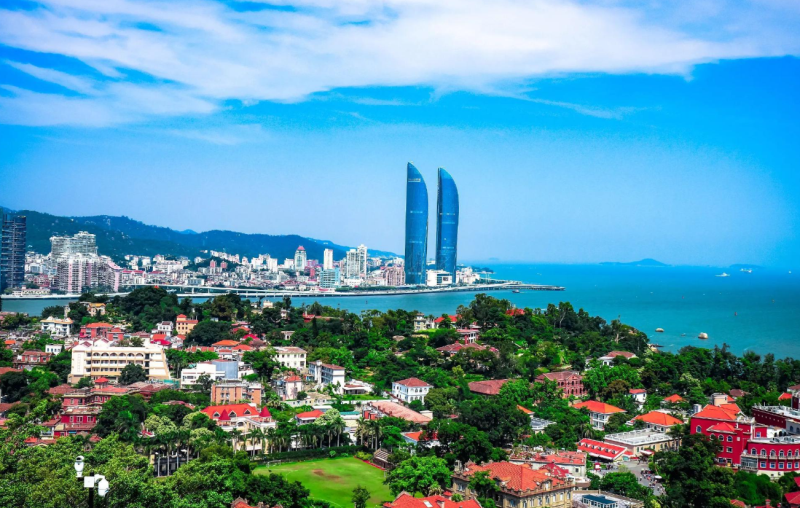
Gulangyu was originally named "Yuanshazhou" (Round Sand Islet) and also known as "Yuanzhouzai". During the Southern Song Dynasty, it was named "Wulongyu" (Five Dragon Islet), and it has been called "Gulangyu" since the Ming Dynasty. Located in the southwestern corner of Xiamen, Fujian Province, it faces Xiamen Island across the sea, covering an area of about 1.88 square kilometers with an elevation of 35–100 meters. It is known as the "Garden on the Sea".
The terrain of Gulangyu is high in the southwest and low in the northeast. The island is mostly mountainous, featuring natural landscapes such as sea reefs and rocky cliffs. Its coastline is winding and曲折, surrounded by the sea on all sides. It has a subtropical maritime monsoon climate, warm and humid all year round, with no severe cold in winter and no extreme heat in summer. The main attractions include Sunlight Rock, Shuzhuang Garden, and Haoyue Park.
Human activity on Gulangyu dates back to the Neolithic Age. Permanent settlement began in the Song Dynasty, and development took place during the Ming Dynasty. In 1573, the island's earliest stone inscription, "Gulang Dongtian" (Gulang Cave Heaven), appeared on Sunlight Rock. In 1650, Zheng Chenggong (Koxinga) drilled his naval forces on Sunlight Rock, leaving behind sites such as the "Water Drill Platform". In 1842, Britain, the United States, and Spain successively established consulates on the island. In 1945, after Japan's unconditional surrender, Gulangyu, which had been exclusively occupied by Japan, returned to the people of Xiamen. During the Kuomintang rule, a district was established on Gulangyu. After the founding of the People's Republic of China, it continued to be called Gulangyu District. In 2003, Xiamen's Gulangyu District was abolished and the Gulangyu Subdistrict Office was established. In 2014, the "Island-wide Museum" plan was implemented, incorporating key historical buildings into a public, wall-less ecological museum system, and cultural relic restoration design plans were carried out.
Gulangyu integrates history, culture, and natural scenery. It preserves over a thousand buildings of various styles and maintains its musical traditions. It has built China's first and world-class Piano Museum and China's only and world's largest Organ Museum, earning the reputations of "Piano Island" and "Hometown of Music". Gulangyu has successively been honored as a National 5A Tourist Attraction and a National Key Cultural Relic Protection Unit. On July 8, 2017, "Gulangyu: An International Historic Community" was inscribed on the World Heritage List.