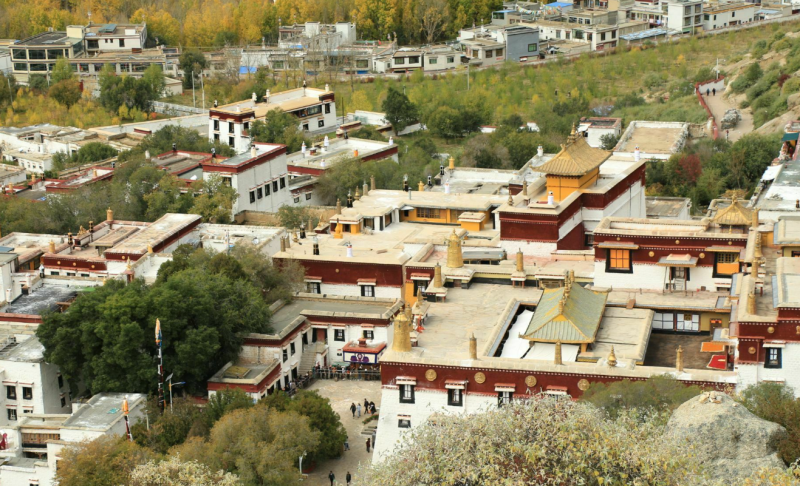
Sera Monastery, fully known as Sera Thegchen Ling (Sera Mahayana Monastery), is located at No. 1 Sera Road, Chengguan District, Lhasa, Tibet Autonomous Region. As a renowned monastery of the Gelug school of Tibetan Buddhism, it is listed as one of the "Three Great Monasteries of Lhasa" alongside Ganden and Drepung Monasteries, and is also one of the six major monasteries of the Gelug school.
The monastery was built in 1419 (the 17th year of the Yongle Reign of the Ming Dynasty) by Jamchen Choje Shakya Yeshe, a disciple of Tsongkhapa, under his master's instruction. Shakya Yeshe visited the Ming capital twice and was received with great courtesy by Emperor Yongle and Emperor Xuande, receiving gifts of Buddhist scriptures, statues, and ritual implements. During the Qing Dynasty, the monastery developed its layout consisting of the Coqen Hall, three major Dratsangs (colleges), and 33 Khamsens (residential units), with a monastic population reaching 5,500 at its peak.
Built against the mountains, the monastery centers on the Coqen Hall, surrounded by the three major Dratsangs—Jey Dratsang, Mey Dratsang, and Ngagpa Dratsang—as well as the 33 Khamsens. It covers an area of approximately 115,000 square meters (specifically 114,964 square meters). The four-story Coqen Hall comprises a front square (approx. 2,000 sqm), a Great Sutra Hall (nearly 2,000 sqm), and five Buddha halls. To the north of the temple lies the debating courtyard, where monks engage in daily afternoon debates. The Jey Dratsang houses bronze cymbals inscribed with "Made in the Xuande Reign of the Great Ming with added gold and silver," while the Ming Dynasty statues, murals, and thangkas inside the Coqen Hall blend Tibetan and Han artistic styles. These artifacts serve as physical testimony to the inheritance of Gelug doctrine. Furthermore, as a significant Gelug monastery, it stands as crucial physical evidence for researching the development of Tibetan Buddhism since the 15th century, the interactions between the central government and the Tibet region during the Ming Dynasty, and the cultural exchange between the Han and Tibetan peoples.
On February 23, 1982, Sera Monastery was announced by the State Council of the People's Republic of China as one of the second batch of Major Historical and Cultural Sites Protected at the National Level.