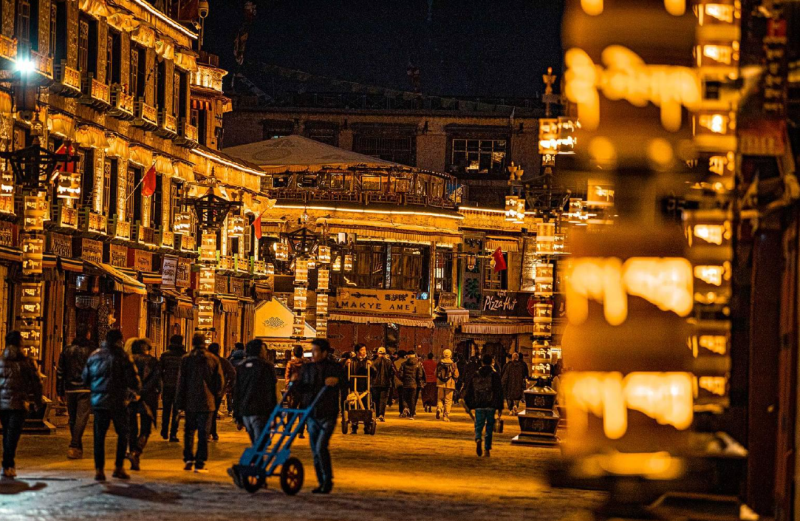
Barkhor Street, also known as Bajiao Street, is located in Chengguan District, Lhasa, in the Tibet Autonomous Region. As a national 5A-level tourist attraction, it encircles the Jokhang Temple and is known in Tibetan as the "Middle Pilgrim Circuit."
Originally built during the reign of Songtsen Gampo in the 7th century as a pilgrimage path around the Jokhang Temple, the street has evolved into a polygonal ring comprising East, West, South, and North Barkhor Streets. The circuit spans over 1,000 meters, encompassing 35 alleys and 199 residential courtyards across four neighborhood committees. In 2009, it was selected as one of the first "Famous Historical and Cultural Streets of China," and in November 2023, it was included in the third batch of National Tourism and Leisure Blocks.
After the 15th century, with the rising religious status of the Jokhang Temple, the area developed into a comprehensive district blending pilgrimage, commerce, and residential life. It preserves the traditional character and living style of the ancient city remarkably well. Historical sites such as the Qiongye Phodrang (Songtsen Gampo's Palace) and the Tang-Tibet Alliance Monument remain intact, alongside traditional hand-laid stone pavements and Tibetan-style architecture.
Since 2012, Lhasa has launched an Old Town conservation project, upgrading water supply, drainage, and power lines while protecting the ancient city's unique character. Advanced technologies like 3D scanning have been used to restore historic buildings and courtyards. Today, the street seamlessly blends traditional handicraft shops with modern businesses like cafes and cultural creative stores, creating a new model of integrated cultural tourism development.