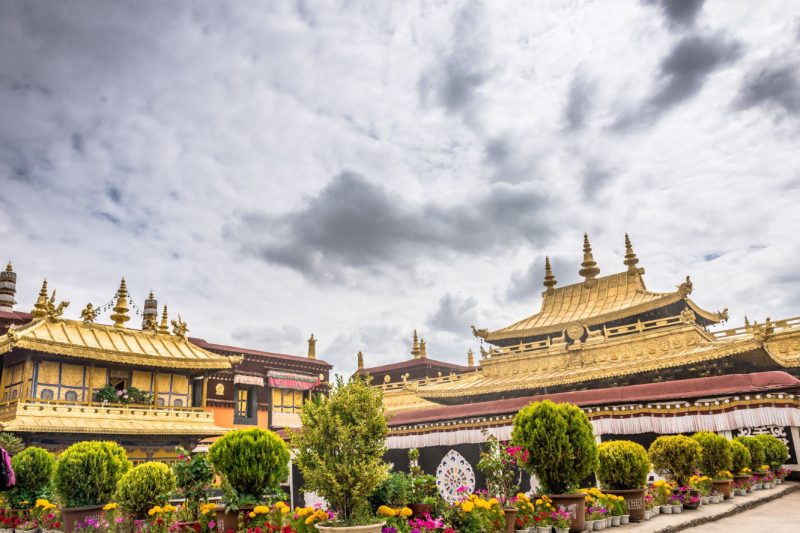
Jokhang Temple, also known as "Zulakhang" or "Jokhang" (meaning "House of the Buddha" in Tibetan), is a Tibetan Buddhist temple located on Barkhor Street in the old city of Lhasa, Tibet Autonomous Region, China.
Construction began in the 21st year of the Zhenguan reign of the Tang Dynasty (647 AD), with some accounts suggesting it was established following Princess Wencheng's entry into Tibet (641–647 AD). It is certain that the temple was built in the mid-7th century by Songtsen Gampo for Princess Wencheng (though some say it was to enshrine the Mingjiu Duoji statue). Through expansions during the Yuan, Ming, and Qing dynasties, the temple gradually evolved into a grand architectural complex, covering an area of approximately 13,000 square meters (some sources say 25,100 square meters) with a floor area of over 25,100 square meters.
With a history spanning more than 1,300 years, Jokhang Temple holds a supreme status in Tibetan Buddhism. It is the most magnificent surviving architecture from the Tubo period in Tibet and the earliest timber-framed structure in the region, pioneering the flatland layout style for Tibetan temples.
The circuit around the central shrine of Shakyamuni inside the temple is called the "Nangkhor"; the circuit around the outer walls is the "Barkhor"; and the streets radiating outward from the temple are known as "Barkhor Street" (or Octagonal Street). The larger circuit encompassing Jokhang Temple, the Potala Palace, Chakpori Mountain, and Ramoche Temple is called the "Lingkhor." These three concentric rings form the pilgrimage routes for the circumambulation rituals performed by Tibetan devotees.
Blending architectural styles from Tibet, the Tang Dynasty, Nepal, and India, the temple stands as an eternal model of Tibetan religious architecture. Incense smoke curls around the temple entrance day and night, while the deep impressions left by pilgrims prostrating on the bluestone floor bear witness to their devotion. The eternal glow of thousands of butter lamps records the passage of time and the footsteps of pilgrims.
On March 4, 1961, Jokhang Temple was designated as one of the first batch of Major Historical and Cultural Sites Protected at the National Level by the State Council of the People's Republic of China. In November 2000, UNESCO inscribed Jokhang Temple as an extension to the Potala Palace on the World Heritage List, recognizing it as a World Cultural Heritage site.