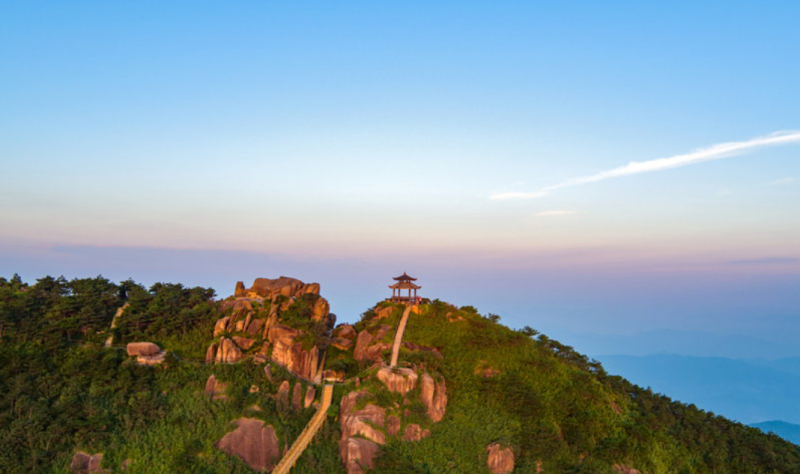
Jiuxian Mountain is located in Dehua County, Fujian Province, standing at the junction of Chishui, Shangyong, and Daming townships in the northwest of Dehua—China's ancient "Porcelain Capital." It sits 22 kilometers from the county seat and 140 kilometers from Quanzhou, with an altitude of 1,658 meters.
According to county records, the mountain owes its name to a legend in which nine Taoist priests cultivated the Dao here and eventually ascended to immortality. The mountain features towering crags, scattered grotesque rocks, and competing peaks. Notable scenic spots include Yong'an Rock, Dragon Pool, Lingjiu Rock, and the Immortals' Chessboard. Originally a Taoist site, it was later taken over by Buddhism. The Lingjiu Rock Temple was built during the Tang Dynasty and houses the earliest known stone carving of Maitreya (the Laughing Buddha) in southern Fujian.
After the founding of the People's Republic of China, the area was designated as a tourist zone. It is home to Fujian's only high-altitude meteorological station, and a highway leads directly to the summit.