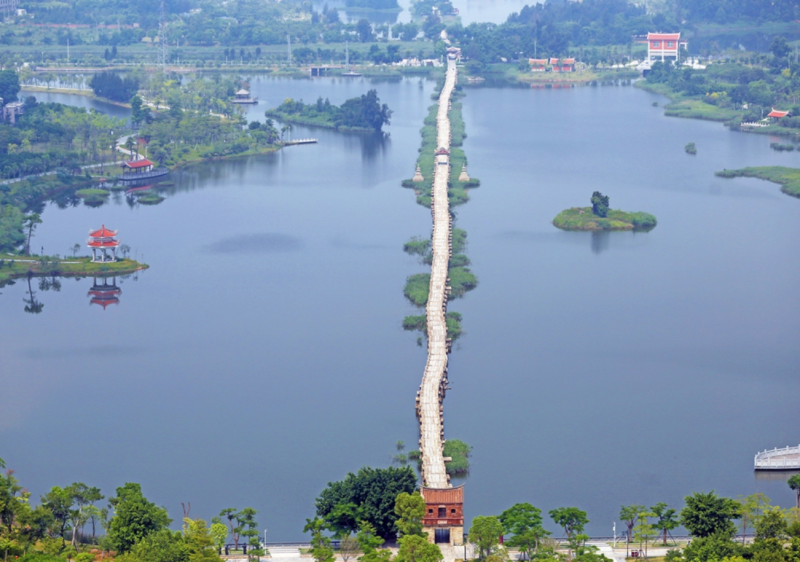
Anping Bridge, formerly known as Wuli Bridge, Xi Bridge, or Anhai Bridge, connects Jinjiang City and Nan'an City in Quanzhou, Fujian Province, China. It stands as the longest beam-type stone bridge of the medieval world and remains the longest existing harbor stone bridge in China. As a masterpiece of ancient bridge architecture, it enjoys the prestigious reputation: "No bridge in the world is longer than this one."
Construction of Anping Bridge began in the 8th year of the Shaoxing reign of the Southern Song Dynasty (1138 AD) and was completed and opened to traffic in the 22nd year of Shaoxing (1152 AD). It underwent several renovations during the Ming and Qing dynasties. In January 1928 (the 17th year of the Republic of China), the bridge was rebuilt through enthusiastic public fundraising after suffering damage. A comprehensive restoration based on its original appearance commenced in February 1981 and was completed in May 1985. Later, emergency reinforcement works began in late 2007 and were officially accepted and put into use on July 24, 2009.
Located on the estuary at the junction of Anhai Town (Jinjiang) and Shuitou Town (Nan'an), Anping Bridge commands a strategic position for water and land transportation between the two regions. Geographically located between 24°30'–25°56' N and 117°25'–119°05' E, the bridge starts from Xing'an Road in the east, spans across Anhai Bay, and ends at Shuitou Street in the west, with a total length of 2,255 meters.
On July 25, 2021, "Quanzhou: Emporium of the World in Song-Yuan China" was inscribed on the UNESCO World Heritage List during the 44th session of the World Heritage Committee. Becoming China's 56th World Heritage site, the designation includes Anping Bridge as one of the 22 representative historic monuments.
In August 2025, after enduring over 800 years of wind and rain, parts of the bridge showed signs of deterioration, such as peeling and cracking, prompting local authorities to officially launch a new conservation project.