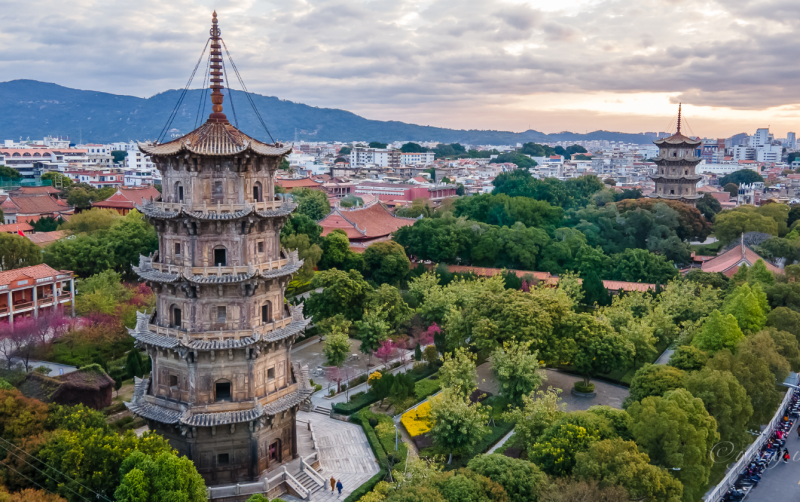
Located at No. 176 West Street, Licheng District, Quanzhou, Fujian Province, Kaiyuan Temple is a significant cultural heritage site on the southeastern coast of China and one of the largest Buddhist temples in Fujian Province, covering an area of 78,000 square meters.
The temple was originally built in the second year of the Chuigong era of the Tang Dynasty (686 AD) under the name "Lotus Temple." In 738 AD, Emperor Xuanzong of Tang ordered the construction of a Kaiyuan Temple in every prefecture across the empire, leading to its renaming as "Kaiyuan Temple." After a fire in 897 AD, it underwent renovation between 858 and 904 AD. By the Yuan Dynasty, the temple had gathered various Buddhist sects, creating a grand spectacle of "a thousand monks living together." However, during the chaos at the end of the Yuan Dynasty (around 1357), the temple suffered damage once again. From 1594 onwards, and continuing after 1981, major structures such as the main hall, rear hall, and the East and West Pagodas were successively renovated. The existing main hall was rebuilt by Zheng Zhilong during the Chongzhen reign of the Ming Dynasty (1628–1644).
The central axis consists of the Ziyun Screen, the Hall of Heavenly Kings, the Worship Courtyard, the Mahavira Hall (also known as the Hall of a Hundred Columns), the Sweet Dew Ordination Platform, and the Scripture Library. The subsidiary axis includes the East Corridor, the Benefactor Shrine, the "Small Kaiyuan Temple" (Zhunti Chanlin), the West Corridor, the Merit Hall, the Zunsheng Yuan (Master Hong Yi Memorial Hall), and the Shuilu Temple. Together with the Zhenguo and Renshou stone pagodas, these two axes form the largest Buddhist architectural complex in Fujian. Since 2000, a nursing home has been added, and the Zhunti Temple has been converted into the Quanzhou Buddhist Museum and the Master Hong Yi Memorial Hall.
In 1982, Kaiyuan Temple was listed as a Major Historical and Cultural Site Protected at the National Level. On January 5, 2001, it was designated as one of the first batch of National AAAA-level Tourist Attractions. On July 25, 2021, it was inscribed on the UNESCO World Heritage List as one of the 22 representative historic sites. During the 7-day National Day holiday in October 2024, the temple welcomed 375,800 visitors, marking a 61.5% year-on-year increase.