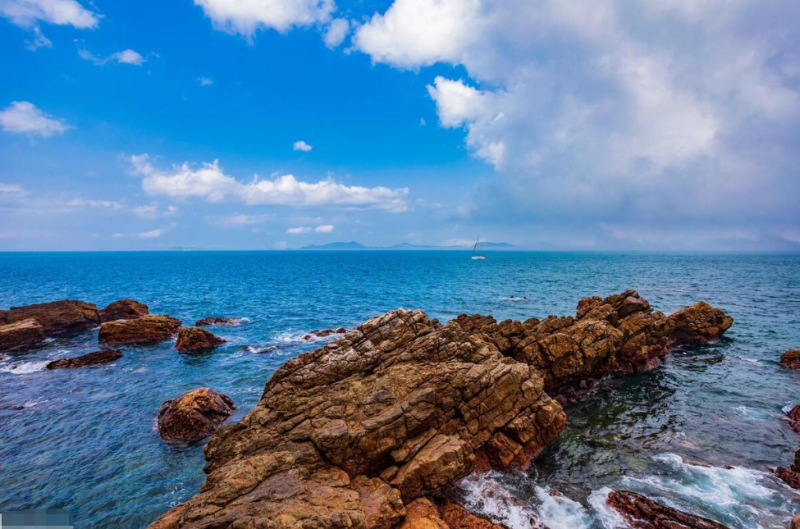
Yangmeikeng, also known as the Northern Nao Coast Scenic Area, is located beside the Yangmeikeng Seaside Bathhouse on Xindong Road in the Dapeng New District of Shenzhen, Guangdong Province. It leans against Qiniang Mountain to the south and overlooks Daya Bay to the north. The geological stratification here is relatively simple, consisting mainly of the Chunwan Formation from the Devonian system and the Nanshan Formation from the Jurassic system. Yangmeikeng features a relatively complete combination of coastal erosion landforms, including sea cliffs, sea caves, and marine terraces.
The soil types are primarily lateritic red soil, red soil, and yellow soil. These are acidic soils with a heavy texture and low organic matter content. Lateritic red soil has the largest distribution area, covering about 60% of the entire peninsula. The region enjoys a subtropical monsoon climate characterized by mild temperatures, abundant sunshine, plentiful rainfall, and humid air. The forest coverage rate reaches as high as 87%, with vegetation types belonging to subtropical evergreen monsoon rainforests, along with significant distributions of subtropical evergreen broad-leaved forests.
Yangmeikeng refers to the coastal area between Daya Bay and Qiniang Mountain in the northern part of the Nao Peninsula. It has a total coastline length of 16.5 kilometers and covers an area of approximately 6.5 square kilometers. Formed by the convergence of two major streams—Zhengweikeng and Dakenghu—it is located within the Dongshan Community of Nao and serves as a key component of Shenzhen's eastern "Golden Coast." The coastline consists of sandy beaches, rocky beaches, and rocky shores, featuring high-quality beaches such as Judiaosha, Changshatou, and Luzui.
The Yangmeikeng area is home to 294 plant species, classified into 237 genera and 97 families. This includes 98 species of trees, 84 shrubs, 94 herbs, and 13 vines. The marine ecosystem supports 22 species of stony corals across 6 families and 14 genera. Specifically, the Favidae family accounts for 11 species (including 2 species of Favia, 2 of Favites, 2 of Platygyra, 2 of Goniastrea, 1 of Echinopora, and 1 of Paragoniastrea); the Poritidae family includes 7 species (4 species of Porites, 2 of Goniopora, and 1 of Alveopora); the Tubiporidae family is represented by 1 species of Tubipora; the Merulinidae family by 1 species of Acanthastrea; the Acroporidae family by 1 species of Acropora; and the Flabellidae family by 1 species of Flabellum.