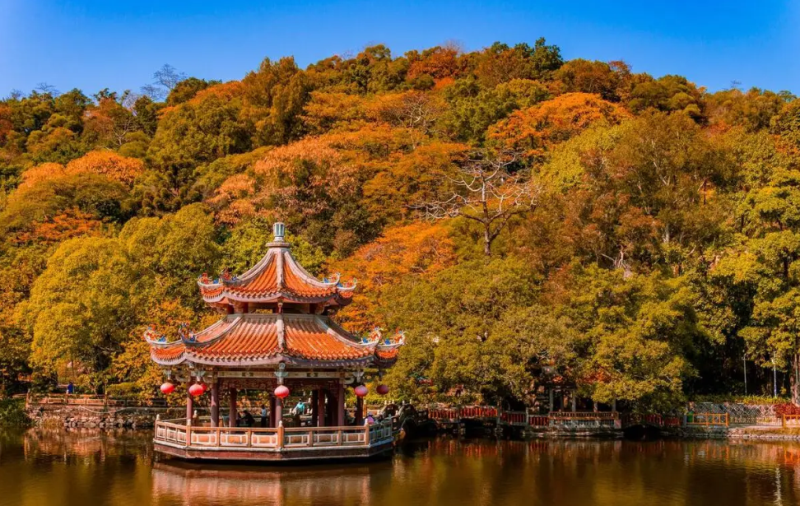
Located in the western suburbs of Chaozhou City, Guangdong Province, Chaozhou West Lake is a National AAA Tourist Attraction. It is recognized as one of the thirty-six major West Lakes in China and is the home of "West Lake Fishing Rafts," one of the Eight Views of Chaozhou. Originally a tributary of the Han River, the lake was formed in the Tang Dynasty after the construction of the North Embankment. During the Qianyuan era, it was designated as one of the 81 release ponds nationwide. Having survived war damage in the Yuan Dynasty, land reclamation for city walls in the Ming Dynasty, turmoil in the Qing Dynasty, and occupation by warlords in the Republic of China era, it follows an evolutionary trajectory described as: "Originating in the Tang, gaining fame in the Song, destroyed in the Yuan, flourishing in the Ming, and declining in the Qing."
The scenic area consists of Hulu Mountain (Gourd Mountain) and the lake itself. It features over 130 cliffside stone inscriptions on Hulu Mountain and the Hanbi Building, a provincial cultural relic protection unit. The latter served as the office for Zhou Enlai and other leaders of the Nanchang Uprising troops in 1927, a historical event known as the "Seven Days of Red in Chaozhou." Acting as a green watershed between the ancient and new urban districts, the scenic area serves as a vital link connecting the city's history with its modernity. Major attractions include the Living Person Cave, Shou'an Rock Inscriptions, the Lake Heart Pavilion, the Maiden Spring, Fengqi Building, and Jinghan Pavilion. Among them, the "West Lake Fishing Rafts" stand out as the iconic landscape, with rafts appearing and disappearing amidst the shimmering, misty, and ever-changing lake scenery.
Following a dredging project implemented in 2017, the water quality improved from inferior Grade V to Grade III, turning the lake into a "green pearl" showcasing the city's environmental image. In 2023, the Master Plan for the Chaozhou West Lake Provincial Scenic Area (2022-2035) was approved. The plan establishes a spatial pattern of "Mountain-Lake Symbiosis and Water-Green Integration," dividing the area into three major scenic zones: West Lake, Han Shrine, and Huiru. The core scenic area focuses on the protection of the water ecosystem and cultural relics.