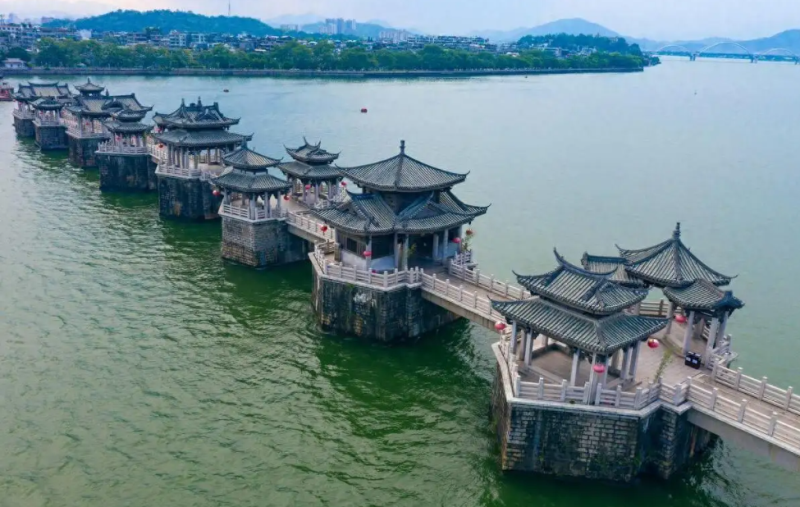
Guangji Bridge, officially known as Chaozhou Guangji Bridge, was historically called Kangji Bridge, Dinghou Bridge, and Jichuan Bridge. Commonly referred to as Xiangzi Bridge, it is recognized as one of the Four Ancient Bridges and one of the Four Famous Bridges of China. Praised by bridge expert Mao Yisheng as "the earliest open-and-close bridge in the world," it stands as a historical landmark of Chaozhou culture.
Located outside the east gate of Chaozhou's ancient city in Guangdong Province, the bridge spans the Han River, connecting the eastern and western banks. It uniquely integrates beam bridges, a pontoon bridge, and an arch bridge. Historically, it served as a crucial transportation link from Guangdong to Fujian and Zhejiang provinces. Today, it is one of the "Eight Views of Chaozhou," a Major Historical and Cultural Site Protected at the National Level, and a National AAAA Tourist Attraction.
Construction of Guangji Bridge began in the seventh year of the Qiandao era of the Southern Song Dynasty (1171 AD). By the second year of the Kaixi era under Emperor Ningzong (1206 AD), it had formed a basic structure combining beam and pontoon bridges. The iconic layout of "eighteen shuttle boats and twenty-four piers" was established in the eighth year of the Zhengde era of the Ming Dynasty (1513 AD). It underwent renovations in the second year of the Yongzheng era of the Qing Dynasty (1724 AD). By the pre-liberation era, the bridge had fallen into disrepair. In 1958, it was reinforced and repaired; the eighteen shuttle boats were removed and replaced with a three-span steel frame and two high-pile cap structures. A comprehensive restoration began in October 2003, adopting the Ming Dynasty style as the basis for restoration and repositioning the bridge for tourism and pedestrian use. The project was completed in 2007.
Guangji Bridge features a combined structure of floating and beam sections, consisting of stone beam bridges on the east and west ends and a pontoon bridge in the middle. The beam bridges are composed of piers, stone beams, and bridge pavilions. The bridge has a total length of 518 meters. The eastern beam bridge is 283.35 meters long, featuring 12 piers, one abutment, and 12 spans. The western beam bridge is 137.3 meters long, with 8 piers and 7 spans; its stone beams are 5 meters wide. The central pontoon bridge is 97.3 meters long and is formed by connecting eighteen wooden boats.