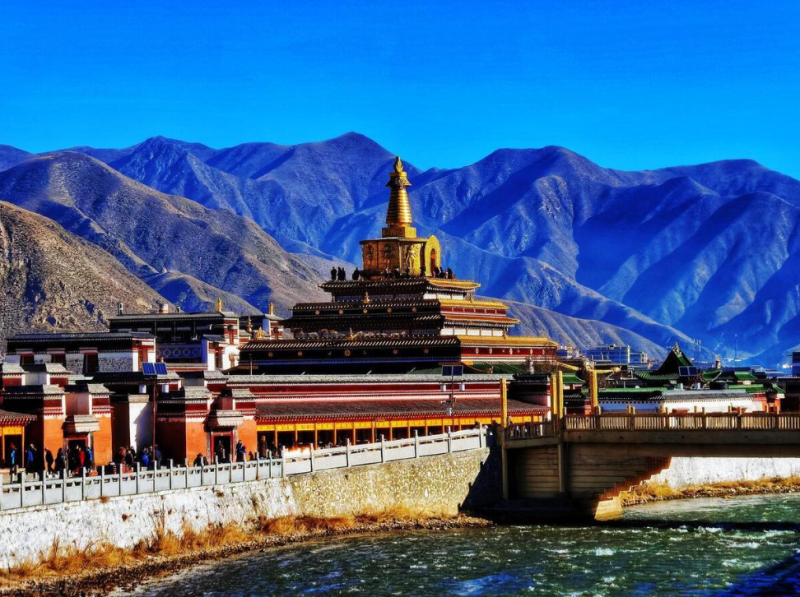
Labrang Monastery is located in Xiahe County, Gannan Tibetan Autonomous Prefecture, Gansu Province. Its full Tibetan name, "Gaden Shachub Darjay Tashi Khyil," translates to "The Monastery of Joyful Teaching and Practice with Auspicious Rightward Circumambulation." It is commonly referred to as Labrang Monastery (or Tashi Khyil). The name "Labrang" is a variation of the Tibetan word "Labrang," meaning "the residence of a living Buddha or great master." As one of the six great monasteries of the Gelug school of Tibetan Buddhism, it covers a total area of 866,000 square meters, with a construction area of over 400,000 square meters. It has been open to tourists since 1980.
Founded in 1709 under the direction of the first Jamyang Zhepa, the monastery was continuously expanded and perfected by successive Jamyang Zhepa masters and other great living buddhas. It has grown into a sacred sanctuary for Buddhist meditation, a comprehensive institution for the dissemination of knowledge, and the cultural and artistic center for the Tibetan people in the Amdo region. Hailed globally as the "World's Tibetan Academy," it has earned the reputation of being the "Second Tibet." At its peak, the monastery was home to over 4,000 monks.
The complex includes six scripture halls and 48 Buddha halls of various sizes. Based on their function, the buildings are categorized into five types: scripture halls, Buddha halls, living quarters (Nangqian), monks' dormitories, and others. Architecturally, they feature stone-and-wood or earth-and-wood structures, typically with stone exteriors and wooden interiors. Historically, it claimed to have 108 affiliated monasteries (though the actual number was far greater), serving as the political and religious center of the Gannan region. Labrang Monastery preserves the finest system of Tibetan Buddhist education in China. The oldest surviving hall, and the only one built during the time of the first Jamyang Zhepa, is the Lower Tantric College hall located beside the Great Sutra Hall.
In 1982, it was designated as a Major Historical and Cultural Site Protected at the National Level by the State Council of China. In 2018, it was included in the "Top 100 Magical Scenic Spots of Northwest China" list at the Northwest China Tourism Marketing Conference and Tourism Equipment Exhibition. On December 29, 2022, it was recognized as an "Advanced Collective in the National Religious Circle."