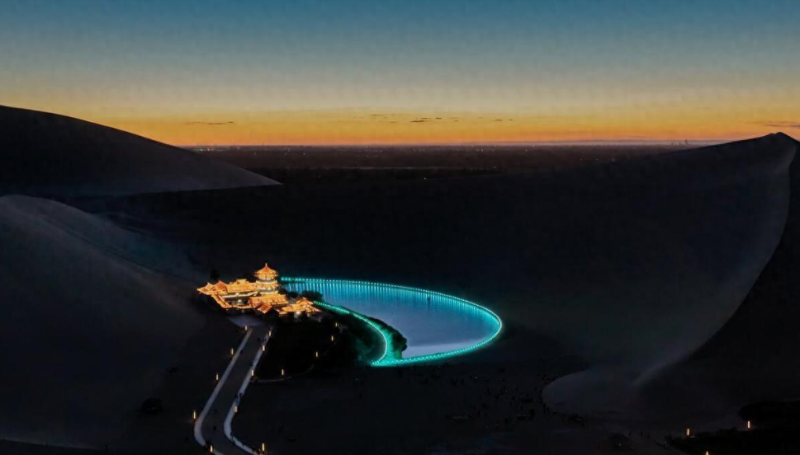
Mingsha Mountain and Crescent Moon Spring Scenic Area in Jiuquan, commonly referred to as Mingsha Mountain and Crescent Moon Spring Scenic Area, is situated 5 kilometers south of Dunhuang City, Jiuquan, Gansu Province. It covers a total area of 76.82 square kilometers, with the core scenic zone spanning 12.79 square kilometers. World-famous for its extraordinary desert landscape where springs and mountains coexist and sand and water thrive side by side, it is hailed as "one of the finest sights beyond the Great Wall". The scenic area has three entrances: the Middle Gate, East Gate and West Gate. The East Gate and West Gate were officially opened in 2024. As of June 2024, the number of ticketed visitors exceeded one million, and its online exposure surpassed 500 million views.
Dunhuang’s Mingsha Mountain and Crescent Moon Spring Scenic Area features a typical warm temperate arid climate. Stretching 40 kilometers from east to west and roughly 20 kilometers from north to south, Mingsha Mountain runs from the Mogao Grottoes in the east to the Danghe River Estuary in the west. Its main peak stands at an altitude of 1,715 meters. The mountain is formed by fine sand in five colours: red, yellow, green, black and white. Nestled amid Mingsha Mountain, Crescent Moon Spring gets its name from its shape resembling a new moon. The spring is home to the iron-backed fish and star-grass, a traditional Chinese medicinal herb. The scenic complex consists of six sections including Moon Spring Bay and Singing Sand Slope. Major attractions include Mingsha Mountain, Crescent Moon Spring, the First Spring Stele, Couple Willow and the ruins of the King of Medicine Temple.
It was designated a National Key Scenic Spot in 1994. In 2005, it won the title of "One of China’s Five Most Beautiful Deserts". In 2015, it was awarded the status of a National AAAAA-level Tourist Attraction and became part of the Dunhuang Global Geopark of China. It was included on the list of National Sports Tourism Demonstration Bases in 2021, and featured on the public notice list for the second batch of National Civilized Tourism Demonstration Units in 2023. The Ten-Thousand-Person Starry Sky Concert held here in 2024 won the Excellent Case Award at the Great Wall Awards. Thanks to seepage water regulation projects, the water area of Crescent Moon Spring reached 31.73 mu, the largest figure in more than 20 years. On June 5, 2026, a sudden sandstorm hit the scenic area, forcing many tourists riding camels to turn back halfway.