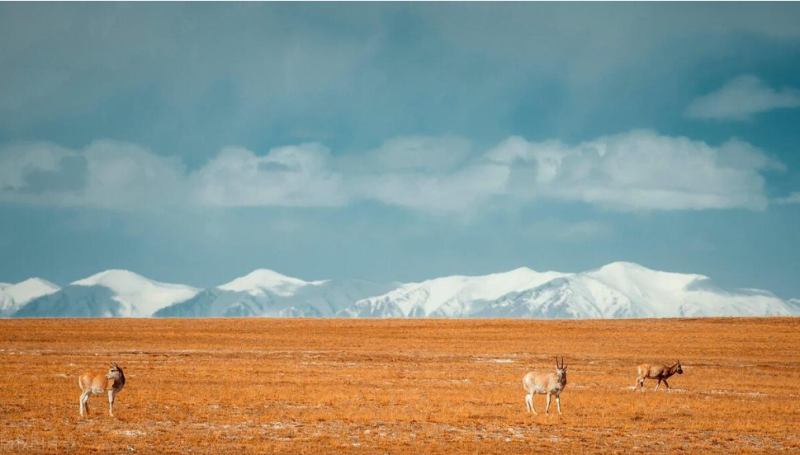
Qinghai Hoh Xil National Nature Reserve is located in the northwest of Yushu Tibetan Autonomous Prefecture, Qinghai Province, on the southern foot of the Kunlun Mountains and the northern headwaters of the Yangtze River. It borders the Xinjiang Uygur Autonomous Region, the Xizang Autonomous Region, Haixi Mongolian and Tibetan Autonomous Prefecture and Qumarlêb County of Yushu Prefecture. Geographically, it lies between 89°30′–95°05′ east longitude and 33°02′–36°30′ north latitude. It stretches about 280 kilometres from north to south and 200 to 400 kilometres from east to west, covering an area of 45,000 square kilometres. Its core zone is situated between 34°40′–35°50′N and 89°30′–92°30′E, with an area of approximately 25,500 square kilometres.
Qinghai Hoh Xil National Nature Reserve is established mainly to protect rare wild animals such as the Tibetan antelope, wild yak, kiang and Tibetan gazelle. Around 202 species of higher plants have been recorded here, belonging to 102 genera in 30 families. The flora is dominated by low herbs and cushion plants, with very few woody species, only a handful including *Myricaria prostrata* and *Ephedra gerardiana* var. *sikkimensis*. Among the more than 200 plant species, Qinghai-Tibet Plateau endemic species, as well as those distributed from the Qinghai-Tibet Plateau to the Central Asian alpine zone, the Western Himalayas and the Eastern Pamirs, form the dominant floristic components. The reserve also contains numerous mountain ranges, including sections of the Kunlun Mountains.
In November 2014, the work for Qinghai Hoh Xil to apply for World Natural Heritage status was launched. On 7 July 2017, at the 41st Session of the World Heritage Committee held in Kraków, Poland, Qinghai Hoh Xil was unanimously approved for inclusion in the World Heritage List, becoming China’s 51st World Heritage Site.