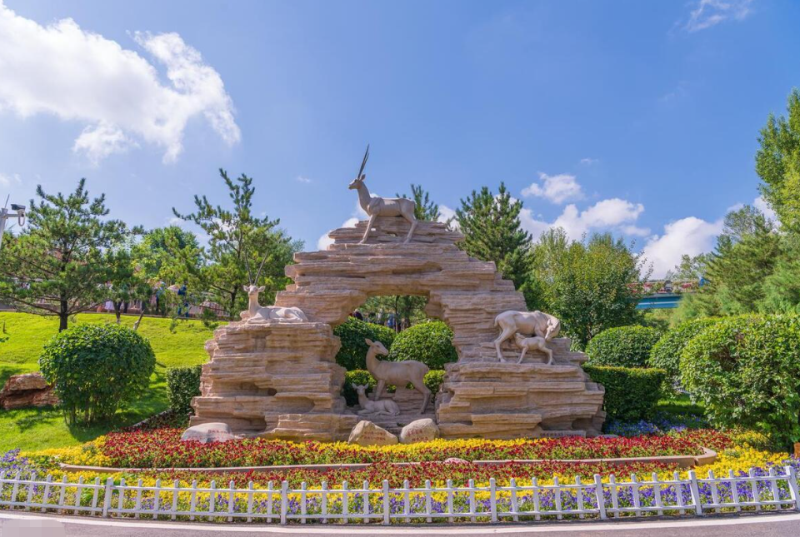
Xining Wildlife Zoo, also known as the Qinghai Wildlife Rescue and Breeding Center and Qinghai-Tibet Plateau Wildlife Zoo, is located in Chengxi District, Xining. It opened in May 2009 and covers an area of 1,500 mu. It is a national AAAA-level tourist attraction and a national science popularization education base. As the only large comprehensive wildlife zoo in Qinghai Province, it exhibits 1,162 animals of 105 species, including characteristic species of the Qinghai-Tibet Plateau such as snow leopards, black-necked cranes and Przewalski's gazelles, as well as exotic animals such as giraffes and hippopotamuses. Adopting a combined mode of free-range enclosures and indoor exhibits, it has 13 exhibition zones including a beast area, herbivore area and aviary.
The zoo undertakes wildlife rescue work across the province. In 2021, it established the country’s only long-term scientific research base for snow leopard breeding research on the Qinghai-Tibet Plateau. It has taken in and rescued more than 2,000 wild animals of 62 species in total. In 2022, it completed China’s first captive breeding research project for Himalayan griffons, and was awarded the titles of National Science Popularization Education Base and National Green Camp for Youth Nature Education. In 2025, the zoo successfully rescued the snow leopard cub "Ling Xiaozhe" and achieved breakthroughs in artificial breeding technology. By the end of that year, it kept 12 snow leopards, maintaining the largest captive snow leopard population in China. In August 2025, a stray cat strayed into the tiger enclosure. On September 26, the snow leopard "Naonao" escaped and was safely recaptured at 20:08 the same day. The zoo reopened to visitors on September 27, 2025. On October 3, the zoo confirmed that snow leopard "Naonao" was put on display for adaptive viewing in scheduled sessions. On December 2, the zoo’s new snow leopard enclosure was officially delivered. On January 3, 2026, the zoo rescued an elderly, weak snow leopard that had lost its hunting ability and could not forage on its own.