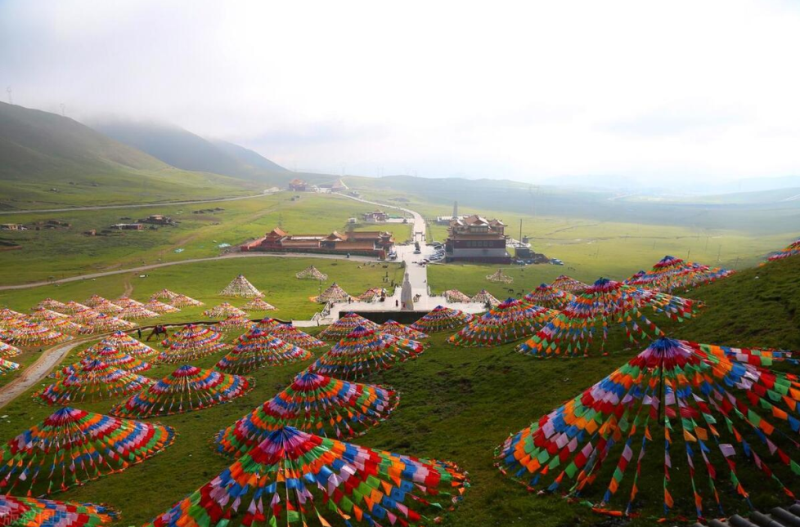
Riyue Mountain lies 40 kilometres southwest of Huangyuan County, Qinghai Province. A sub-range of the Qilian Mountains, it stretches 90 kilometres with an average elevation of 4,000 metres. Its main peak, Mount Alida Bay, rises to 4,877 metres, while the Riyue Mountain Pass crossed by the Qinghai–Tibet Highway sits at 3,520 metres above sea level.
It serves as a multi-fold natural geographical divide in China: between the monsoon and non-monsoon zones, exterior and interior drainage basins, the Loess Plateau and the Qinghai–Tibet Plateau, and agricultural and pastoral regions. The Huangshui Valley on its eastern flank receives 300–800 millimetres of annual precipitation, whereas the core of the Qaidam Basin to the west gets less than 15 millimetres. The eastern hillside is farmland, and the western side is grassland for nomadic herding. Its reddish summit is formed of Tertiary purple sandstone, hence its ancient name *Chiling* (Red Ridge). In Tibetan it is called **Nyima Dawa**, and in Mongolian **Nara Sara**, both meaning “the sun and the moon”.
The mountain range runs northwest–southeast and acts as a natural dyke on the eastern edge of Qinghai Lake. Geologically, it is a NNW-trending fault-block mountain dominated by Pre-Sinian crystalline rock series. Historically, it was a mountain pass on the *Qiangzhong Road* and the *Tang–Tibetan Ancient Road*. From the Northern and Southern Dynasties through the Tang Dynasty, it formed the core corridor linking the Central Plains and Tubo. It was home to the first ancient tea-horse market on the Qinghai–Tibet Plateau; a designated trading post was established here in the 21st year of the Kaiyuan reign of the Tang Dynasty, namely 733 AD. Surviving landmarks include the Sun Pavilion, the Moon Pavilion, the Princess Wencheng sculpture group and the Qinghai–Tibet Highway Memorial. Legend says Princess Wencheng shattered her sun-and-moon treasure mirror at this site, giving the mountain its present name. Derived cultural attractions include Princess Spring and the Gazing-Back Rock.
The Qinghai–Tibet Highway passes through Riyue Mountain Pass. In December 2019, the site was upgraded to a national AAAA-level tourist attraction. Within the scenic area stands an Ancient Road Museum, exhibiting relics dating from prehistory to the Han and Tang dynasties to showcase the history and culture of Qinghai’s ancient routes. In July 2024, the scenic spot was closed for rectification for one month over poorly maintained service facilities. On 1 October 2025, the area saw its first autumn snowfall, blanketing lawns. The attraction remained open, with temporary snow shelters set up and events such as an ice-and-snow photography contest launched.
In July 2023, the first installation for the promotional campaign *Tracing the Yangtze River to Understand China — Journey along the Ten-Thousand-Li Yangtze River* was unveiled here. Riyue Mountain is also among Qinghai Province’s first provincial education bases for ethnic unity and progress.