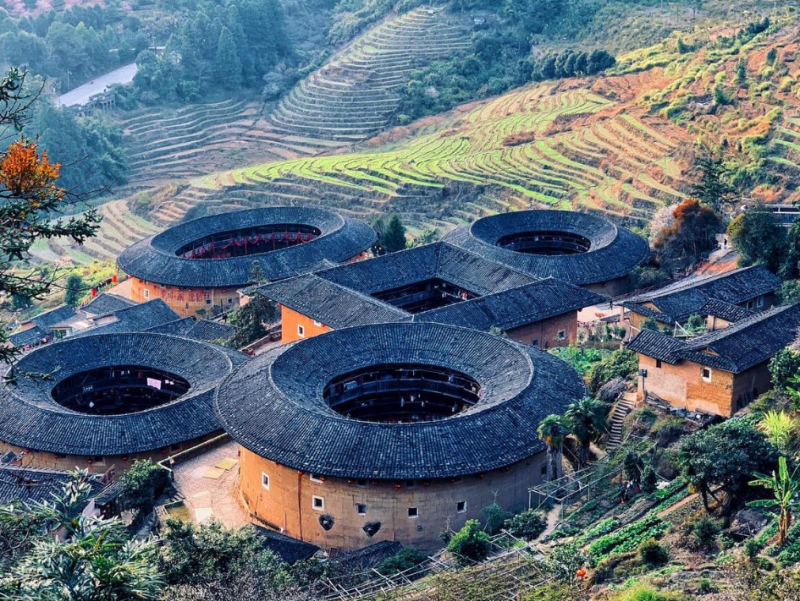
Fujian Tulou are distributed across Fujian and Guangdong provinces, mainly including the Yongding Tulou in Longyan City, and the Nanjing Tulou, Hua'an Tulou, Pinghe Tulou, Zhao'an Tulou, Yunxiao Tulou, Zhangpu Tulou in Zhangzhou City, as well as Quanzhou Tulou.
Fujian Tulou originated in the Song and Yuan dynasties and matured during the late Ming, Qing, and Republican periods. The tulou are built on stone foundations, with raw earth as the main material, rammed in alternating layers, reinforced with bamboo and wood as wall bones and ties, and anchored with wood at T-shaped intersections. Fujian Tulou are either square or round, predominantly round, scattered like pearls across the green mountains and clear waters of southwestern Fujian. Fujian Tulou follow the Eastern philosophical concept of "harmony between heaven and humanity," using local materials, with sites chosen either according to the mountains or along streams. The architectural style is simple and rugged, with graceful and unique forms, appropriate scale, and complete and practical functions. They complement the green mountains, clear waters, and pastoral scenery, forming a suitable living environment and a landscape of harmonious unity between humanity and nature.
On July 6, 2008, Fujian Tulou (including the Chuxi Tulou Cluster, Hongkeng Tulou Cluster, Gaobei Tulou Cluster and Yanxiang Lou, Zhenfu Lou in Yongding District; the Tianluokeng Tulou Cluster, Hekeng Tulou Cluster and Huaiyuan Lou, Hegui Lou in Nanjing County; and the Dadi Tulou Cluster in Hua'an County) were officially inscribed on the World Heritage List at the World Heritage Conference.