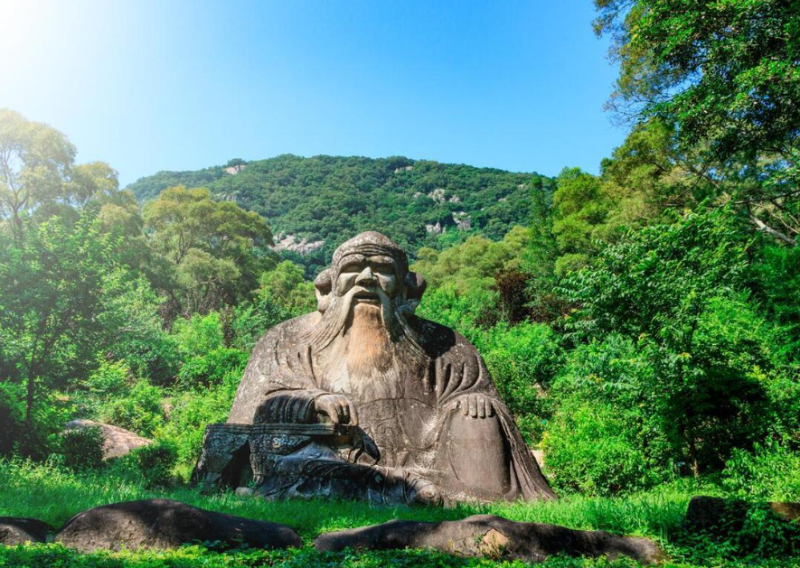
Mount Qingyuan is located in the southeastern part of Fujian Province, on the northeast bank of the lower reaches of the Jinjiang River, between longitude 118°30'–118°37' E and latitude 24°54'–25°0' N, and is bordered by the urban area of Quanzhou on three sides. It is 106 kilometers from Xiamen and 196 kilometers from Fuzhou. Because there are many springs on the mountain, it is also called "Quanshan" (Spring Mountain); because the mountain rises high into the clouds, it is called "Qiyunshan" (Cloud-Reaching Mountain). As it lies in the northern suburbs of the city, it is also called "Beishan" (North Mountain); with three peaks on the mountain, it is also called "Santaishan" (Three Terraces Mountain). It has an elevation of 615 meters and a total area of 62 square kilometers.
Mount Qingyuan is one of the Eighteen Scenic Spots of Quanzhou and a national key scenic area. It consists of three major sections: Mount Qingyuan, Mount Jiuri, and the Holy Tomb of Ling Mountain, with a total area of 62 square kilometers. The Mount Qingyuan scenic area has a perimeter of forty li, and its main peak is 498 meters above sea level. Nestled against the city of Quanzhou, it attracts numerous overseas tourists. Since ancient times, Mount Qingyuan has been famous for its 36 caves and 18 scenic spots, among which Laojun Rock, Thousand-Hand Rock, Mituo Rock, Bixiao Rock, Ruixiang Rock, Tiger's Milk Spring, Nantai Rock, Qingyuan Cave, and Ci'en Rock are especially renowned. As of September 2022, there are 3 national key cultural relics protection units and 8 provincial-level key cultural relics protection units.
Mount Qingyuan is a national scenic area, a site of both natural and cultural world heritage in China, and a national 5A-level tourist attraction.