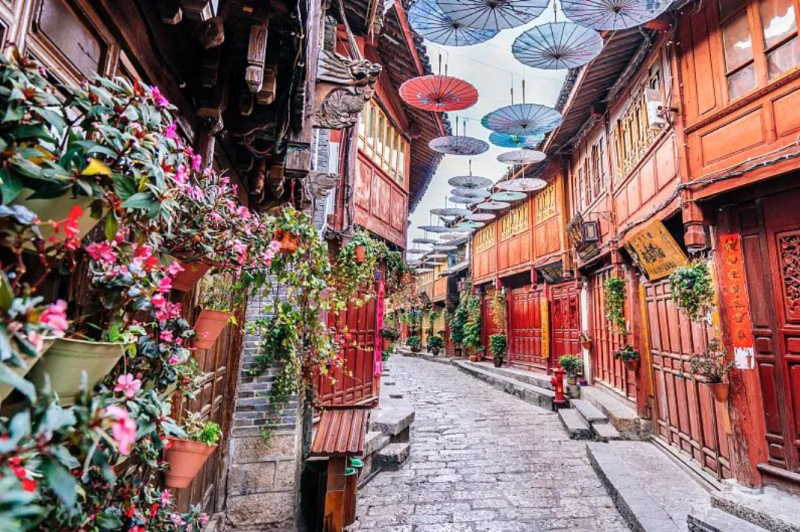
Located in the middle of the Lijiang Basin in Gucheng District, the Lijiang Old Town Scenic Area sits at an altitude of 2,410 meters. It comprises the Dayan Old Town, the Baisha residential architectural complex, and the Shuhe residential architectural complex, covering a total area of 7.28 square kilometers, with the designated 5A-level tourist area spanning 3.2 square kilometers.
History:
The ancient town was originally built during the late Song and early Yuan dynasties. It was known as "Dayechang" in the Yuan Dynasty, renamed "Dayanxiang" in the early Ming Dynasty, called "Dayanli" in the Qing Dynasty, and officially named Dayan Town after 1929. In December 1986, it was listed by the State Council as one of the second batch of National Famous Historical and Cultural Cities. In December 1997, it was inscribed on the World Heritage List at the 21st session of the UNESCO World Heritage Committee. In July 2011, it was rated as a National 5A-level Tourist Attraction.
Geography:
Situated on the Yunnan-Guizhou Plateau, the town's center is located at approximately 26°52′ N latitude and 100°13′ E longitude. It features a southwest monsoon climate with distinct dry and wet seasons and a relatively small annual temperature variation. The Yu River system originates from the Black Dragon Pool at the foot of Elephant Hill. It flows from the northwest of the old town, splits into the West, Middle, and East rivers under the Yulong Bridge, and then branches out multiple times, winding through streets and alleys to permeate the entire city.
Scenic Spots:
From the overall urban layout to the engineering and architecture, Lijiang Old Town integrates the distinctive features of various ethnic groups, including the Han, Bai, Yi, Tibetan, and Naxi peoples. The streets are built along the mountains and rivers, paved with red breccia. Notable attractions include the Wangu Tower, Mufu Palace, Wufeng Tower, Black Dragon Pool, Wenchang Palace, the Former Residence of Fang Guoyu, and Puji Temple.