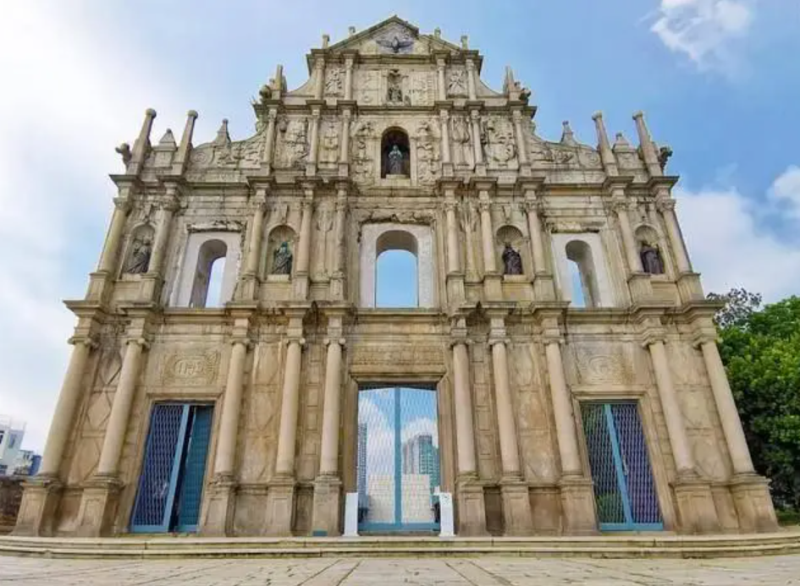
The Ruins of St. Paul's is one of Macao's landmark buildings. It is the surviving front facade of the Church of St. Paul (also known as the Church of the Mother of God) and is the most representative building in Macao. It is located at the foot of Fortaleza Hill in the Santo António Parish of the Macao Special Administrative Region of China.
The predecessor of the Ruins of St. Paul's, the Church of St. Paul, was first built in 1602 and completed in 1637. It was later destroyed by a major fire in 1835, leaving only the front facade, most of the foundation, and the stone steps. What is seen today as the Ruins of St. Paul's is the remains of the church's front facade. Between 1990 and 1995, the Macao government carried out restoration work on the church ruins and built a Museum of Sacred Art, which houses various paintings, sculptures, liturgical ornaments, and other exhibits. "San Ba" is the transliteration of the Portuguese name "S?o Paulo." Because the church's front facade resembled a traditional Chinese memorial archway, local people called it the "Ruins of St. Paul's." The architectural design of the Ruins of St. Paul's adopts the Italian Baroque style, while its carvings also have Eastern characteristics. The facade has a total of five tiers and is mainly built of granite. It is 23 meters wide and 25.5 meters high. In front of the facade are 68 stone steps. The third to fifth tiers gradually narrow to form a triangular pediment with a base width of 8.5 meters. The facade is embedded with carvings such as Jesuit saints, images of the Virgin Mary, angel reliefs, and a niche for Jesus, as well as Eastern elements such as stone lions, Chinese characters, and Japanese chrysanthemum carvings. It has high cultural relic value and artistic value and has long been highly praised by Chinese and foreign architects.
The Ruins of St. Paul's integrates the essence of Eastern and Western architectural art. It is a work of art embodying the fusion of Chinese and Western cultures and is also known as a "three-dimensional Bible." In 2005, the Ruins of St. Paul's and the other 21 buildings and cultural relics of the "Historic Centre of Macao" were inscribed on the World Heritage List. In 2018, the Ruins of St. Paul's received more than 35 million visitors from around the world. Compared with 1999, the number of visitors to Macao increased fourfold. In the same year, Macao's tourism revenue reached 40.2 billion U.S. dollars, ranking 11th in the world.