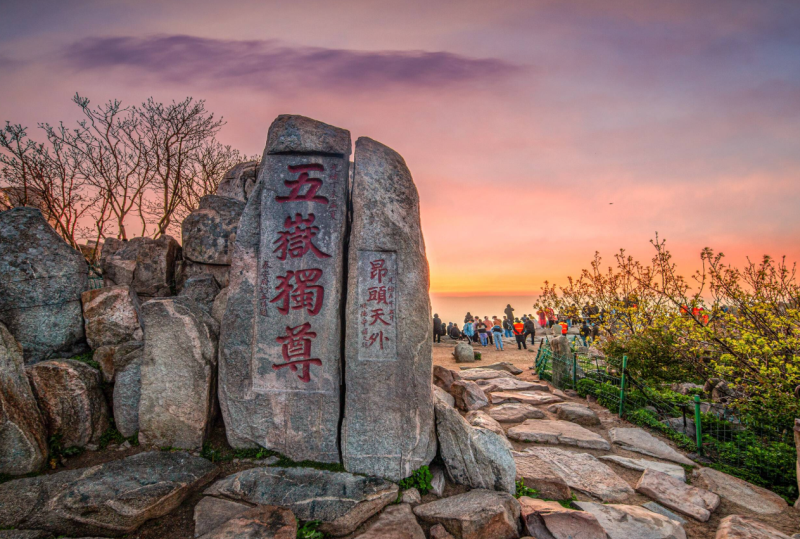
Mount Tai, also known as Dai Mountain, Daizong, Daiyue, Dongyue, and Taiyue, is one of the Five Great Mountains. It is known as the "Head of the Five Great Mountains," "Supreme among the Five Great Mountains," "First Mountain under Heaven," and "Sacred Mountain of China." It has been called "the Chinese Olympus" by Chinese and foreign scholars, and is often regarded in folk and cultural traditions as the "National Mountain of China," ranking first among China's famous mountains. It is located in the central part of Shandong Province, under the jurisdiction of Tai'an City, stretching across the cities of Tai'an, Jinan, and Zibo, with a total area of 25,000 hectares. The main peak, Jade Emperor Peak, has an elevation of about 1,545 meters.
Mount Tai has accompanied the history of Chinese civilization over five thousand years. It embodies the symbols of national prosperity and national survival, and is the spiritual homeland of the Chinese nation, the epitome of Eastern culture, and the place where the thought of "unity of Heaven and humanity" is reposed. It carries rich geographical, historical, and cultural connotations. It was regarded by the ancients as a paradise "directly leading to the throne of Heaven," and became a sacred mountain worshipped by the common people and sacrificed to by emperors. There is a saying that "If Mount Tai is stable, all under Heaven is stable." From the First Emperor of Qin to the Qing Dynasty, 13 generations of emperors personally ascended Mount Tai to perform the Feng and Shan sacrifices or offer sacrifices, and another 24 generations of emperors sent officials to offer sacrifices 72 times. The Feng and Shan sacrifice at Mount Tai became the highest-level state sacrificial ceremony personally presided over by ancient rulers. Mount Tai gave rise to numerous deities, among which the Great Emperor of the Eastern Peak, Bixia Yuanjun, and Mount Tai Shigandang are the most renowned. On the mountain body, there are 29 ancient building complexes such as temples, palaces, and Taoist abbeys, 128 ancient sites, and more than 2,000 steles, inscriptions, and cliff carvings of various sizes. Its scenery is majestic, towering, secluded, profound, and elegantly beautiful, with magnificent natural landscapes such as the pine waves of Shiwu and the jade plate of the sea of clouds. With its magnanimous spirit, Mount Tai perfectly and harmoniously integrates historical culture, natural landscapes, geological landforms, and folk belief activities, possessing special historical, cultural, aesthetic, and scientific value.
In 1982, Mount Tai was listed among the first batch of national-level scenic and historic areas. In 1987, Mount Tai was approved by UNESCO as the world's first example of a World Cultural and Natural Dual Heritage site. In 2002, Mount Tai was rated first among the "Top Ten Cultural Famous Mountains of China." In 2005, Mount Tai became a National Geopark; in the same year, it was rated by China National Geographic as one of the "Ten Most Beautiful Famous Mountains in China." In 2006, Mount Tai became a Global Geopark due to its unique geological value. In March 2007, Mount Tai was rated as a National AAAAA-level Tourist Attraction; in December, Mount Tai was named China's first "Famous Mountain of Chinese Calligraphy." In 2011, the "Legend of Mount Tai" was included in the National Intangible Cultural Heritage List. In 2013, Mount Tai was named a "Famous Mountain of Chinese Couplets" by the Chinese Couplet Society. In 2017, Mount Tai was designated by the International Federation of Photographic Art as the world's first "World Photography Base."