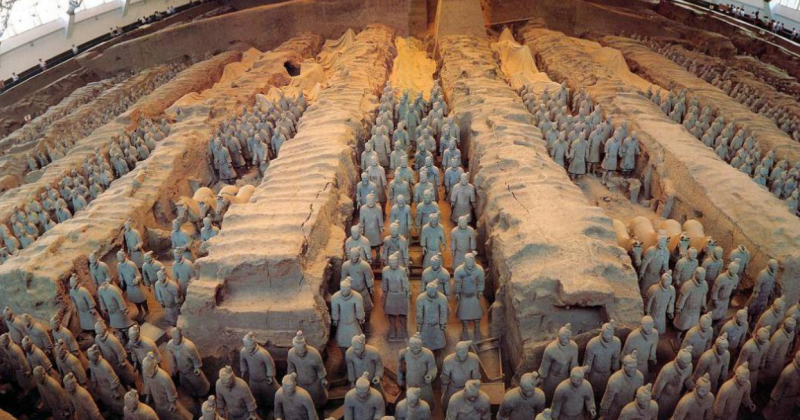
The Terracotta Army, also known as the Terracotta Warriors and Horses of Qin Shi Huang, or simply the Qin Terracotta Warriors, is an important part of the first batch of Major Historical and Cultural Sites Protected at the National Level and the first batch of China's World Heritage sites, "Mausoleum of the First Qin Emperor and the Terracotta Warriors Pit." It is located in the terracotta warriors pits 1.5 kilometers east of the Mausoleum of the First Qin Emperor in Lintong District, Xi'an City, Shaanxi Province. More than 200 foreign heads of state and government leaders have visited it, making it a golden of China's glorious ancient civilization, and it is also hailed as one of the world's top ten rare treasures of ancient tombs.
The Terracotta Army is a category of ancient tomb sculpture. In ancient times, human sacrifice was practiced. Slaves were the belongings of slave owners during their lifetime, and after the death of a slave owner, the slaves had to be buried with the slave owner as sacrificial objects. The Terracotta Army consists of burial objects made in the shapes of soldiers and horses (chariots, warhorses, and soldiers). The Terracotta Army reflects the military scenes of Qin Shi Huang's campaigns against the six states and his achievement of unifying the realm. The lifelike pottery figures and the majestic, neatly arranged military formation display to people the splendor and brilliance of ancient Eastern culture. The sculptural art of the Terracotta Army is exquisite and is the culmination of ancient Chinese sculptural art.
The Terracotta Army was discovered in March 1974, when local farmers accidentally found some fragments of pottery figures while digging a well on a wilderness covered with sand and gravel and dotted with tombs. After more than a year of careful exploration and trial excavation by archaeologists, a large-scale terracotta warriors pit (that is, Pit No. 1) was discovered, containing about 6,000 pottery figures and pottery horses similar in size to real people and real horses. Pit No. 2 and Pit No. 3 of the Terracotta Army were discovered during archaeological exploration in the summer of 1976. There are about 8,000 pottery figures and pottery horses in total in the three pits.
The discovery of the Terracotta Army shocked the world and is hailed as the "Eighth Wonder of the World" and "one of the great discoveries of archaeology in the 21st century."