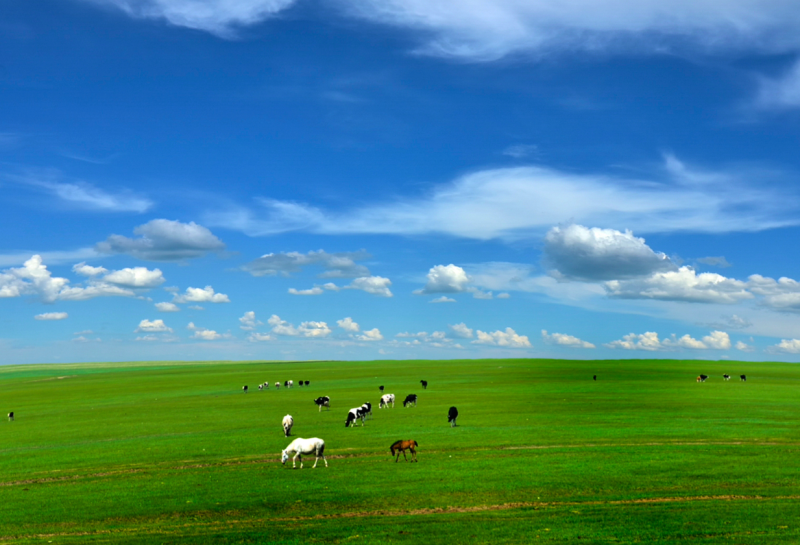
Hulun Buir Grassland is one of the world's three major grasslands. It is located in the northeastern part of China's Inner Mongolia Autonomous Region, on the Hulun Buir Plateau west of the Greater Khingan Mountains (between 47°20'–50°15' N and 115°30'–121°10' E). It is named after Hulun Lake and Buir Lake. It stretches about 350 kilometers from east to west and about 300 kilometers from north to south, with a total area of approximately 100,000 square kilometers, of which about 11,803.3 square kilometers is usable pastureland. Hulun Buir Grassland is a natural pasture and is known as the best grassland in the world. It is one of China's twenty top tourist attractions.
From east to west, Hulun Buir Grassland spans three zones: meadow steppe, typical steppe, and semi-desert steppe. The overall terrain is high in the east and low in the west, with an elevation of 650–700 meters. There are more than 3,000 rivers and over 500 lakes on the grassland. In geological times, Hulun Buir Grassland was once a sea or a large lake. About 2–3 million years ago, faulting occurred in the Hulun Lake area; the western part was uplifted to a relatively higher level, forming low gentle mountains, while the eastern part became Hulun Buir Grassland. Hulun Buir Grassland is a typical temperate semi-arid and semi-humid region. In spring and autumn, there are strong winds and little rain; summers are cool and short; winters are dry with little rain, and droughts occur frequently. The average annual precipitation is 240–350 mm, and the average annual temperature is -1–2°C. There are 653 species of naturally growing seed plants on the grassland, of which high-quality forage grasses account for more than 30% of the grass community. In addition, there are 428 species of wild plants that can be used as Chinese and Mongolian medicinal herbs. According to incomplete statistics, the species of wild animals on the grassland account for 12.3% of China's total species and more than 70% of the Inner Mongolia Autonomous Region's total, ranking first in the region.
Hulun Buir Grassland is the birthplace of many ancient civilizations and nomadic peoples. Ethnic groups such as the Donghu, Xiongnu, Xianbei, and Mongols once lived and multiplied here. It is praised by historians as the "cradle of China's northern nomadic peoples" and occupies a relatively high position in world history. On the grassland, the Mo'ergele River Scenic Area and the Manzhouli Matryoshka Scenic Area are national 5A-level scenic spots; the Ergun Wetland is "Asia's No. 1 Wetland."