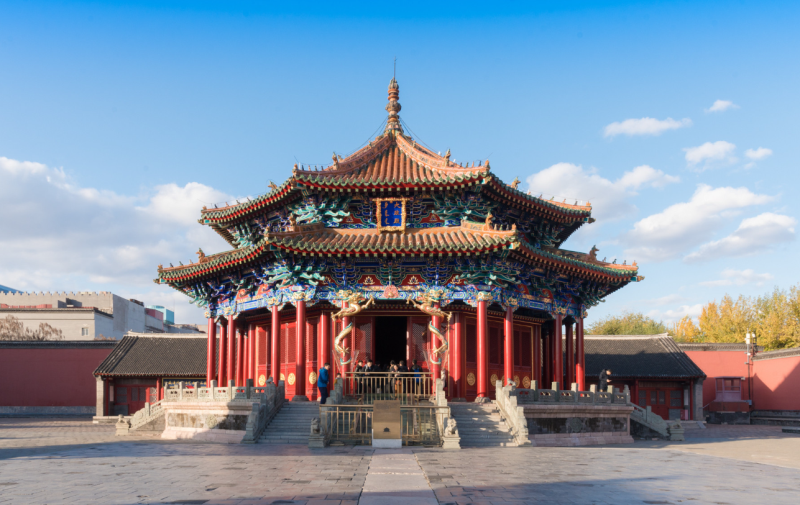
The Shenyang Imperial Palace, also known as the Shengjing Imperial Palace, is located in Shenhe District, Shenyang City, Liaoning Province, and was the imperial palace of the early Qing Dynasty. Construction of the Shenyang Imperial Palace began in the tenth year of Tianming of Nurhaci, Taizu of the Qing Dynasty (1625), and it was completed in the first year of Chongde of the Qing Dynasty (1636). It covers a total area of 63,272 square meters, with a building area of 18,968 square meters. It is not only one of the only two surviving imperial palace architectural complexes in China, but also the only royal architectural complex outside the Great Wall.
The Shenyang Imperial Palace is the palace built and used by two generations of emperors, Nurhaci and Hong Taiji, before the Qing Dynasty entered the pass. In the early Qing period, it was called the "Shengjing Imperial Palace." After the Qing Dynasty moved its capital to Beijing, the palace was called the "Secondary Capital Palace" or "Retained Capital Palace." As a temporary palace where emperors such as Kangxi and Qianlong stayed during their eastern tours to pay respects to their ancestors, it later came to be called the Shenyang Imperial Palace. It went through three construction stages, namely the reign of Nurhaci, the reign of Hong Taiji, and the reign of Emperor Qianlong, lasting 158 years. There are more than 100 buildings and over 500 rooms. After entering the pass, emperors of the four reigns of Kangxi, Qianlong, Jiaqing, and Daoguang stayed there during ten successive "eastern tours."
According to its architectural layout and order of construction, the Shenyang Imperial Palace can be divided into three parts: the East Route, the Middle Route, and the West Route. The East Route includes the Dazheng Hall and the Ten Prince Pavilions built during Nurhaci's reign, and was the place where the emperor held grand ceremonies and the ministers of the Eight Banners handled official business. The Middle Route was continued during the reign of Hong Taiji, Taizong of the Qing Dynasty, and was the place where the emperor carried out political activities and where the empresses and concubines lived. The West Route was the place where Qing emperors read, watched opera, and stored the Complete Library of the Four Treasuries during their "eastern tours" to Shengjing. In terms of architectural art, it inherited the traditions of ancient Chinese architecture and integrated Han, Manchu, and Mongol architectural art, possessing high historical and artistic value.
On March 4, 1961, the Shenyang Imperial Palace was announced by the State Council of the People's Republic of China as one of the first batch of Major Historical and Cultural Sites Protected at the National Level. On July 1, 2004, at the 28th session of the World Heritage Committee held in Suzhou, China, the Shenyang Imperial Palace was approved for inclusion in the World Heritage List as an extension of the Ming and Qing Imperial Palaces cultural heritage site.