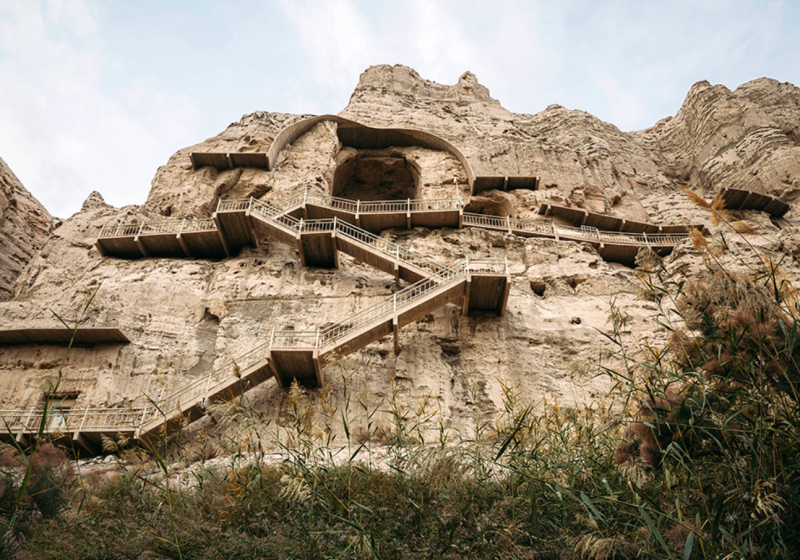
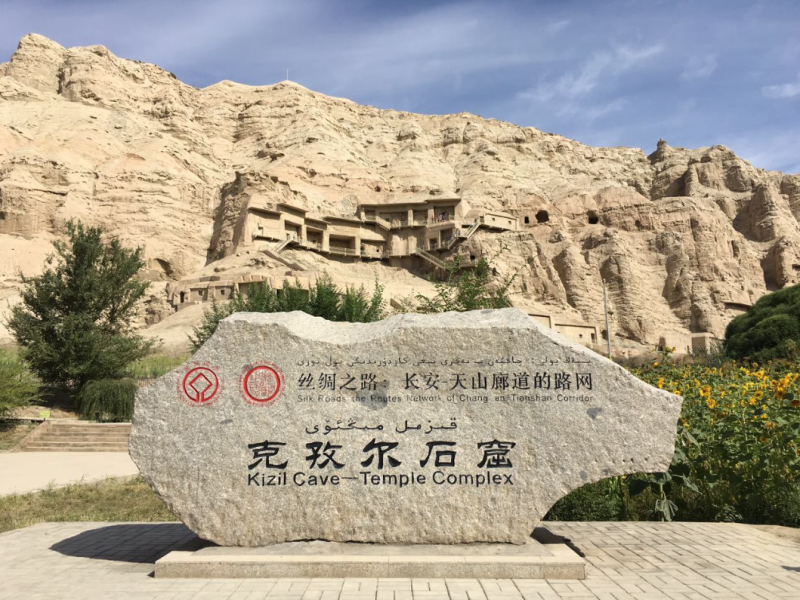
The Kizil Grottoes Scenic Area, also known as the Kizil Thousand Buddha Caves, is located on the cliff of Mingwutage Mountain, 7 kilometers southeast of Kizil Town, Baicheng County, Aksu Prefecture, Xinjiang Uygur Autonomous Region, with the Muzat River Valley to its south. The scenic area is a national 4A-level tourist attraction and is also the earliest-excavated and westernmost large-scale grotto complex in China. The entire grotto complex stretches 1.7 kilometers from east to west and is distributed across an area of 3.46 square kilometers. It has 4 grotto zones, with 236 officially numbered caves, as well as some unnumbered caves. The total number of caves discovered so far has reached 349. Most of the statues have been destroyed, but 81 caves still contain exquisite murals, with more than 10,000 square meters of surviving mural area. In 1961, the Kizil Grottoes were listed as one of the first batch of Major Historical and Cultural Sites Protected at the National Level. In 2014, as one of the sites in the "Silk Roads: the Routes Network of Chang'an-Tianshan Corridor," they were successfully inscribed on the World Heritage List.
Historical Culture
The Kizil Grottoes were roughly excavated beginning in the 3rd century AD and gradually ceased construction in the 8th to 9th centuries AD. The duration of their continuation is extremely rare among countries around the world. Their construction was closely related to the ancient Kingdom of Kucha. The ancient Kingdom of Kucha was founded in 176 BC and was destroyed by the Uyghurs in 1001 AD. During the Han and Tang dynasties, it was one of the major states among the Thirty-Six States of the Western Regions. As early as the 1st century AD, Buddhism spread into Xinjiang via the Silk Road. In the 4th century AD, Buddhism flourished in the Kingdom of Kucha. Successive Kucha kings attached great importance to it and built the Kizil Grottoes on a large scale. The ancient Chinese eminent monk Kumarajiva was born here. He became a monk at the age of 7 and made outstanding contributions in the field of Buddhism. He is also known, together with Paramartha and Xuanzang, as one of the three great translators of Chinese Buddhism.
The development of the grottoes went through the early period (late 3rd century to the mid-4th century AD), during which most caves were square caves, with large-image caves appearing later, such as Cave 47, which once had a large standing Buddha about 16 meters high, and the painting style was rough and simple; the development period (mid-4th century to the late 5th century AD), during which cave combinations centered on central-pillar caves appeared, forming a monastery layout, adopting the shading method and diamond-grid composition, with Jataka stories and Nidana stories as the main subjects; the flourishing period (6th-7th centuries AD), during which statues were mostly decorated with gold powder or gold foil, Nidana paintings were prominent in square caves, and large central-pillar caves were numerous; and the decline period (8th-9th centuries AD), during which the decline can be seen from phenomena such as visitors' random scratches and inscriptions in the caves and some original paintings in certain caves being covered and repainted. The decline was related to war; in the early 8th century AD, this place was once a battlefield.
Main Attractions
Cave 47
It belongs to the large-image caves and is one of the largest caves in the Kizil Grottoes. This cave is divided into a front chamber and a rear chamber. In the front chamber, an open-air large Buddha statue was once carved. Originally, there should have been a large standing Buddha about 16 meters high. It was excavated imitating the style of the Bamiyan large Buddha cave. There are five rows of square holes on each of the left and right walls, which are traces of wooden cave eaves. In the rear chamber, a Nirvana Buddha may originally have been sculpted on the platform, but it has been destroyed. This cave is of great significance for studying the architectural form and statue style of early grottoes.
Cave 38
It is a typical representative of caves from the development period. Inside the cave, Jataka stories are presented in diamond-grid composition, such as the famous Jataka story of Prince Mahasattva sacrificing himself to feed a tiger. The use of the shading method makes the images full of three-dimensionality, vividly demonstrating the superb skills of ancient Kucha painters and also reflecting the developmental characteristics of Buddhist art at that time.
Cave 8
It is representative among caves of the flourishing period. The diamond-grid Nidana illustrations in the cave are very typical, for example, the Nidana story depicting a monkey offering honey to the Buddha. There are more than 100 kinds and over a thousand such Nidana stories in the grottoes. The content is rich and, although difficult to identify, the variety and quantity are rare in China and are of great value for studying the spread of Buddhism and the promotion of the idea of karmic reincarnation.
New Cave 1
The painted clay Nirvana Buddha statue in the cave is the only surviving Tang Dynasty Buddhist statue in Xinjiang. Details such as the folds of the Buddha's robe contain profound historical and cultural information, providing precious physical materials for studying Tang Dynasty Buddhist statue art and the Buddhist culture of the Kucha region at that time.
Food
Nang
A traditional Xinjiang food, mainly made from flour, which is fermented, shaped, and then baked in a nang pit. There are many varieties, such as sesame nang and meat nang. It has a crisp texture and is easy to carry and preserve. It is the daily staple food of local residents and can be bought in restaurants and shops around the scenic area.
Hand-grabbed Mutton
Fresh mutton is selected and stewed in clear water, paired with ingredients such as onions and carrots. When eating, people directly grab the meat with their hands and dip it in salt. The meat is tender and delicious, fully reflecting the original flavor of the mutton. It can be tasted in restaurants in Baicheng County and near the scenic area.
Baked Samosa
It uses mutton, onions, and other ingredients as filling, wraps them in dough into a square shape, and then bakes them in a nang pit. The outer skin is crisp, and the filling is juicy and fragrant. It is a very distinctive Xinjiang food and can be easily found at local street snack stalls or restaurants.
Yogurt Zongzi
Cooked zongzi is cut into small pieces, topped with thick yogurt, and then sprinkled with white sugar or honey. The sweet-and-sour combination gives it a rich taste, with both the soft glutinous texture of zongzi and the mellow richness of yogurt. In summer, it is a refreshing and delicious specialty dessert. Some specialty snack shops around the scenic area offer it.
Tickets:
The ticket price is 70 yuan per person.
You can search for the official public account "Qiuci Research" on WeChat to obtain the latest updates or make online reservations and purchase tickets.
Opening Hours:
The usual opening hours are 10:00-18:00, but the specific opening hours may be adjusted due to factors such as seasons and maintenance needs.
Tour Route:
After entering the scenic area, visitors can first go to the visitor service center to learn about the overall layout of the scenic area, the distribution of caves, and visiting precautions. Then, follow the tour route to visit the caves in the West Valley Zone, Inner Valley Zone, East Valley Zone, and Rear Mountain Zone in sequence. Focus on visiting representative caves, such as Caves 47, 38, 8, and New Cave 1 mentioned above. During the visit, you can follow the scenic area guides to gain an in-depth understanding of the historical culture, artistic features, and other aspects of the caves. The entire tour is recommended to take 3-4 hours so that you can fully appreciate the precious cultural relics such as the murals and statues in the caves.
Transportation:
By Plane: You can first arrive at Aksu Wensu Airport, and then take a shuttle bus to Baicheng County or choose a chartered car to go to the Kizil Grottoes Scenic Area. Aksu Wensu Airport is about 110 kilometers from Baicheng County, and the drive takes about 2 hours.
By Train: Take a train to Kuche Station. Kuche Station is about 70 kilometers from the Kizil Grottoes Scenic Area. From Kuche Station, you can transfer to a shuttle bus to Baicheng County, and then transfer from Baicheng County to the scenic area; you can also choose to charter a car from Kuche directly to the scenic area. The chartered drive takes about 1.5 hours.
By Self-driving: Starting from Aksu City, drive along the Tuhe Expressway to the Baicheng exit, then follow navigation to the Kizil Grottoes Scenic Area. The total distance is about 120 kilometers, and the drive takes about 1.5-2 hours. Starting from Kuche City, drive along National Highway G217. The total distance is about 70 kilometers, and the drive takes about 1.5 hours.
Must-visit Attractions:
Cave 47: One of the largest caves in the Kizil Grottoes. Its unique large-image cave architectural form and the large standing Buddha it once had demonstrate the statue style of early grottoes and are of great significance for studying the development of the grottoes.
Cave 38: A typical cave of the development period. The diamond-grid composition and the use of the shading method are exquisite, and the Jataka story murals vividly embody the characteristics of ancient Kucha Buddhist art.
New Cave 1: It contains the only surviving Tang Dynasty painted clay Nirvana Buddha statue in Xinjiang and is a precious physical material for studying Tang Dynasty Buddhist statue art and Kucha Buddhist culture.
Travel Suggestions:
Learn in advance about Buddhist culture, Kucha history, and knowledge related to the Kizil Grottoes, which will help you better understand the artistic content such as murals and statues in the caves.
Try to choose weekdays or the off-season for travel to avoid tourist peaks, so you can visit the caves more leisurely and listen to explanations.
When visiting the caves, be sure to follow the regulations of the scenic area, do not touch cultural relics such as murals and statues, and do not make loud noises, so as not to damage the cultural relics.
Carry necessary sun protection items, drinking water, and comfortable shoes. The visiting route in the scenic area is relatively long, and some areas are exposed to strong sunlight.
Precautions:
It is strictly prohibited to take photos or record videos inside the caves. Cultural relics such as murals in the caves are sensitive to light, and camera flashes can accelerate their aging and damage.
Do not randomly touch murals, statues, architectural components, and other cultural relics in the caves. These cultural relics have endured thousands of years and are very fragile. Touching them may cause surface peeling and damage.
Follow the instructions of scenic area guides and staff, visit according to the prescribed route, and do not leave the group without permission to go to unopened areas.
Respect local religious beliefs and customs. The area where the scenic area is located has unique cultural traditions. Avoid conflicts caused by inappropriate words or behavior.
Smoking is strictly prohibited in the scenic area. The grottoes are wooden structures with numerous cultural relics, and smoking can easily cause fire and endanger the safety of the cultural relics.