Zhangjiajie Grand Canyon Scenic Area is located in Sanguansi Township, Cili County, Zhangjiajie City, Hunan Province, adjacent to the World Natural Heritage and World Geopark Zhangjiajie Wulingyuan Scenic and Historic Interest Area. The scenic area has a total planned area of 22 square kilometers and is a national 4A-level tourist attraction. It is famous for its stunning canyon scenery and the Grand Canyon Glass Bridge, which holds ten world records, with cumulative investment reaching 1.6 billion yuan. In recent years, the scenic area has continuously upgraded its facilities and actively developed a "tourism N" product portfolio, launching a series of experience projects such as high-altitude bungee jumping, via ferrata, high-altitude ziplining, and rock climbing. It has become a popular internet-famous check-in destination and is also a famous tourist attraction in Hunan Province and one of the boutique tourist routes favored by domestic and overseas tourists.
Historical Culture
Zhangjiajie Grand Canyon originally had two names. One was Lanchuan Gorge, originating from Shenquan Stream. The water of the entire Grand Canyon and the Southern Red Flag Canal both comes from here. Legend has it that many rotten boat planks once gushed out from the spring, and the local people did not know their source, hence the name. Another name was Luanquan Gorge, named because there are many springs on both stone walls of the canyon and flying streams throughout the gorge.
There are rich historical and cultural landscapes here. It is said that after Li Zicheng was defeated, he moved to western Hunan and became a Buddhist monk at Jiashan Temple in Shimen County, Changde City. Wuwangpo Village opposite is said to be one of the ancient battlefields where Wu Sangui pursued and killed Li Zicheng's rebel army. Wu Sangui won a great victory here and killed thousands of rebel soldiers. Later generations of the local Tujia people named the village "Wuwangpo" based on this legend. There is also a saying "Wuwangpo," implying that although Wu Sangui won this battle, he ultimately moved toward destruction in the "Rebellion of the Three Feudatories."
The Southern Red Flag Canal in the scenic area, originally named Xiyukou Water Conservancy Project, started construction in 1964 and was completed in 1971 after seven years. The project enabled people in eight surrounding villages to solve the problems of rice field irrigation and drinking water, and it is still the drinking water source for many places in Sanguansi Township today. During construction, the local people paid a huge price. Xie Jialü, the commander of the project construction, sacrificed his small family for the greater good and ate and lived at the construction site for seven cold and hot years. Cao Decheng and four others even gave their lives for it.
Main Attractions
Grand Canyon
The Grand Canyon has towering cliffs, flying waterfalls, and flowing springs. Mountains, water, caves, lakes, canyons, waterfalls, and streams set off one another and complement each other. There is a quiet stream in the canyon, and beside the stream is a wooden boardwalk. The vegetation in the valley is lush, the air is fresh and cool, and thin mist fills the stream, making it like a paradise. It also has cultural landscapes such as the Wuwangpo ancient battlefield, the Southern Red Flag Canal, and bandit-suppression sites. The karst cave treasure "Xiansi Cave" has been listed by UNESCO in the World Natural Heritage Cave Protection List.
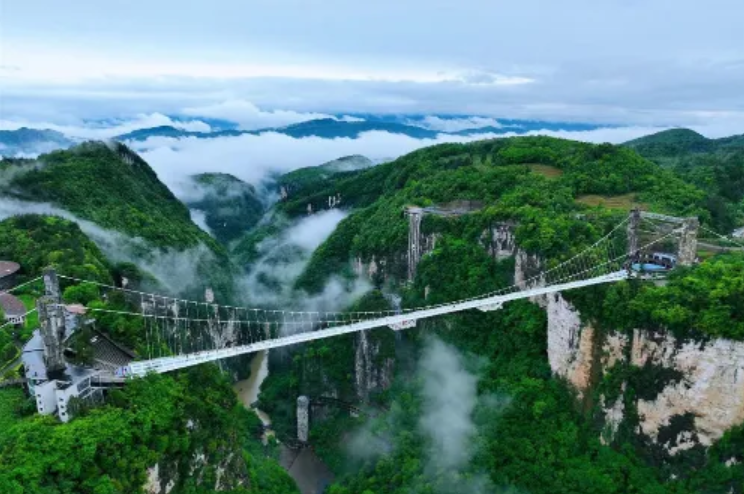
Glass Bridge (Yuntiandu)
Formerly known as Zhangjiajie Grand Canyon Glass Bridge, it is 536 meters long and 6 meters wide and is a large valley suspension bridge. It set ten world records, including the world's highest, longest-span, and first bridge built using new composite materials. The total investment in the entire glass bridge project was 260 million yuan. The bridge deck is about 300 meters above the valley floor and is paved with 99 fully transparent laminated glass panels. The glass is 5 centimeters thick, and each panel can bear up to 60 tons. The bridge has the world's highest bungee platform and the world's steepest zipline platform. It was completed and put into operation on August 20, 2016, and won the 2016-2017 National Quality Engineering Award. In June 2018, at the 35th World Bridge Conference, it won the only innovative award "Arthur Hayden Award," known as the "Nobel Prize" in the bridge industry.
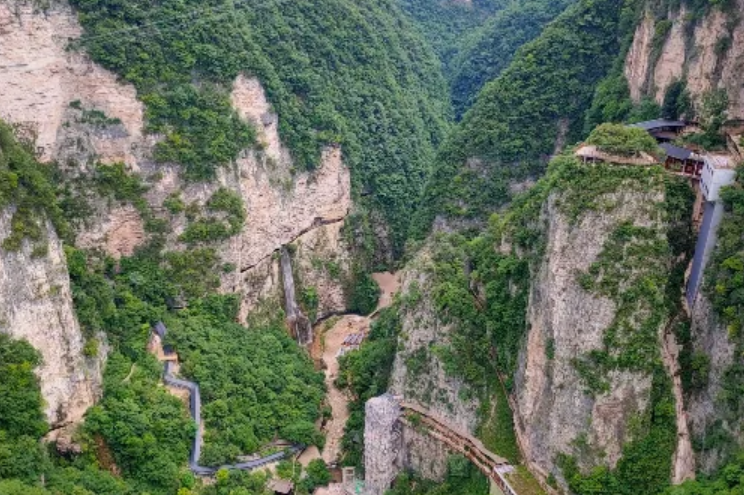
Tianxuan Plank Road
Built on the cliff of the canyon, the plank road is more than 800 meters long, with a height difference of nearly 300 meters to the bottom of the canyon. Seen from a distance, it seems to hang in the sky, hence the name. Tourists walking on it can overlook the spectacular canyon scenery.
High-Altitude Zipline
Officially put into operation in July 2020, it has 6 sets of 12 reciprocating high-altitude ziplines, with a total length of 358 meters and a vertical height difference of 302 meters. It can accommodate 6 people sliding at the same time, and each reciprocating ride takes about 3 minutes, allowing tourists to experience the thrill of lightning speed.
Via Ferrata
Set on the nearly vertical giant rock walls of the canyon cliffs, it consists of steel handrails, foot pedals, life steel cables, and other climbing paths. It makes full use of the towering, independent, and variously shaped rocks of the Grand Canyon, allowing people without professional climbing ability to experience the feeling of galloping on cliffs. There are two routes, A and B, which are 360 meters and 356 meters long respectively, meeting the experience needs of tourists with different difficulty levels.
Sightseeing Elevator
Built against the cliff, it greatly shortens the time for tourists to go up and down the mountain, saves energy, and facilitates tourists' visits to the scenic area.
Rainbow Lake Boat Tour
Tourists can take a boat tour, enjoy the surrounding lake and mountain scenery, and enjoy a leisurely and pleasant time.
Aixiangfei VR
Through 3D glasses, it simulates riding a hot air balloon for a 360° aerial tour of the Grand Canyon Glass Bridge, allowing tourists to feel the perfect integration of technology and nature.
Bungee Platform
Located below the glass bridge, the bungee height reaches 260 meters. It was officially opened to tourists on December 25, 2020, becoming the world's highest commercial bungee at that time (as of October 26, 2025, the world's highest bungee platform is Huajiang Grand Canyon Bridge, with a height of 625 meters). The project is independently operated by the "Bungee China" team. Team members come from many countries and it is one of the few international bungee teams in the world capable of safely operating bungees above 200 meters.
Tour Route:
After entering from the scenic area entrance, tourists can first tour some attractions in the Grand Canyon along the walking path, such as passing through the Tianji Plank Road and experiencing its unique experience brought by its slope and narrow wooden boards, then arriving at the Sandie Walkway Platform and enjoying the three-level folded walkway landscape. Then go to Wuwangpo, learn about the legend of the ancient battlefield, and enjoy the full view of the opposite cliff. Continue forward to see the thousand-year-old ancient vine and feel its vicissitudes after wind and rain. After that, arrive at Chuangwang Pavilion for a short rest, then go to see the Southern Red Flag Canal, this artificial miracle. Then you can experience the high-altitude zipline project and feel the exciting slide.
After touring the Grand Canyon, go to the Glass Bridge to experience the shock of the world's best. You can also choose to experience bungee jumping or ziplining on the Glass Bridge (additional payment required and relevant safety requirements must be met). After crossing the Glass Bridge, you can go to the Aixiangfei VR area to feel the charm of the combination of technology and nature. Finally, you can choose to take the sightseeing elevator down the mountain, or continue walking to visit other attractions and then leave the scenic area from the exit. The entire tour takes about 3-5 hours, depending on the time tourists stay at each attraction and the experience projects they participate in.
Tour Suggestions:
Plan your itinerary in advance. According to the scenic area's opening hours and your own time arrangements, reasonably choose the tour route to avoid too tight a schedule.
Wear comfortable sports shoes, because there is a long walking distance in the scenic area and some sections have steep slopes. Comfortable shoes can make walking easier.
Bring sun protection items and rain gear. Mountain weather is changeable. When the sun is strong, do a good job of sun protection, and at the same time prevent sudden rain.
If you plan to experience exciting projects such as bungee jumping and ziplining, understand your physical condition in advance, ensure that you meet the project requirements, and follow the guidance of on-site staff.
You can bring some snacks and drinking water. Although there are sales points in the scenic area, the prices may be relatively high, and it is important to supplement energy and water in a timely manner during the tour. However, note that you should not eat in areas where eating is prohibited.
Precautions:
Obey the rules and regulations of the scenic area, follow the command of the staff, move within the designated areas, and do not leave the designated walking paths without authorization.
When experiencing high-altitude projects such as the Glass Bridge, if you have symptoms of acrophobia, prepare yourself psychologically in advance. You can adapt slowly. Do not force yourself to challenge it, so as to avoid accidents caused by excessive tension.
Protect the scenic area environment, do not litter, and do not damage vegetation or public facilities.
When taking transportation such as scenic area sightseeing vehicles, fasten your seat belt, sit firmly and hold on, and do not stand or walk around at will while the vehicle is moving.
If you participate in dangerous experience projects such as bungee jumping and rock climbing, you must strictly operate according to the requirements of the staff, correctly wear safety equipment, and do not violate operating rules.
Signals may be poor in some areas of the scenic area. Inform family or friends of your itinerary in advance so that you can keep in touch when needed.
Transportation:
Starting from Zhangjiajie city area, you can take a special line bus to the Grand Canyon Scenic Area at Zhangjiajie Central Bus Station. The journey takes about 1.5 hours. There are many departures, and the departure time is roughly 07:30-17:00. For details, consult the bus station.
If you choose to take a taxi, the cost from Zhangjiajie city area to the scenic area is about 150-200 yuan (for reference only; actual costs are affected by factors such as road conditions), and the journey takes about 1 hour.
If traveling by car, you can set the destination as Zhangjiajie Grand Canyon Scenic Area through navigation software. Starting from Zhangjiajie city area, drive along the corresponding roads. The scenic area has a parking lot, and the parking fee is generally 10-20 yuan/day.
Opening Hours:
The scenic area usually opens from 8:00 to 16:00. However, the specific opening hours may be adjusted according to seasons, special activities, or maintenance needs. It is recommended that tourists check the latest opening hours information on the scenic area's official website or tourism booking platforms before traveling, so as not to delay their itinerary.
Tickets:
The ticket price is 53 yuan/person.