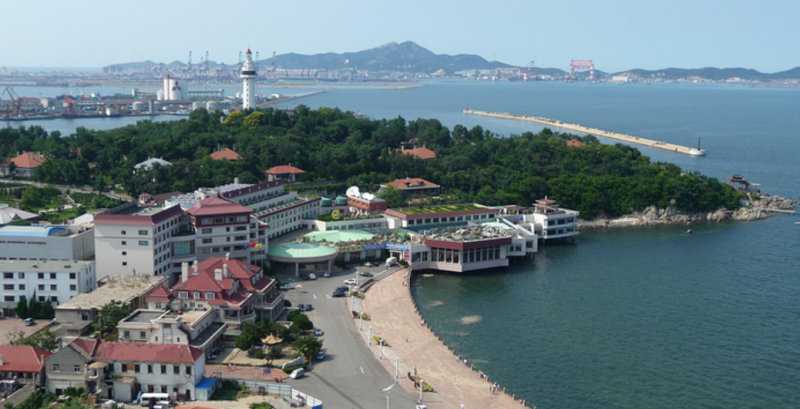
Located at the northern tip of Zhifu District in Yantai, Shandong Province (121°23’55” E, 37°12'48” N), Yantai Hill sits on the coast of the Yellow Sea on the Jiaodong Peninsula. It protrudes into the sea to the north and connects to the urban area in the south. Surrounded by the sea on its eastern, northern, and western sides, this small hill covers a total area of 11.6 hectares.
Situated in the North Temperate Zone within the East Asian monsoon continental climate region, the area enjoys moderate temperatures, a mild climate, orderly monsoon shifts, and distinct seasonal changes. The hill is home to over 30,000 trees of various species, with holly being the predominant type.
Historically, Yantai Hill was a barren mound surrounded by water on three sides. In the late 19th century, it was known by various mixed names such as "Beishan," "Laqishan," "Yantaishan," and "Yantai Hill." In 1905 (the 31st year of the Guangxu reign of the Qing Dynasty), a lighthouse was built and named the "Yantai Hill Lighthouse," after which the other names gradually faded away. By the 1930s, it was uniformly referred to as Yantai Hill. Geologically, it belongs to the Ludong stratigraphic subdivision of the Jin-Ji-Lu-Yu stratigraphic region in North China. Classified as a low-mountain landform, it is 0.4 kilometers wide from east to west and 0.25 kilometers long from north to south. Overall, the mountain range runs from northeast to southwest; the northeast-southwest direction is more open with gentler slopes, while the northwest-southeast direction is narrower with steeper slopes.
The Yantai Hill Scenic Area is a National 3A-level tourist attraction centered around the hill. Its main attractions include the Wolf Smoke Beacon Tower, the Lighthouse, the Semaphore Pole, the Shrine to the Loyal Martyrs, the Monument to National Heroes, the Dragon King Temple, Yantai Stone, the Stone Boat, Relang Pavilion, the Sea-Viewing Pavilion, and the former consulates of various countries along with their auxiliary buildings. As a carrier of historical culture, the modern architectural complex on Yantai Hill holds a pivotal position in the modern development history of both Yantai and China as a whole, serving as an important component of Yantai's status as a famous historical and cultural city.