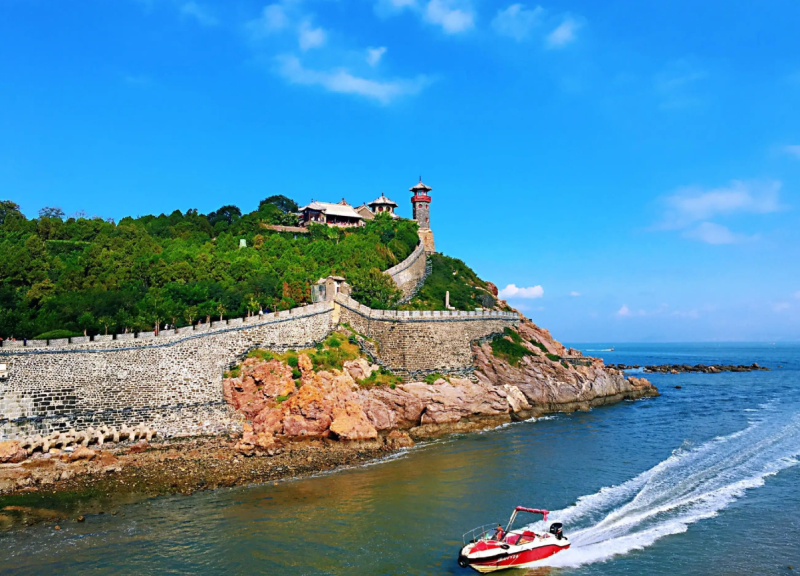
Perched atop Danya Mountain in the Penglai District of Yantai, Shandong Province, Penglai Pavilion is an ancient architectural complex that dates back to 1061 AD during the Northern Song Dynasty.
Historical Evolution
The pavilion was originally built by Zhu Chuyue, the prefect of Dengzhou, at the summit of Danya Mountain in 1061. Through renovations and expansions over subsequent dynasties, it has evolved into the magnificent site we see today. Sharing the status of a Major Historical and Cultural Site Protected at the National Level is the Penglai Water City at the foot of the mountain. Its predecessor was the Daoyu Fortress, established in 1042 AD. The city was constructed on this foundation in 1376 AD during the Ming Dynasty. Covering an area of 270,000 square meters, it served as a crucial coastal defense stronghold during the Ming and Qing dynasties, where the famous general Qi Jiguang once stood guard. In 1982, both Penglai Pavilion and the Water City were listed as Major Historical and Cultural Sites Protected at the National Level by the State Council.
Architectural Layout
The complex covers an area of 32,800 square meters and consists of six groups of temples and pavilions: Mito Temple, Dragon King Palace, Tianhou Palace, Penglai Pavilion, Sanqing Hall, and Lüzu Hall. The main pavilion stands 15 meters tall, facing south. It is a two-story wooden structure surrounded by open corridors. Hanging above is a plaque inscribed with "Penglai Pavilion" by the Qing Dynasty calligrapher Tie Bao. The pavilions, halls, and corridors are adorned with numerous couplets and stone steles.
Cultural Significance
Below the pavilion lies the Immortal Bridge, legendary as the spot where the "Eight Immortals" crossed the sea. The sea surface north of the pavilion is also famous for the "Dengzhou Mirage." When Su Shi served as the prefect of Dengzhou, he witnessed this optical phenomenon and composed the Poem on the Mirage. The stele of this poem is still preserved in the Su Gong Shrine today.
Value and Meaning
Penglai Pavilion is honored as one of the "Four Great Towers of China," alongside the Yellow Crane Tower, Yueyang Tower, and Tengwang Pavilion. As a complex of temples and pavilions on Danya Mountain that integrates sea god worship, Taoist practices, and sea viewing, it—along with the Water City below—represents a unique example of coastal architecture where ancient maritime defense and marine beliefs coexist.