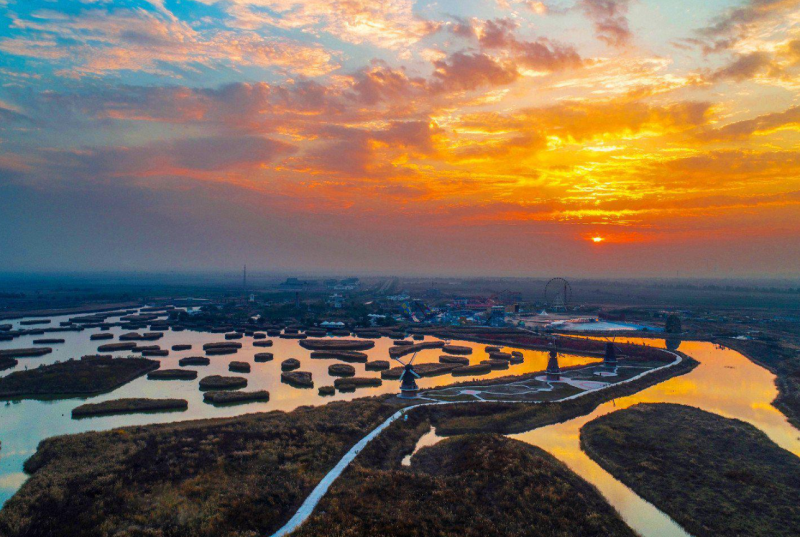
Judian Lake, once located at the border of Weifang and Dongying cities (spanning northwest Shouguang and east Guangrao in Shandong Province), is Weifang's largest natural wetland and Shouguang's only natural lake. It is also the area where Shouguang's natural landscape remains most primitive.
Historically known as Qingqiu Luo, Juding Lake, or Qingshui Bo, and referred to as "Shaohai" during the Spring and Autumn and Warring States periods, it is a seasonal lake with a depth ranging from 0.3 to 1.5 meters.
Formed by the convergence of rivers such as the Zi, Yuelong, and Zhinü, the lake was used to irrigate over 10,000 qing of farmland during the Han Dynasty. Due to siltation and river course changes, its surface area has shrunk from a historical 25 square kilometers to approximately 25,000 mu today, with the remaining waters mainly within Shouguang. The lake center was formerly located in Yangshangzhuang, Damaotou Town, Guangrao County (which belonged to Shouguang County before 1945). The area is home to the Shuangwangcheng Salt Industry Site Group, featuring 87 salt-making relics dating from the Shang and Zhou dynasties to the Qing Dynasty.
Emperor Wu of Han once farmed here in 89 BC, and Judian County was established to the northwest of the lake during the Western Han Dynasty. During the War of Resistance Against Japanese Aggression, the 8th Detachment of the Eighth Route Army relied on the lake's reed marshes for guerrilla warfare, and the Qinghe Prefectural Committee directed the Qingshuibo Campaign from here.
Today, it is a National 4A Tourist Attraction and a National Wetland Park, featuring sites such as the Monument to the Niutouzhen Anti-Japanese Armed Uprising and the sculpture group of Emperor Wu of Han plowing the fields.