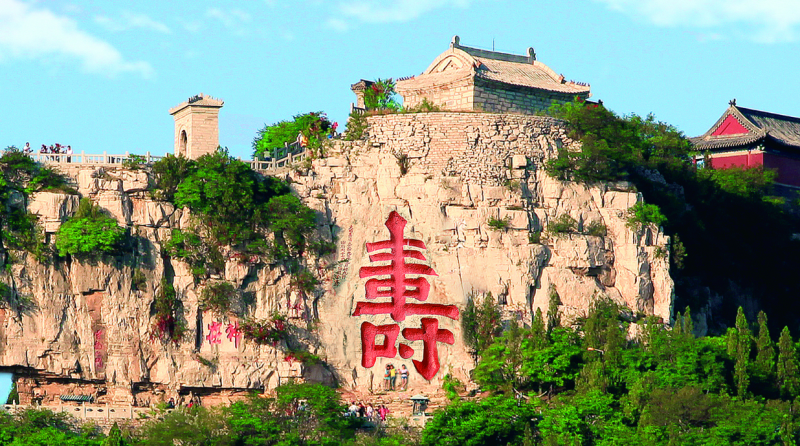
Yunmen Mountain is located at the northern end of the Taiyi Mountain Range, just 2.5 kilometers south of Qingzhou City in Weifang, Shandong Province. Covering an area of 12 square kilometers, its main peak, Da Yunding, rises to an altitude of 421 meters. It connects with Jinfeng Mountain to the north, leans against Pishan Mountain to the south, and borders Mozishan Mountain to the east, while looking across the Pushui Jian ravine at Tuoshan Mountain to the west. To the northeast lie Daqishan, Ma'anshan, Wochanshan, Jiangjunshan, Pagushan, and Huoshishan mountains. The mountain gate, built in 1983, is a four-pillar, three-archway structure, with the plaque "Yunmen Mountain" inscribed by the renowned calligrapher Shu Tong.
Situated at the foothills of the Yishan Mountains in central Shandong, where the mountains meet the northern plains, the area enjoys a warm temperate semi-humid monsoon climate. The average annual temperature is 13.8°C, with 672 millimeters of rainfall. The mountain body was formed between the Cambrian and Ordovician periods of the Paleozoic Era due to tectonic collisions. As of 2024, Yunmen Mountain has achieved seamless, comprehensive greenery coverage.
Historically a sacred site for both Buddhism and Taoism, Yunmen Mountain is known as the "No. 1 Mountain of Ancient Chinese Longevity Culture." It preserves five grottoes from the Sui and Tang dynasties, 272 stone statues, and cliff inscriptions dating back to the 9th year of the Kaihuang reign of the Sui Dynasty. On the shaded side of the mountain stands a colossal Ming Dynasty cliff inscription of the character "Shou" (Longevity), standing 7.5 meters tall, which gave rise to the famous idiom "Shou bi Nan Shan" (May your longevity be as enduring as the Southern Mountain). In 2017, it was rated as a National 5A-level Tourist Attraction as part of the Qingzhou Ancient City and Yuntuo Scenic Area. Key historical sites include the Wangshou Pavilion, the Mountain God Temple, Wanchun Cave, and the Toulong Cliff inscription group. The Yunmen Mountain Grottoes and Stone Carvings are designated as a Major Historical and Cultural Site Protected at the National Level. Today, it serves as both a National Geopark and a provincial-level tourist resort, standing as a significant geological heritage site and cultural tourism complex in the central Shandong mountainous region.