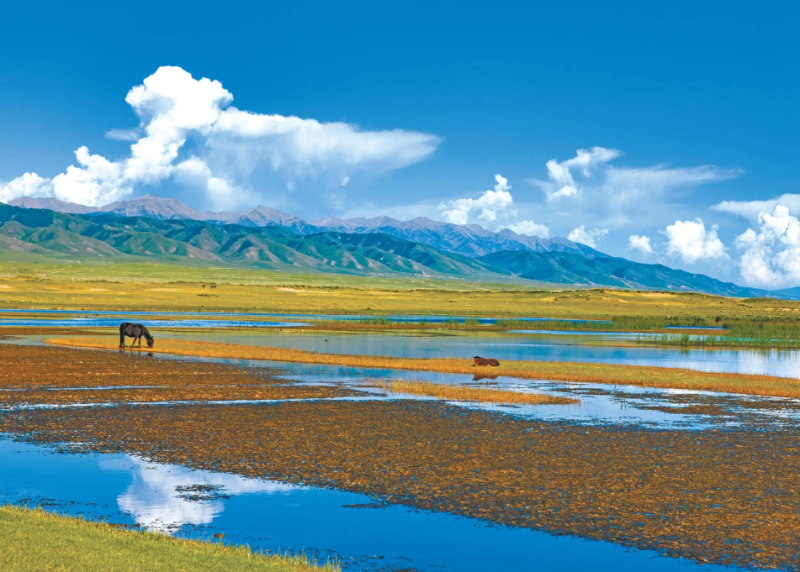
Located in southern Qinghai Province, the Sanjiangyuan region sits in the heart of the Qinghai-Tibet Plateau—often called the "Roof of the World"—with an average elevation ranging from 3,500 to 4,800 meters. It serves as the headwater catchment area for three world-famous rivers that have nurtured the long-standing civilizations of the Chinese nation and the Indochina Peninsula: the Yangtze, the Yellow River, and the Lancang River (known abroad as the Mekong). Hence, it is hailed as the "Water Tower of China."
Sanjiangyuan refers to the source region of these three rivers, covering the entire administrative areas of the Yushu, Golog, Hainan, and Huangnan Tibetan Autonomous Prefectures in Qinghai, as well as the Tanggula Mountain Town under the jurisdiction of Golmud City. With a total area of 395,000 square kilometers, this region accounts for more than half of Qinghai Province's total land area.
As one of the areas with the most concentrated high-altitude biodiversity globally and one of the most water-rich regions in the world, it has rightfully earned its title as the "Water Tower of China." In 2018, it was shortlisted for the "Top 100 Magical Sights of Northwest China" at the Northwest China Tourism Marketing Conference and Tourism Equipment Exhibition.
In January 2019, the government of Yushu Tibetan Autonomous Prefecture issued a notice explicitly banning the permanent release of non-native fish species into the waters of the three river sources. Later, in November 2020, the scientific expedition team focusing on the glaciers of Sanjiangyuan, part of the Second Scientific Expedition to the Qinghai-Tibet Plateau, made significant progress in their comprehensive scientific survey and ice core drilling at the Anyemaqen Glacier.
On October 21, 2021, during a press conference held by the State Council Information Office, officials from the Sanjiangyuan National Park Administration announced that, building upon the pilot program, the functional zones and boundaries of the Sanjiangyuan National Park had been optimized and adjusted. Key areas such as Geladandong (the main source of the Yangtze), Dangqu (the southern source of the Yangtze), and Yueguzonglie (the source of the Yellow River) were officially included in the national park, expanding its total area to 190,700 square kilometers.