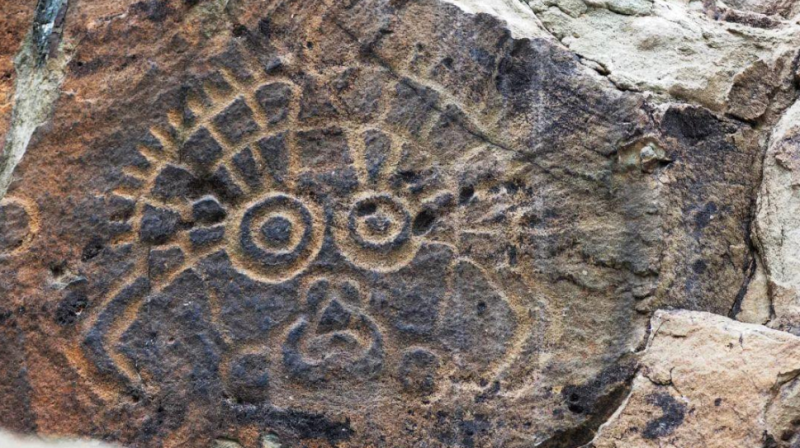
Located on the eastern foothills of the Helan Mountains in Helan County, Yinchuan City, Ningxia Hui Autonomous Region, the Helan Mountain Rock Art is a spectacular historical site. Stretching from north to south along the mountains (including the Weining North Mountains), rock art remnants have been discovered at 27 sites, such as Heishimao, Helankou, Kujinggou, and Damadi. In total, there are over 5,000 groups of composite paintings and more than 27,000 individual images, with 19,752 images currently recorded.
These rock paintings record the daily life and activities of ancient humans from 3,000 to 10,000 years ago, depicting scenes of herding, hunting, sacrifices, warfare, dancing, and reproduction. They have become a cultural treasure trove for studying the cultural and primitive art history of ancient humanity. The scenes of dancing and sacrifices, in particular, exude enthusiasm, joy, and solemnity, showcasing forms such as solo dances, duets, and group dances. Created using a combination of chiseling, grinding, and line engraving, the artworks feature balanced, fluid lines and clear, aesthetic imagery.
On November 20, 1996, the Helan Mountain Rock Art was listed as a Major Historical and Cultural Site Protected at the National Level (Batch 4) by the State Council of the People's Republic of China. In January 2006, it was included in the first batch of the Preliminary List of China's Dual Natural and Cultural Heritage sites, and in April of the same year, it was awarded the Gold Prize as one of the "Top 50 Places in China Worth Visiting by Foreigners." It became a National AAAA Tourist Attraction in 2008, and in 2018, it was selected for both the "Top 100 Magical Northwest Sights" and the "Top 50 Yellow River Sights in China." In January 2021, Ningxia utilized digital technology to conduct multi-method, multi-dimensional, and high-precision recordings of the rock art, providing data support for future preservation and utilization. The scenic area also houses the Yinchuan World Rock Art Museum and the Han Meilin Art Museum, which centrally display global rock art remnants and related artistic works.