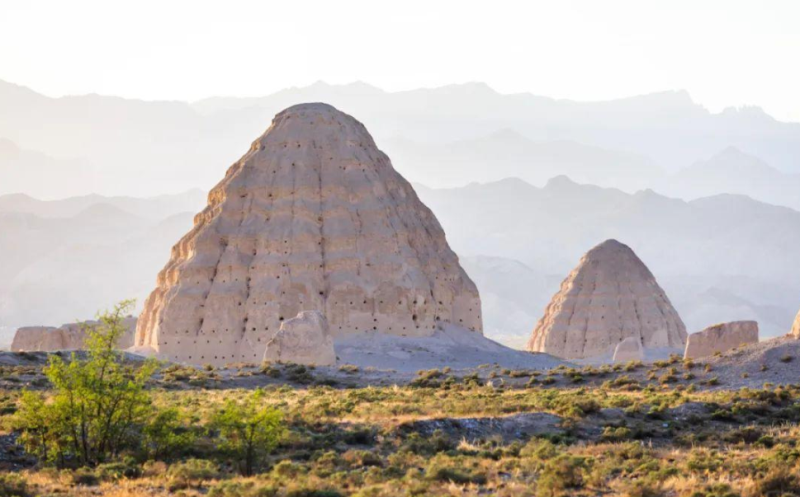
Located at the eastern foot of the southern section of the Helan Mountains in Yinchuan, Ningxia Hui Autonomous Region, the Western Xia Mausoleums sit on the northwestern edge of the Yinchuan Plain. Stretching from Yushugou in the south to Quanqigou in the north, and extending from the West Canal in the east to the foot of the Helan Mountains in the west, the site spans 4.5 kilometers in width and over 10 kilometers in length, covering a total area of approximately 50 square kilometers (some estimates suggest nearly 40 square kilometers).
The mausoleum complex comprises nine imperial tombs, 271 accompanying burial tombs, one large-scale architectural site (the Northern Architectural Site), 32 flood control engineering sites, and numerous brick, tile, and lime kiln sites. Since the initial survey and confirmation of the site in 1971, the layout and distribution characteristics of the mausoleum area have been gradually clarified. Since the turn of the 21st century, the clearing of ground ruins at Tombs No. 3 and No. 6 has provided a clearer picture of the cultural landscape of the Western Xia Mausoleums. Each imperial tomb is oriented north-to-south, forming an independent, longitudinally rectangular architectural complex comparable in scale to the Ming Tombs. Absorbing the strengths of imperial mausoleums from the Qin and Han dynasties through the Tang and Song dynasties, and influenced by Buddhist architecture, they are known as the "Oriental Pyramids." The Western Xia Mausoleums serve as tangible evidence of the Western Xia Dynasty's pivotal role as a hub along the Silk Road. Preserved authentically and completely to this day, they provide significant testimony to the pluralistic integration of Chinese civilization and the formation process of a unified multi-ethnic country, holding an irreplaceable position in the history of world civilization.
In 1988, the Western Xia Mausoleums were announced by the State Council of the People's Republic of China as the third batch of Major Historical and Cultural Sites Protected at the National Level and were designated as a National Scenic Area in the same year. In 2006, they were included in the Preparatory List for China's Mixed Natural and Cultural Heritage. On October 25, 2008, they were rated as a National AAAA Tourist Attraction. In 2017, the site was designated as the third batch of National Archaeological Site Parks. In 2021, it was selected as one of the "Top 100 Archaeological Discoveries of the Century" in China. On July 11, 2025, the Western Xia Mausoleums were inscribed on the UNESCO World Heritage List.