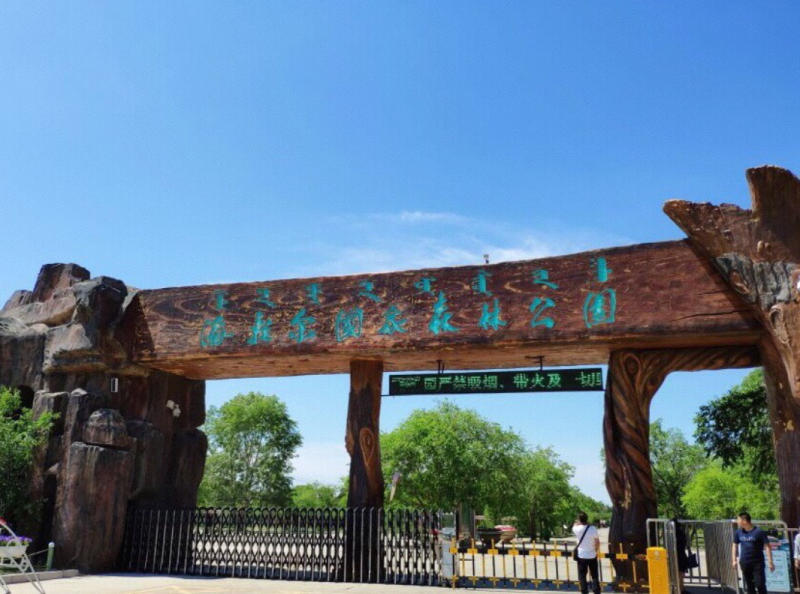
Formerly known as the Hailar Xishan (West Mountain) Scenic Area, Hailar National Forest Park is located to the west of the Hailar District government and the Workers' New Village in Hulunbuir, Inner Mongolia. It holds the title of the national forest park closest to an urban area in the world and is the most representative site for sandy Scotch pine (Pinus sylvestris var. mongolica).
The sandy Scotch pine, also known as the Hailar pine, is remarkably cold and drought-resistant. It thrives on barren sand dunes, with a root system that extends two to three times the length of its trunk. These roots firmly lock the shifting sands in place, making the Hailar pine an excellent species for windbreaking and sand fixation in China's "Three-North" region.
The park is divided into three main gardens and one reserve area: the South Garden, North Garden, West Garden, and the Reserve Resource Area.
South Garden: This area features cultural ruins from the Northern Grassland Fine Stone Tool period, dating back thousands of years. It is one of only four such sites in Northern China. Additionally, there are three former Japanese military fortification sites from the invasion era located on the south side of Mingren Peak.
North Garden: As the largest of the three gardens, the North Garden preserves the Scotch pines in their natural state. It is most famous for the Hailar White Sand Beach scenic spot.
West Garden: Dominated by wetlands, this area covers a total of 2,500 hectares. It contains 15 lakes with a combined area of 250 hectares, the largest of which is Bing Lake (Ice Lake), covering 56 hectares.
Reserve Resource Area: This zone consists of mother tree seed collection areas, shelterbelt construction zones, forest-grass demonstration areas, sand control zones, wetland protection zones, and nursery/research areas. The artificial forests here were planted in the 1980s.
Located less than 2 kilometers from the city center and covering a total area of 4,062 hectares, this is China's only national forest park centered on natural Scotch pine landscapes. It was approved and established by the former Ministry of Forestry on September 9, 1992.
Historically listed as one of the "Eight Views of Hulunbuir" during the Qing Dynasty for its ancient pines on sand dunes, the park is now a National AAA Tourist Attraction, a national education base, an autonomous region-level nature reserve, and a key site for patriotism and popular science education in Hulunbuir City.