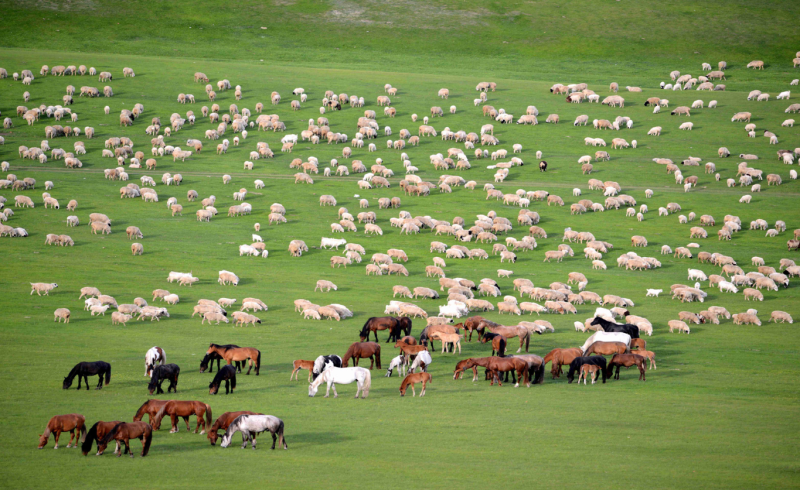
Xilamuren Grassland is located in the southeastern part of Xilamuren Town, Darhan Muminggan Joint Banner (Damao Banner), Baotou City, Inner Mongolia Autonomous Region. It lies about 72 kilometers from Hohhot, the capital of Inner Mongolia, approximately 250 kilometers from Baotou City, and about 90 kilometers from Bailingmiao Town, the seat of the local banner government. The grassland stretches 35 kilometers from east to west and 30 kilometers from north to south, covering a total area of 720 square kilometers, or 4% of the banner's total area. It is a typical representative of the temperate continental monsoon climate, characterized by long, cold winters and short, hot summers, with a large diurnal temperature range.
The grassland takes its name from its location between Puhui Temple, a renowned monastery on the grassland, and the Xilamuren River. Its strata consist of a series of sedimentary and igneous rocks. The terrain belongs to relatively flat and open low mountains and hills, situated in the transition zone between the Yinshan Mountains and the Inner Mongolia Plateau. Its elevation is about 1,602 meters, with an average altitude of 1,700 meters, and the land is gently undulating. However, the soil texture is poor and its fertility is very low, making production conditions extremely harsh. The main vegetation species include Leymus chinensis (Chinese wildrye), Achnatherum splendens (krylovia grass), Carex duriuscula (rigid sedge), Artemisia frigida (fringed sagebrush), Artemisia ordosica (sand sagebrush), Artemisia scoparia (oriental wormwood), and Iris lactea (white-flowered iris).
In the mid-to-late 1980s, the natural grassland of Xilamuren suffered severe degradation. After 2000, the deterioration became even more acute. On August 15, 2007, Baotou City began implementing a 10-year grazing ban with enclosure over all desertified and degraded pastures throughout Damao Banner. In 2008, the enclosed pastureland accounted for 40% of the total area. In 2009, a complete enclosure and grazing ban was enforced, and herders across the banner shifted from the traditional free-range grazing method to a barn-fed, pen-raised production model.