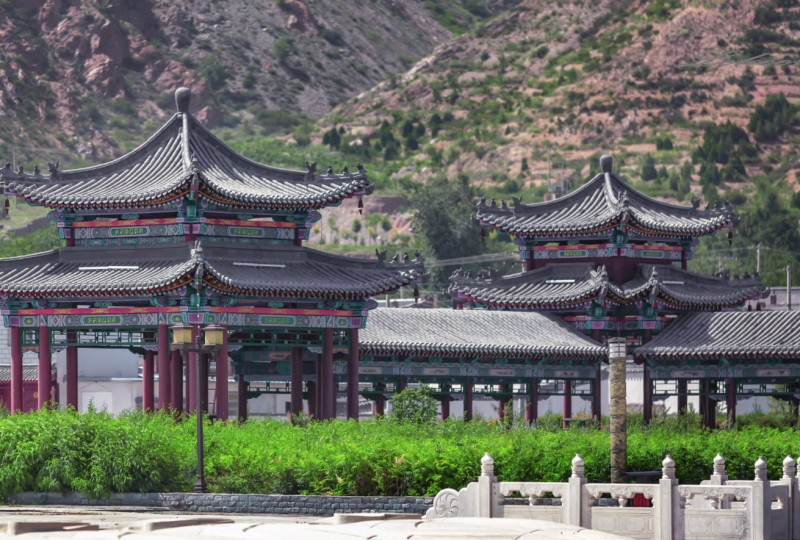
Meidaizhao (with "Meidai" meaning Maitreya in Mongolian), originally named Lingjue Temple and later Shouling Temple, is one of the most significant Tibetan Buddhist architectural sites in Inner Mongolia and a Major National Historical and Cultural Site. It is located in Meidaizhao Village, Tumed Right Banner, on the north side of the Beijing-Tibet Expressway, about 50 kilometers east of Baotou City. The temple features projecting platforms with corner towers at its four corners, extending about 11 meters. The city walls, built of rammed earth and faced with stone, form a rectangle with a perimeter of 681 meters and a total area of approximately 4,000 square meters.
The architecture is modeled after traditional Central Plains Han styles while blending Mongolian and Tibetan elements, creating a unique "temple-fortress integration where monks and Buddha coexist." The temple houses 1,650 square meters of well-preserved Ming Dynasty murals, depicting the life of Shakyamuni Buddha and scenes of Mongolian nobles paying homage to Buddha. Passing through the Taihe Gate, visitors are greeted by the Mahavira Hall. As a vital center for the spread of Lamaism into Mongolia, the hall was designated as one of Inner Mongolia's first provincial-level civilized tourism demonstration units in 2022, and was recognized as a key regional model for integrated cultural and tourism industry development in 2023.
During the Longqing era of the Ming Dynasty (1567–1572), Altan Khan, the leader of the Mongolian Tumed tribe, was titled Prince Shunyi and began constructing the temple-fortress. Completed in the third year of the Wanli era (1575), it was granted the name Fuhua City by the imperial court. In the 34th year of the Wanli era (1606), the Tibetan Master Maidari Hutuktu arrived here to preach, and the temple was renamed Maidari Temple, which eventually evolved into its current name. The site once served as the residential city for Altan Khan and Lady Sanniangzi. The Taihou Temple within the complex enshrines Sanniangzi's ashes, which are kept in a sandalwood pagoda. During the revolutionary war period, prominent figures such as Ulanfu and Wang Ruofei carried out revolutionary activities here.