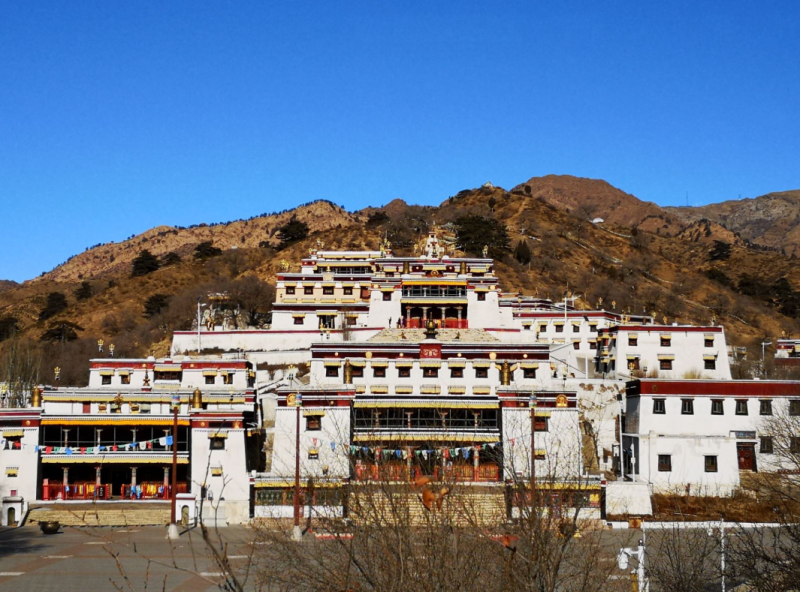
In Mongolian, "Wudang" means "willow." Its original name was Badagar Zhao; in Tibetan, "Badagar" means "white lotus," and "Zhao" means "temple." Construction began during the Kangxi era of the Qing Dynasty (1662–1722) and was rebuilt in the fourteenth year of the Qianlong era (1749), when it was granted the Chinese name Guangjue Temple. The first Living Buddha, Lobsang Gyatso, modeled it after Tashilhunpo Monastery in Tibet. Through successive expansions during the Kangxi, Qianlong, Jiaqing, Daoguang, and Guangxu eras, it gradually grew to its present scale. Because it was built on the slope of Aobao Mountain in Wudang Valley, it became commonly known as Wudang Zhao.
Facing south, the temple was built following the natural terrain. It comprises over 2,500 halls, scripture halls, and monks' quarters, covering more than 300 mu (about 50 hectares) and stretching across a hillside 1.5 kilometers long. The white buildings are stacked in tiers up the slope, surrounded by mountains and shaded by lush pines and cypresses, presenting a majestic and imposing sight.
Wudang Zhao is located deep in the Daqing Mountains, within Wudang Valley of Jihuluntu Sumu, approximately 45 kilometers northeast of Shiguai District, Baotou City, Inner Mongolia Autonomous Region.
Wudang Zhao is a Major Historical and Cultural Site Protected at the National Level and a 4A-rated tourist attraction. Alongside the Potala Palace in Tibet, Kumbum Monastery in Qinghai, and Labrang Monastery in Gansu, it is one of the four great monasteries of Tibetan Buddhism in China and the largest Tibetan Buddhist monastery in Inner Mongolia.