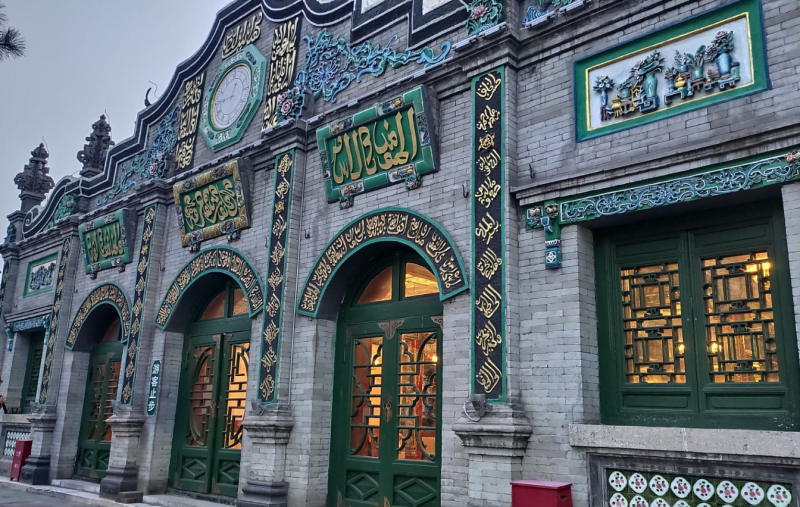
The Grand Mosque of Hohhot, located at No. 28 Tongdao South Street, Huimin District, Hohhot City, Inner Mongolia Autonomous Region, was first built in the 32nd year of the Kangxi reign of the Qing Dynasty (1693). It is the oldest and largest mosque in Hohhot.
Covering an area of over 4,000 square meters, the mosque is oriented with its back to the east and its front facing west, forming a standalone three-courtyard complex. The three-bay main gate bears a horizontal plaque overhead inscribed with "Grand Mosque" (清真大寺). Directly inside the gate stands the rear wall of the main prayer hall. The main entrance of the prayer hall faces east and features three archways, with a small platform in front. Lecture halls are situated on the north and south sides of the prayer hall. Opposite the prayer hall, on the eastern side, is a vestibule whose inner walls are painted with an image of the Kaaba in Mecca; this area serves as a resting place for Muslims before prayer. East of the prayer hall lies the second courtyard, with a reception room on its north side. Connected to the platform of the prayer hall, this courtyard hosts festivals and celebratory events. East of the reception room is the third courtyard, where the north side houses the bathhouse and water room, the due east side contains a row of buildings used as offices, and the south side serves as a storage area. At the southwest corner of the third courtyard stands the Moon Watching Tower. The Grand Mosque of Hohhot is a physical testament to and carrier of the influence of Western architectural culture on modern Chinese architecture.
On May 28, 1996, the Grand Mosque of Hohhot was announced by the People's Government of the Inner Mongolia Autonomous Region as a third-batch regional cultural relic protection unit of Inner Mongolia. On March 5, 2013, it was announced by the State Council of the People's Republic of China as a seventh-batch major national cultural relic protection unit.