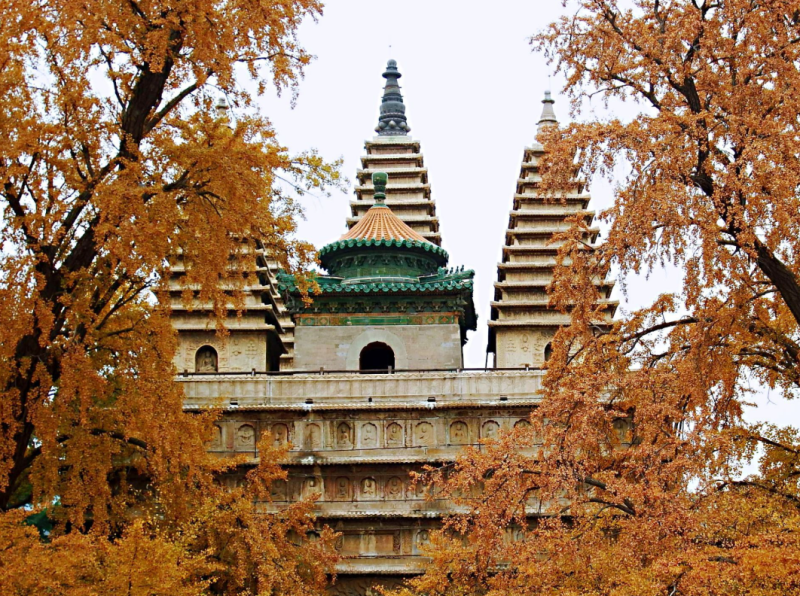
Located in the southeastern part of the old city of Hohhot, Inner Mongolia, the Five Pagoda Temple was originally named the Vajrasana Sarira Pagoda. It earned its popular name from the five square sarira stupas (relic pagodas) standing on its base.
Construction of the pagoda began in 1727 (the fifth year of the Yongzheng reign of the Qing Dynasty) and was completed in 1732. Standing 16.5 meters tall, this brick-and-stone structure features a convex-shaped floor plan and consists of a pedestal, a diamond throne, and the five small pagodas. The pagoda body is built with glazed bricks. The lower tier is engraved with the text of the Diamond Sutra in Mongolian, Tibetan, and Sanskrit, while the upper tier is adorned with over 1,660 gilded relief Buddha statues, earning it the alternative name "Thousand Buddha Pagoda." The waist of the diamond throne is carved with patterns of lions, elephants, and Garuda birds. On the south side, an arched gateway is framed by a stone plaque inscribed in Mongolian, Chinese, and Tibetan.
Originally, the five pagodas were part of the Cideng Temple complex. Over time, the temple buildings collapsed, leaving only the pagoda standing. Starting in 1977, the state initiated restoration projects. In 1982, the Five Pagoda Relics Preservation Office was established, and in 1988, the site was designated as a Major National Historical and Cultural Site under state protection.
Embedded in the north wall behind the pagoda is a precious stone carving of an astronomical chart in Mongolian. With a diameter of 144.5 cm, the chart features the north celestial pole as its center, marking the twenty-eight lunar mansions and five concentric circles. It is recognized as the only surviving Mongolian-language astronomical stone carving in the world.