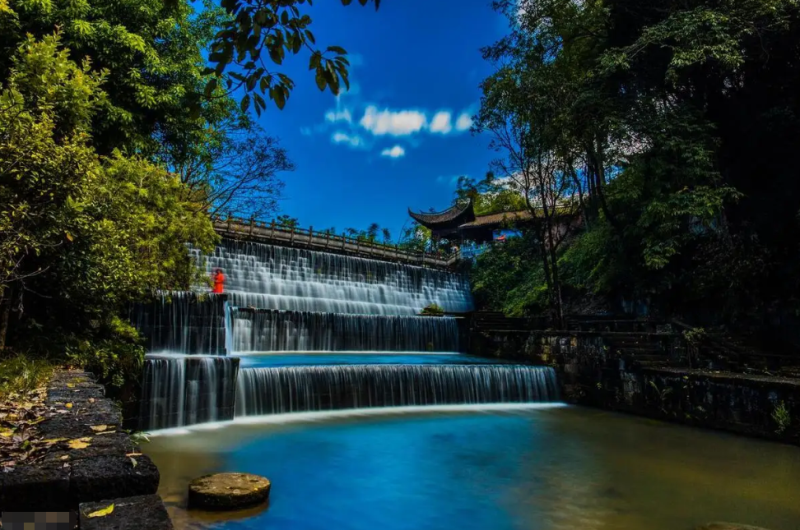
Located west of Tengchong City in Yunnan Province, Dieshuihe Waterfall is the only urban volcanic barrier lake waterfall in China, belonging to the Irrawaddy River system. The waterfall stands 46 meters high, formed by the Daying River cascading over cliffs created by a volcanic eruption approximately 12,000 years ago. It features a two-tiered landscape, with columnar jointing distributed along the cliff walls, presenting a scene described as "flowers scattering naturally without the need for a bow." Historically acclaimed as the "No. 1 Waterfall in Central Yunnan," it is known as "Dragon Cave Hanging Curtain," one of the Twelve Scenic Spots of Tengchong.
Above the waterfall stands the Taiji Bridge, built in 1913 (the second year of the Republic of China) by Zhang Shaosan Wenguang. It is a double-arch cantilevered flat stone bridge. The bridge pier platform features a waterfall-viewing pavilion, engraved with the Taiji diagram and a plaque reading "Viewing the Waterfall." It was listed as a key cultural relic protection unit in 1984.
In the 12th year of the Chongzhen reign of the Ming Dynasty (1639), the traveler Xu Xiake investigated and recorded that the waterfall cascaded down in three streams. The Longguang Terrace on the west bank was originally built in the 6th year of the Jiajing reign of the Ming Dynasty (1527), expanded by Deng Zilong, and rebuilt in 1922 (the 11th year of the Republic of China). It preserves the regular script inscription "Longguang Terrace" by Li Yuanhong and seal script by Wu Changshuo. The temple currently houses 12 stone inscriptions of poetry and prose from past dynasties, including a long couplet written by Cun Kaitai, a Jinshi scholar from the Guangxu reign of the Qing Dynasty.