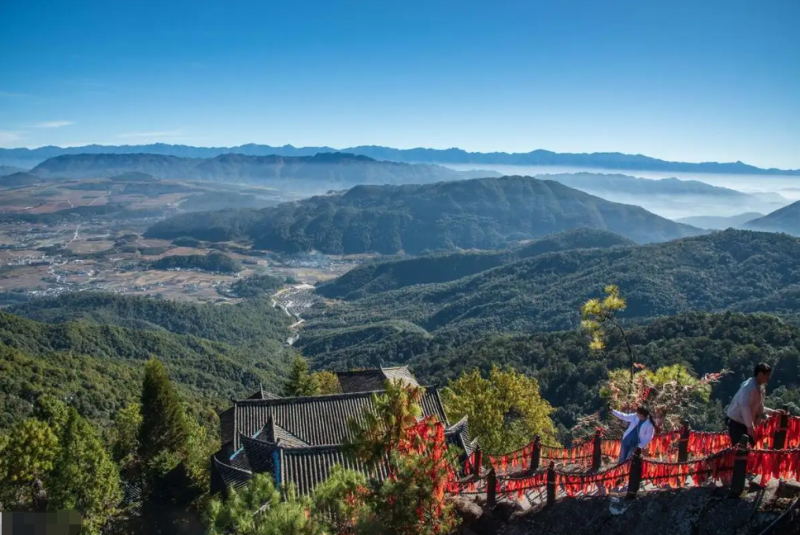
Located in Ruidian Town (now Diantan Town) in northwest Tengchong, Yunnan Province, Yunfeng Mountain is part of the Gaoligong Mountain range within the Hengduan Mountains. Its main peak stands at 2,449 meters above sea level. The mountain gets its name from the clouds and mist that perennially shroud its waist. Characterized by granite landforms, the peak rises sharply into the sky like a jade shoot and is renowned for its "deep valleys, steep slopes, and precipitous terrain." The area is home to primeval forests and rare flora and fauna.
The mountain is traversed by the "Three-Bend Cloud Ladder," a series of over 2,700 stone steps. The steepest sections are nearly vertical, flanked by deep valleys on both sides. From the summit, visitors can overlook the sea of clouds, the sunrise, and the snow-capped peaks of the Gaoligong Mountains. The vegetation, ranging from the waist to the foot of the mountain, shifts with the seasons, featuring peach blossoms in spring, locust trees in summer, and maples in autumn. The Ming Dynasty geographer Xu Xiake once climbed and explored the mountain, documenting its topography and Taoist temple layout in his travel diaries.
The summit houses a complex of Ming Dynasty Taoist architecture, including the Jade Emperor Pavilion and the Three Pure Ones Pavilion. Built against sheer cliffs, these structures were originally constructed in the early Ming Dynasty and expanded in 1634 (the 7th year of the Chongzhen reign), forming a three-dimensional religious landscape known as the "Imperial City in the Clouds." Currently a National 3A Tourist Attraction, it features high-altitude cableways and hiking trails, blending natural wonders with Taoist culture, and is often hailed as a "Fairy Mountain" or "Spiritual Mountain."